
Review

By Night Owl
A new contender in a crowded arena
Absolum arrives on Switch 2 with a target on its back. The roguelite brawler space is stuffed with pretenders and a few modern greats, and this is coming from the studio that helped resurrect Streets of Rage. Expectations are high.
The good news is that Absolum largely lives up to that legacy. It is a side-scrolling beat ’em up built on expressive, hand-drawn animation and a surprisingly deep combat system, then layered with roguelite structure in a way that rarely feels like busywork. On Switch 2 specifically, it is also one of those games that makes the hardware feel properly current, with fast loads, responsive controls, and performance that holds up even in the messiest four-player brawls.
Roguelite bones, arcade heart
Runs in Absolum play out as a chain of side-scrolling arenas across the fantasy world of Talamh. Each run forks constantly, offering branching routes, optional challenges, shops, and miniboss detours. The structure is pure roguelite: you pick a route, survive as long as you can, die, funnel earned currency into meta-progression, and jump back in a little stronger and a lot wiser.
What saves it from feeling like a watered-down Hades clone is how firmly it stays rooted in beat ’em up fundamentals. Stages are short but dense, focused on enemy waves that force you to use the full move set. The roguelite layer mainly affects what tools you bring to those fights. Between arenas you choose boons and relics that modify your character in tangible, sometimes wild ways. A run where you lean into aerial juggle bonuses and lifesteal throws feels completely different from one built around guard breaks and crowd-control supers.
Importantly, Absolum does not hide basic power behind grind. The first hour unlocks core defensive tools and mobility options quickly, and the meta-upgrades tend to smooth difficulty spikes rather than patch over weak base design. You are still winning runs through skill more than numbers, which keeps it from becoming just another treadmill.
Combat that actually feels like a Dotemu joint
If the roguelite structure is what gets you to start a run, the combat is what keeps you launching another.
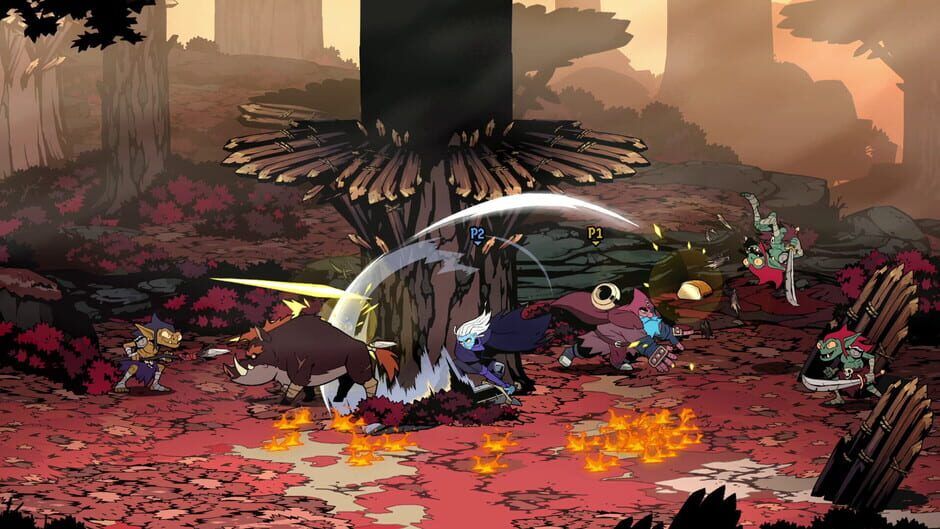
Every character shares a familiar foundation. There is a light and heavy combo chain, launchers, air juggles, dash attacks, throws, a dodge with generous invincibility, and a parry for the brave. Inputs are clean and readable, closer to a fighting game than an old-school mashy brawler. You can cancel normals into dodges, supers, and tag-team moves in co-op, which opens up satisfying combo routes even in the chaos of four people on screen.
Impact is where Absolum absolutely nails it. Animations have clear anticipation and follow-through, hitstop is tuned so that big blows land with a satisfying pause, and enemies tumble and bounce just long enough for you to improvise. It feels weighty without being sluggish, and the screen is full of tiny flourishes like shield sparks, elemental trails, and squash-and-stretch that reward watching as much as playing.
Enemy variety backs that up. Early areas throw standard grunts and shield carriers at you, but later biomes introduce teleporting casters, armored brutes that must be cracked with guard breaks, and flying pests that punish players who refuse to use their launchers and aerial options. Mixed groups are designed to stress different parts of your toolkit, and because of the roguelite randomness, you are often adapting with imperfect builds rather than running a single solved loadout.
A cast that encourages experimentation
Absolum launches with a roster that feels curated rather than bloated. Each character has a distinct rhythm, and more importantly, that rhythm interacts differently with the game’s randomized upgrades.
You get a bruiser archetype with slow but sweeping normals and powerful armor-breaking moves, a nimble rogue-like fighter built around dash-cancels and counterattacks, a zoner who controls space with spells and wide-area specials, and a hybrid support who leans into crowd control and team buffs in co-op.
The key is that they are not just cosmetic swaps. Hitboxes, hurtboxes, recovery frames, and stamina values change dramatically from character to character. On Switch 2’s 60 fps output this nuance is easy to feel. For example, the rogue’s dash-cancel windows tighten into a rhythmic “dash, poke, dash, launcher” loop that is a joy to perfect, while the bruiser’s delayed overheads gain tremendous payoff when combined with relics that reward single-hit damage.
The roguelite upgrades interact with those identities rather than flattening them. A crit-focused build sings on the rogue but feels wasteful on the caster, who benefits more from elemental stacks and status extensions. This pushes you to actually learn each character instead of defaulting to one favorite forever.
Co-op that finally treats online as more than an afterthought
Beat ’em ups live or die on their co-op, and Absolum takes that seriously. Switch 2 supports two players locally on a single console or up to four players online with public matchmaking and friend lobbies. There is also a local-plus-online hybrid setup, so two people on a couch can join two more online without fuss.
Locally, Absolum is just about perfect. Four Joy-Con or Pro Controllers sync without hassle, UI scaling keeps health bars and upgrade choices readable even in handheld mode, and the game smartly slows the action during level-up choice moments so people can actually read and vote without eating stray attacks.
Online is better than most brawlers on Nintendo platforms. On a wired Switch 2 connection the netcode holds up, with only occasional stutters when someone with a weaker connection joins. The game uses a delay-based system with light input buffering rather than heavy rollback, but in practice that works for a pacey side-scroller. Parry windows feel slightly more generous online, which helps offset small spikes in latency.
The nicest touch is that the progression and loot are properly shared. Everyone gets their own upgrade picks and currency share. Nobody has to sacrifice a build because someone else opened the chest first, and drop ownership is clearly communicated. It avoids the petty co-op squabbles that plague other roguelites.
Cross-play is limited to within the Nintendo ecosystem, so you are not matching with PC or PlayStation players, but matchmaking on Switch 2 has been healthy around launch, especially in the evenings.
Switch 2 performance: finally, a portable that keeps up
Where many roguelite brawlers stumble on Nintendo hardware is simply keeping 2D art and particle effects running smoothly in hectic fights. Absolum on Switch 2 is refreshingly solid.
The game targets 60 frames per second in both docked and handheld modes, and it mostly sticks the landing. In normal play, whether solo or two-player, it is rock steady. Even in late-game areas with layered environmental hazards, swarms of enemies, and multiple supers detonating at once, drops are rare.
Four-player chaos is the only place the frame rate occasionally dips, usually during big elemental screen-clears or when the camera zooms out to fit everyone during vertical sections. These dips are brief and tend to land in the 50–55 fps range rather than falling off a cliff. Crucially, inputs continue to feel predictable, so your combos might look a little less silky but never fall apart.
Input latency is impressively low. With a Pro Controller wired to the dock, Absolum feels nearly instantaneous, on par with other best-in-class Switch 2 action games. Even on wireless Joy-Con in handheld mode, parries and tight dodge cancels are reliable. There is no sense of that sluggish, smeared response some early Switch-era ports suffered from.
Load times are another highlight. From the main menu to being in a run takes around five seconds, and restarts after a death are almost instant on Switch 2’s faster storage. That snappy loop is vital in a genre where you might fail a run in two minutes and impulsively mash “retry.” Here, that impulse is rewarded instead of punished.
Visually, Switch 2 is not cutting corners. The hand-drawn art holds its crisp line work at 1080p docked, and the downscale to the handheld screen still looks sharp, with no distracting shimmering or aliasing on character outlines. Effects density appears comparable to other platforms, though pure pixel counters might note that shadow resolution and background depth-of-field are slightly pared back compared to PS5 and PC. In practice you have to look for it.
Battery life in handheld mode is unsurprisingly on the lower side during long four-player sessions, given the constant 60 fps target and particle spam, but for solo play you can still get several solid hours before reaching for the charger.
How it stacks up against rival roguelite brawlers
The roguelite brawler niche is now crowded with heavy hitters, and Absolum knows exactly what it wants to be in that field. It does not chase the narrative density of something like Hades, nor the meta-layer bloat of some grind-heavy indie roguelites. Instead, it leans into combat clarity and replayable routes.
Compared to other beat ’em up roguelites, Absolum is more exacting about spacing and defense. You cannot mindlessly mash your way through, especially on harder branches. Enemy telegraphs, parry windows, and hurtbox tuning feel closer to a 2D action game like Dead Cells or a modern fighting game than a coin-muncher from the 90s. That may turn off players who just want to zone out with friends, but it gives the game a high skill ceiling that rewards practice.
Where it falls a bit short is long-term run variety. Biomes are distinct and attractive, and there are plenty of relics and boons to toy with, but after a couple dozen runs you start to see familiar combinations. Some late-game unlocks help, including new enemy variants and additional branching paths, yet it never completely escapes that feeling of repetition that haunts the genre.
Even so, Absolum’s core excellence in feel and its robust co-op keep it above many of its peers. When a run repeats beats you have seen before, the act of playing is still so satisfying that you rarely resent it.
Verdict
Absolum on Nintendo Switch 2 is the kind of port you hope for and too rarely get. It preserves everything that works on other platforms while taking advantage of the hardware’s strengths. Fast loads, a near-locked 60 fps, great input responsiveness, and strong local and online co-op support make it easy to recommend to action fans who split their time between docked and handheld play.
It is not the most inventive roguelite on a structural level, and if you demand a sprawling story or wildly transformative builds every run, you might find its loop more straightforward than you would like. But as a pure expression of modern 2D brawling tuned for repeat play, Absolum is one of the standouts of the genre, and the Switch 2 version is absolutely the way to experience it on Nintendo hardware.
Final Verdict
A solid gaming experience that delivers on its promises and provides hours of entertainment.