

Yoshi’s Switch 2 debut wraps familiar platforming in a brilliant storybook concept, but does it actually move the series forward or simply dress it up?
A New Chapter For Yoshi, Literally
Yoshi and the Mysterious Book arrives as the first Yoshi game built for Switch 2, and on paper it sounds like exactly the sort of fresh start the series needed. Good-Feel has traded wool and cardboard for a pop-up picture book, framing the entire adventure as a journey through the talking tome "Mr. E". Every level is a page, every enemy a sketch come to life, and every collectible a scribbled note in the margins.
The pitch is clever: rather than simply marching from left to right, you are cataloging strange book-dwelling creatures and experimenting with their powers to navigate each environment. It is less about pixel-perfect jumps and more about seeing how far you can push each new toy.
The big question is whether that concept truly modernizes Yoshi for new hardware or just paints the same gentle formula in fresh ink.
Storybook Mechanics: Smart Concept, Narrow Execution
Yoshi’s core move set will be familiar. He still gobbles foes, poops eggs, flutters over pits and ground-pounds secrets out of the scenery. The twist comes from the creatures that live inside Mr. E. Each one is essentially a living power-up that subtly redefines what a stage is about.
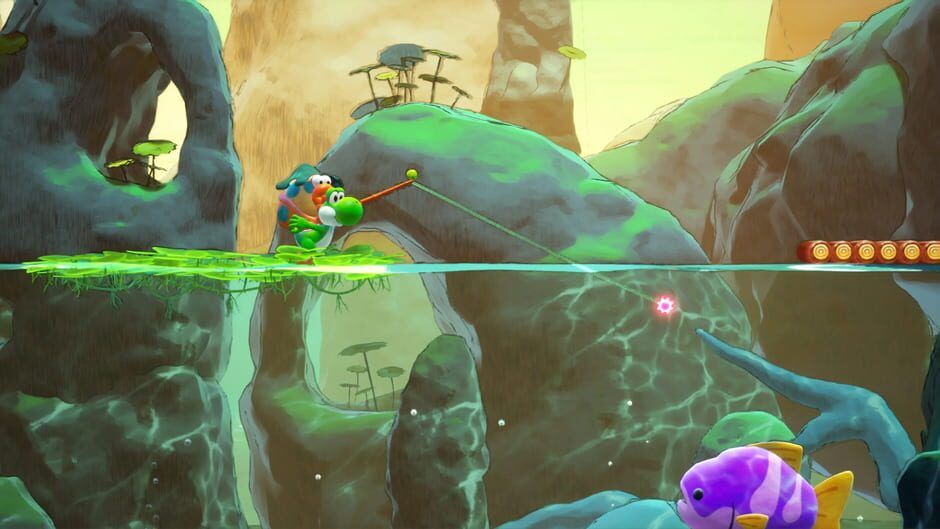
A fish-like friend lets Yoshi dive under paper oceans and skim along currents. Another turns platforms into soap bubbles that can be ridden upward or popped to reveal hidden routes. A stretchy vine critter works like a living grappling hook for swinging across gaps, while a rock-bodied creature can be ridden as a tumbling boulder to smash through barriers.
Mechanically, it is a smart way to fold puzzle and exploration beats into the usual pastel platforming. Discoveries get written into the book as encyclopedia entries, and stages are built around teasing out all the ways a specific creature can interact with the environment. Done right, this sort of design can give a chill platformer a surprising amount of depth.
For roughly the first two thirds of the game, though, Good-Feel keeps these ideas on a short leash. Most levels are built around a single creature and a clearly signposted intended solution. You might see background elements that look like they could support off-the-wall experimentation, but more often than not only one answer actually works. The sense of curiosity is real, yet the solutions feel tightly scripted.
The moment the system truly comes alive arrives very late, in a World 6 level built around the Bewilder Bird. This late-game creature can transform into any previous storybook companion on the fly. Suddenly, puzzles that would have one clear answer earlier in the game open into multiple possible routes. Do you bubble-jump to that ledge, swing up to it, or roll in from a hidden path below? For one stage, at least, Yoshi and the Mysterious Book finally feels as freewheeling as its premise suggests.
Critics are not exaggerating when they say this mechanic is underused. The Bewilder Bird sequence is an intoxicating glimpse of a more systemic, player-driven Yoshi, then the credits roll and the game quietly steps away from the idea. It feels less like the climax of a design arc and more like a proof of concept Good-Feel did not have time or confidence to build an entire campaign around.
Level Design: Comfort Food With Flecks Of Brilliance
If you have played Woolly World or Crafted World, you know Good-Feel can crank out delightful, detail-packed levels. Mysterious Book splits the difference between those games. It does not have the tactile shock of Woolly World’s yarn or the literal craft-store dioramas of Crafted World, but every world leans hard on the book motif.
Stages are framed with thick, printed borders like panels from a children’s book. Bridges fold and unfold along visible paper seams, backgrounds flip like pages to reveal secret areas, and hand-drawn annotations appear whenever you trigger a key discovery. There is a sense that you are hopping across doodles from a particularly imaginative bedtime story.
From a structural standpoint, though, the campaign is more conservative than it first appears. Most levels ask you to meet a new creature, learn a couple of ways to use it, then repeat that loop several times before the goal ring. Optional collectible flowers add reasons to probe every corner, but the path to them is rarely obscure. Nintendo Everything’s review noted the gentle, low-stress rhythm, and that is accurate: this is designed to be breezy.
The best pages break from that template. Mid-game chapters that mix two creatures together hint at the possibility of real emergent challenge. A stage that lets you ride an ink dragon through a gauntlet of crumbling sketch platforms, while occasionally swapping to a bubble buddy to dodge hazards, shows how thrilling this engine can be when the training wheels loosen.
The problem is pacing. Instead of escalating toward that chaos, Mysterious Book often returns to simple, single-creature tours that feel almost like tutorial leftovers. You clear a stretch of levels that feel like they are finally building toward something wild, only to find yourself back in what amounts to a very friendly obstacle course. The sense of discovery never fully disappears, but the structure makes the journey feel flatter than it should.
Difficulty And Audience: Invincible Dino, Fragile Stakes
There is an ongoing tug-of-war in Yoshi’s modern history over who these games are for. Woolly World threaded the needle with optional challenge for experts and a friendlier mode for younger players. Crafted World pushed a bit further toward pure comfort, but still had moments that asked you to focus.
Mysterious Book commits fully to being approachable, to the point that Yoshi is functionally invincible. Falls into pits bounce you back without a harsh reset. Enemies are more speed bumps than threats, and failure carries almost no cost. Nintendo Life’s 6/10 review fixated on this, arguing the stakes are too low for older fans.
From one perspective, the design makes sense. This is a game built around reading creature descriptions, experimenting with abilities and slowly filling in a book of discoveries. For young or less experienced players, removing punishment encourages trying things just to see what happens.
On the other hand, without some form of escalating tension, the storybook tools struggle to feel meaningful. Discovering a creative way to bypass a hazard does not land quite as hard if walking into that hazard in the first place is not actually dangerous. The game attempts to address this by tying more of your completion rating to optional objectives than survival, but it does not fully replace the usual platforming stakes.
The result is an experience that will absolutely succeed as a first serious platformer for kids, but leaves long-time Yoshi fans hunting for the sort of flexible, high-skill challenges they got from the best secret stages in Woolly World.
Visuals And Performance On Switch 2
On the technical front, Yoshi and the Mysterious Book is an interesting showcase for Switch 2, but not a knockout punch. Good-Feel leans into a stylized look that evokes stop-motion animation layered over thick paper. Characters have subtle, almost clay-like shading and environments are lit like a diorama on a well-lit desk.
Docked, the image is crisp enough that you can see tiny print textures baked into platforms and margins. Animation is fluid, particularly in the way creatures morph from sketchy 2D drawings into 3D models as they pop out of the page. The new hardware helps keep the action locked to a stable frame rate, including in the busier pages that layer parallax, particles and multiple moving set pieces.
Handheld is more divisive. Several outlets noted that the image softens noticeably on the Switch 2’s screen, and that the art does not “pop” the way the wool and cardboard did in the prior games. The palette leans toward pastel watercolors and off-white backgrounds, which fits the book theme but can leave some stages looking a bit washed out compared to the saturated craft worlds of the past.
Crucially, there are no real performance distractions. Load times between chapters are brief, the frame rate holds even in cluttered sequences, and input latency feels snappy. Yoshi’s flutter and egg throws are as responsive as ever. If anything, the complaint is that Switch 2 makes you imagine how much further Good-Feel could have pushed this look, from more dynamic page-folding to wilder, more reactive environments.
How It Stacks Up To Woolly World And Crafted World
As a trilogy of Good-Feel Yoshi games, Woolly World, Crafted World and Mysterious Book now sketch a clear trajectory.
Woolly World on Wii U and 3DS was the closest spiritual successor to Yoshi’s Island. It paired a striking yarn aesthetic with the series’ sharpest platforming since the SNES days. Difficulty scaled nicely into some devious late-game content, and co-op allowed for humorous chaos without compromising the underlying level design.
Crafted World shifted focus to visual gimmicks and collectathon structure. Levels were simpler to clear, but offered replayability through hidden Poochy pups, backside runs and a heavier emphasis on scavenger-hunt objectives. Some players loved the relaxed, toy-box energy. Others missed the more confident challenge curve.
Mysterious Book is, mechanically, the most inventive of the three. The idea of tying each level to a specific creature’s powers, cataloged in a living encyclopedia, is stronger than simply flipping a cardboard stage around. The Bewilder Bird twist in particular feels like a genuine attempt to rethink how a Yoshi game could work in 2026.
Where it falls short compared to its predecessors is consistency and follow-through. Woolly World and, to a lesser degree, Crafted World felt like they explored their gimmicks from every angle across a campaign. The wool aesthetic influenced enemy designs, boss battles and secret paths. Cardboard and bottle caps were not just window dressing, they were the logic behind the puzzles.
In Mysterious Book, some creatures get a handful of smart uses and then quietly exit the stage. Others reappear but with nearly identical applications. Co-op, a series staple in both Woolly and Crafted World, is entirely gone. For families who made those games a regular couch ritual, this is a baffling omission, especially now that Switch 2 is more than capable of handling two Yoshis and a page full of moving parts.
If you loved Woolly World’s mix of charm and challenge, Mysterious Book will likely feel like a step down in intensity, even if its core gimmick is clever. If you enjoyed Crafted World’s relaxed, collectible-driven structure, this new adventure may feel like a lateral move with a more interesting framing device.
Are Critics Right About The Wasted Potential?
Across reviews and community threads, a pattern has emerged. Most people agree that Yoshi and the Mysterious Book is charming, polished and enjoyable. Many also agree that it plays its best hand too late and too briefly.
The accusations of “wasting” its best mechanic center squarely on that late-game Bewilder Bird level. For the length of a single page, the game becomes something more open, where your knowledge of every prior creature matters and your choices genuinely alter how you move through space. When the credits roll shortly after, it is hard not to feel like you just unlocked the beta of a sequel that does not exist yet.
In fairness to Good-Feel, there are valid reasons they may have kept this system limited. A fully open-ended toolset brings balance issues, potential sequence breaks and a higher cognitive load for players who just want to see cute dinosaurs do cute things. This is still a Yoshi game, not a physics sandbox.
Even with that in mind, the criticism largely holds water. The game spends hours gently introducing discrete abilities, teaching you their quirks and possibilities, then opts not to fully cash that knowledge in. Instead of a final world that freely remixes those pieces in elaborate puzzle-box stages, you get a tantalizing taste. For a series with such a long history, and for a new hardware generation, that conservatism feels out of step with what the premise deserved.
The silver lining is that the foundation is excellent. The storybook framework, the creature encyclopedia and the idea of binding Yoshi’s progress to creative use of those powers could absolutely form the spine of a more ambitious follow-up or DLC campaign. As it stands, critics calling Mysterious Book a missed opportunity are not dismissing the game; they are recognizing how close it comes to something truly special.
Verdict: A Lovely But Safe First Step On Switch 2
Yoshi and the Mysterious Book is a warm, imaginative platformer that fits nicely into Nintendo’s catalog of family-friendly games for Switch 2. Its storybook presentation is inviting, its creature mechanics are clever, and its relaxed pace makes it an easy recommendation for younger players and anyone seeking low-pressure comfort.
As an attempt to modernize the Yoshi formula, it is only a partial success. The new mechanics hint at transformative potential but are hemmed in by conservative level design, low difficulty and a puzzling retreat from co-op and deeper challenge.
If you come in expecting a charming, cozy adventure with flashes of brilliance, you will likely close the book satisfied. If you were hoping Switch 2’s Yoshi debut would fully reinvent the series or recapture the spark of Yoshi’s Island, you may finish this story wishing the developers had written a few more pages.