
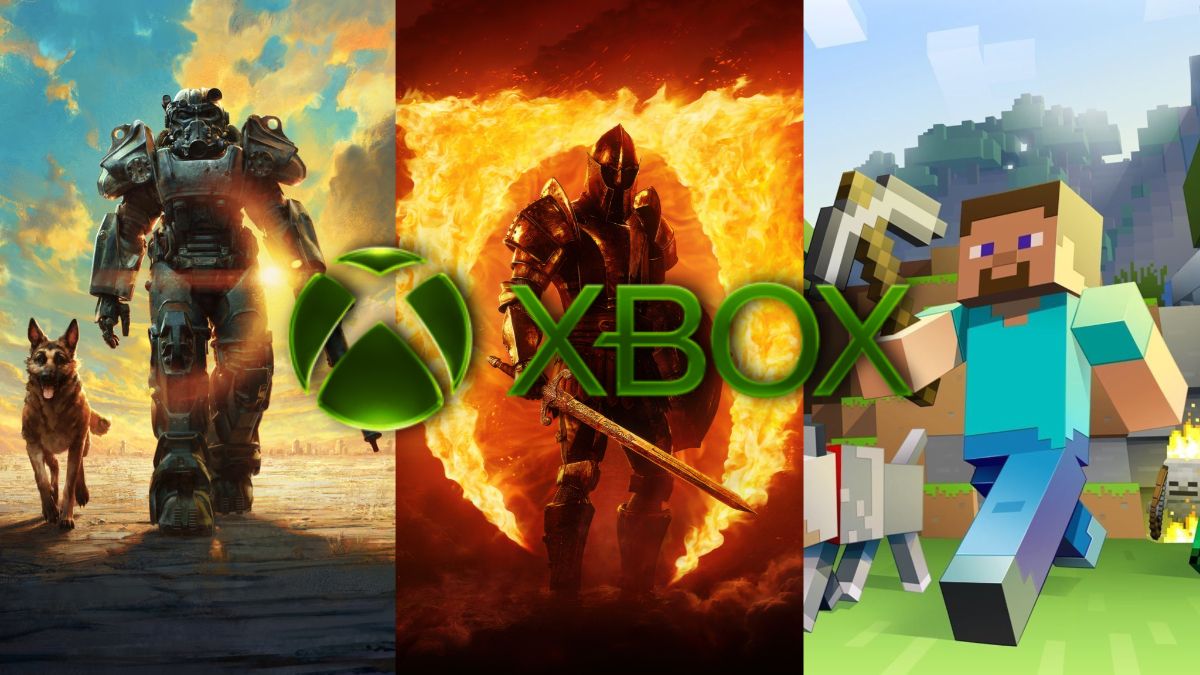

Microsoft is reportedly polling Xbox Insiders on scenarios where Fallout, The Elder Scrolls, Minecraft and other franchises become Xbox console exclusives, but no policy change has been announced.
Image: beebom.com
Microsoft is testing the shape of a much harder Xbox exclusivity pitch
Microsoft is reportedly asking some Xbox Insider members how they would respond if major first-party franchises, including Fallout, The Elder Scrolls and Minecraft, became unavailable on PlayStation and Nintendo consoles in future releases. That is the concrete development. The tension is that the survey describes dramatic exclusivity scenarios while Microsoft has not announced any change to its release policy.
According to Windows Central reporting cited across several outlets, including Push Square, Polygon and Game Rant, screenshots of the questionnaire were verified by reporter Jez Corden. Egamers also reports that a user shared screenshots and that they were confirmed as authentic. The survey is described as going to a subset of Xbox Insider users, meaning it is not a public policy document and not necessarily representative of a final executive decision.
The reported Xbox exclusives survey asks players to imagine future games in named franchises launching only on Xbox consoles and PC, rather than on PlayStation or Nintendo hardware. The named examples across the reports include Fallout, The Elder Scrolls, DOOM, Diablo and Minecraft. Windows Report and Archyde also say the survey explores several tiers of exclusivity, including timed exclusivity and full franchise-level console exclusivity.
The immediate read is simple but important: Microsoft appears to be measuring whether exclusivity would move players toward Xbox hardware or PC, or whether it would make them abandon those games altogether. That is a very different signal from an announcement. A survey can be a pressure test, a forecast input, or an internal argument waiting for data. It is not, by itself, a platform strategy.
What the survey reportedly asks players to imagine
The most detailed reported prompt concerns Fallout. Polygon quotes a survey question asking respondents to imagine that all future Fallout franchise releases become console-exclusive to Xbox and are no longer available on PlayStation or Nintendo. In that scenario, existing Fallout titles would remain available where they are today, and nothing would change on PC.
That wording matters. The survey scenario, as reported, does not describe Microsoft deleting already owned Fallout games from rival consoles. It asks about future content and future titles. It also preserves PC access, which matches Microsoft’s current habit of treating Windows as part of the Xbox ecosystem rather than as a rival platform.
The response choices are the clearest window into what Microsoft may be trying to learn. Polygon reports that respondents could choose options including playing on an Xbox they already own, buying a new Xbox Series X|S, playing on PC, skipping because the game would no longer be available on their preferred console, selecting something else, or saying they were not interested in the content. Push Square and Egamers describe the same basic structure: Microsoft is asking whether exclusivity would convert interest into Xbox usage, new console purchases, PC migration, or lost players.
Strategically, that is the core question. A Fallout Xbox exclusive only strengthens Xbox if enough PlayStation and Nintendo players either buy into Xbox hardware, move to PC within Microsoft’s ecosystem, or engage with Game Pass where applicable. If too many players skip the game, the exclusive becomes a wall that blocks revenue rather than a lever that changes behavior. The survey, as reported, is built around that tradeoff.
Fallout and Elder Scrolls are the pressure points in Microsoft gaming strategy
Fallout and The Elder Scrolls carry a different strategic weight than smaller first-party releases because they sit at the intersection of Bethesda’s legacy audience, Microsoft’s acquisition strategy and the long development cycles of large role-playing games. The survey reportedly names them directly, rather than asking only about Xbox exclusivity in the abstract. That makes the question sharper for players who bought into those series on PlayStation or Nintendo platforms before Microsoft owned Bethesda’s parent company.
A Fallout Xbox exclusive would be especially visible because the series already has a broad console audience and because Polygon’s quoted survey text specifies future Fallout releases while leaving existing titles where they are. That framing would let Microsoft test the appeal of locking the next major entry or future content to Xbox and PC without raising the separate issue of removing old purchases.
The Elder Scrolls carries similar stakes. The reports do not provide a quoted Elder Scrolls prompt in the same detail as the Fallout example, but multiple outlets, including Windows Central as cited by Push Square, My Nintendo News, Game Rant and Windows Report, say The Elder Scrolls appears among the franchises raised in the survey. If Microsoft were to make future Elder Scrolls releases Xbox console exclusives, the practical question would be whether the scale of the franchise is enough to sell hardware or whether it would simply reduce the audience on platforms where the series has history.
This is where the business logic becomes uncomfortable. Microsoft has spent recent years putting some first-party games on PlayStation and Nintendo platforms, according to Game Rant’s summary of the company’s multiplatform period, with examples including Pentiment, Grounded, Hi-Fi Rush, Indiana Jones and the Great Circle, Gears of War: Reloaded and Forza Horizon 5. A renewed exclusivity push would run in the opposite direction. The survey appears to be asking whether Xbox has given away too many reasons to own its console, and whether Bethesda-scale franchises are powerful enough to reverse that without burning too much software revenue.
Minecraft is the most disruptive scenario because it is already everywhere
Minecraft is the outlier in the reported survey because the scenario goes beyond future releases. Push Square quotes a broader prompt asking respondents to imagine all future title releases from every Xbox-developed gaming franchise except Call of Duty becoming console-exclusive to Xbox. For Minecraft specifically, the quoted text says existing titles would no longer be available for purchase on PlayStation or Nintendo consoles and would not receive new content updates, while existing owned titles and content would not be affected. The prompt also says nothing changes on PC.
That is a much more aggressive hypothetical than the Fallout example. It does not merely ask whether the next Minecraft-branded release should skip rival consoles. It asks how players would react if Microsoft stopped selling existing Minecraft versions on PlayStation and Nintendo and ended new content updates there, while leaving previously owned content intact.
Polygon notes that Minecraft is currently available across a wide range of platforms, including Nintendo Switch, Nintendo Switch 2, PlayStation 4, PlayStation 5, Android, iOS, Linux and Mac. That breadth is part of Minecraft’s identity as a platform-agnostic service game. Turning Minecraft into a Minecraft Xbox exclusive scenario, even in a survey hypothetical, carries more risk than fencing off a future single-player RPG. Minecraft lives through cross-generational access, families, schools, creators, Realms, marketplace content and long-tail updates. Cutting off new sales or updates on rival consoles would be a service-platform decision, not a normal launch-window decision.
The careful part is that no source says Microsoft has approved such a move. The reported survey text is still a hypothetical. But the presence of Minecraft in the question changes the temperature of the discussion because it shows Microsoft is willing, at least in research, to test reactions to the most extreme version of console exclusivity.
Call of Duty is treated differently in the reported prompt
The broadest reported scenario includes a notable exception: Call of Duty. Push Square quotes the survey as excluding Call of Duty from a hypothetical where future releases from every Xbox-developed gaming franchise become console-exclusive to Xbox. Polygon connects that likely to the 10-year agreements Microsoft signed in 2023 with Nintendo, Nvidia and Sony to keep Call of Duty available on multiple platforms during the regulatory process around Microsoft’s Activision Blizzard acquisition.
That exception is important because it shows the survey is not simply asking whether every major Microsoft-owned franchise could be pulled behind the Xbox wall. The scenario is shaped around a known constraint. Push Square says Call of Duty must continue to release on PlayStation for several more years due to regulatory requirements, while Polygon frames the broader point as Call of Duty being guaranteed under those agreements in a way other Activision Blizzard franchises are not.
Diablo and DOOM reportedly appearing in the survey underlines that distinction. The source material does not provide a confirmed Microsoft statement saying those franchises will become exclusive, and Microsoft has not announced that policy. But if the survey is accurately represented, Microsoft is testing a universe where Call of Duty remains the special case while other first-party properties are evaluated more aggressively.
From a strategy perspective, that is the cleanest reading of the data-gathering exercise. Microsoft may be trying to separate legally or contractually constrained franchises from those it can still use as platform incentives. That does not mean it will do so. It means the survey’s architecture appears designed to measure where the leverage is.
A survey is evidence of exploration, not proof of an Xbox policy reversal
The most practical guidance for players is to treat this as a real reported survey and an unconfirmed platform outcome. The survey screenshots have been reported as authentic by Windows Central, with multiple outlets relaying that verification. The questions reportedly name Fallout, The Elder Scrolls, Minecraft and other franchises. The prompts reportedly ask whether players would use existing Xbox hardware, buy new Xbox hardware, switch to PC or skip the games if they were withheld from PlayStation and Nintendo.
What has not happened is equally important. Microsoft has not announced that future Fallout games are Xbox console exclusives. Microsoft has not announced that The Elder Scrolls will skip PlayStation or Nintendo. Microsoft has not announced that Minecraft will be removed from sale on PlayStation or Nintendo, or that those versions will stop receiving new content updates. The reported survey itself, as described by Egamers and others, uses imagined scenarios.
Companies often survey players about options they never implement. Sometimes those surveys are early research. Sometimes they test language. Sometimes they quantify an internal debate that is already happening. None of those possibilities gives players a release date, a platform list, a price, a migration path, or a guarantee.
For now, owners of existing games should not read the survey as a takedown notice. The quoted Fallout prompt says existing Fallout titles would remain available where they are today. The quoted Minecraft prompt says existing owned titles and content would not be impacted, even in that hypothetical. PC is also repeatedly carved out as unchanged in the reported prompts.
The bigger unresolved question is whether Microsoft’s gaming strategy is swinging back toward exclusivity after a period of broader multiplatform publishing. The reported Xbox exclusives survey suggests Microsoft wants data on that question from its most engaged users. It does not answer it for them.
The hard choice for Xbox is conversion versus reach
Every platform holder wants leverage, but Microsoft’s current position makes the exclusivity math unusually delicate. Multiplatform releases can expand software revenue, but they can also reduce the urgency to buy Xbox hardware. Console exclusives can make the hardware proposition clearer, but they can shrink the paying audience for expensive games. The reported survey appears to put that tension directly in front of Xbox Insiders.
Fallout and The Elder Scrolls would test the prestige side of the equation. These are the kinds of franchises that can define a platform generation if players believe the next entry is unavailable elsewhere. Minecraft would test the service side, where ubiquity is part of the product’s strength. Call of Duty, meanwhile, is treated as the exception that proves the limits of Microsoft’s freedom to maneuver.
That is why the survey deserves attention without being inflated into a confirmed decision. It is a signal that Microsoft is asking harder questions about exclusivity than it has publicly answered. It is also a reminder that the company’s gaming strategy cannot be judged only by what it ships this month. Surveys like this are about future control, hardware demand, Game Pass value, PC migration and the cost of leaving PlayStation and Nintendo money on the table.
Players looking for a simple answer will have to wait. The current facts support only a narrower conclusion: Microsoft has reportedly surveyed some Xbox Insiders on whether major franchises, including Fallout, The Elder Scrolls and Minecraft, should become Xbox console exclusives in hypothetical scenarios. Anything beyond that remains unannounced.