
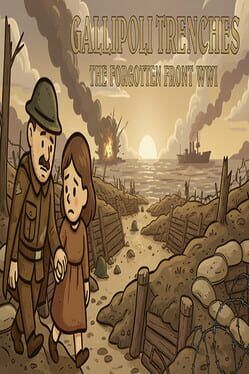
BlackMill’s next World War I FPS, WW1: Gallipoli, finally has a release date. Here’s how its Middle Eastern setting, tactical structure, and grounded tone are shaping up, and whether it looks like a niche mil-sim or a more approachable shooter.
WW1: Gallipoli, the next historical shooter from BlackMill Games, now has a confirmed release date: May 21, 2026 on PC, PlayStation 5, and Xbox Series X|S. The announcement was timed around Anzac Day and framed explicitly as a tribute to the soldiers who fought and died during the Gallipoli campaign, signaling the sort of solemn tone the team is aiming for this time around.
A new front for BlackMill’s WW1 series
If you have played Verdun, Tannenberg, or Isonzo, you already have a sense of what Gallipoli is trying to be: a grounded, semi-tactical WW1 shooter that elevates battlefield authenticity over arcade chaos. Where Verdun focused on the Western Front and Isonzo on the Italian Alps, Gallipoli shifts to the Middle Eastern theatre and one of the war’s most infamous operations.
The campaign at Gallipoli was defined by brutal amphibious landings, grueling trench warfare in harsh terrain, and the involvement of ANZAC forces alongside the wider British Empire. BlackMill is once again building asymmetric sides into that context, with players fighting either for the Ottoman defense or the invading Entente troops.
Setting and atmosphere: from surf to sandstorm
Gallipoli’s new trailer and early details paint a picture of a front that is visually and tactically distinct from the mud and forests of Verdun or the snow and stone of Isonzo. Maps range from beachheads echoing the landings at Anzac Cove to baked desert interiors, ruined towns, and open sandscapes where visibility changes rapidly.
Environmental conditions are central to the setting. Beach assaults look exposed and chaotic, with machine-gun nests and artillery overlooking narrow approaches. Further inland, sandstorms and dusty heat replace barbed-wire quagmires, shifting the rhythm of combat. These conditions should push squads to adapt sightlines, maneuver routes, and even weapon choices depending on the weather and time of day.
The studio’s past work suggests that uniforms, weapons, and fortifications will be painstakingly modeled on period reference material, and the framing around Anzac Day reinforces that Gallipoli is meant to be a respectful, historically grounded depiction rather than a generic desert shooter.
Gameplay structure: tactical roots with familiar class-based play
Although full mechanical details are still being revealed, Gallipoli is framed as the next entry in the same multiplayer-focused formula BlackMill has refined across its previous WW1 titles. Expect class-based squads, objective-driven modes with attacking and defending sides, and a focus on coordinated pushes over lone-wolf heroics.
Beach landings in particular look like they will echo Isonzo’s assault and defense structure, where attackers must break through layered objectives while defenders rely on entrenched positions, artillery support, and smart use of elevation. The cramped geography of cove landings sets up naturally linear chokepoints, while inland maps in ruined settlements and open desert should encourage flanking and wide maneuvering.
Weapons and loadouts will likely stay era-appropriate, revolving around bolt-action rifles, early machine guns, limited automatic weapons, and period-accurate artillery and support tools. The result is a slower, more lethal pacing compared to modern arcade shooters, with suppression, positional play, and battlefield knowledge carrying more weight than twitch reflexes alone.
Tone and authenticity: reverent rather than bombastic
The choice to tie the release date announcement trailer to Anzac Day and to spotlight the Landing at Anzac Cove speaks volumes about the tone Gallipoli is chasing. BlackMill has always leaned into sober presentation, with their games serving as quasi-interactive history vignettes that acknowledge casualty numbers and key battles.
Here, the focus on a notoriously costly and controversial campaign suggests an experience that leans into loss, attrition, and the futility of poorly planned offensives. Visual language in the materials so far favors grounded color grading and grounded effects instead of stylized spectacle. That tracks with the studio’s broader position as a counterpoint to blockbuster, Hollywood-style war shooters.
Authenticity also applies to perspective. Allowing play as both Ottoman forces and British Empire troops invites an appreciation of the conflict from opposing sides. Combined with period kit and historically modeled environments, Gallipoli is positioned as something players might come away from having learned at least a little about one of WW1’s lesser-known fronts.
Niche tactical war game or accessible narrative-driven FPS?
Based on what BlackMill has shown and on the studio’s lineage, WW1: Gallipoli is not suddenly pivoting into a scripted, story-heavy campaign shooter. It appears to stay squarely in the multiplayer, objective-based space, which means it will probably feel closer to Verdun and Isonzo than to a Call of Duty style story mode.
That said, Gallipoli is not a hardcore mil-sim either. The series has historically occupied a middle ground that rewards tactical thinking and squad play without burying players in the dense layers of simulation you see in something like Squad or Hell Let Loose. Newcomers can still spawn, follow a squad leader, and contribute to the team without mastering complex communication setups or logistics systems.
The new front and thematic framing give Gallipoli a potentially wider emotional hook, especially for players in Australia, New Zealand, and Turkey for whom the campaign holds special historical resonance. The Anzac Day announcement and focus on the landing at Anzac Cove position it as accessible in terms of narrative context, even if the core of the game remains a methodical, lethal, class-based FPS.
In other words, WW1: Gallipoli is shaping up as a refined continuation of BlackMill’s niche, authenticity-first multiplayer formula rather than a mass-market, cinematic war story. It looks well placed to appeal to players who want a grounded, atmospheric take on the Gallipoli campaign with enough accessibility to jump into matches, but who are also willing to accept slower pacing, unforgiving gunplay, and the grim realities of the First World War.