
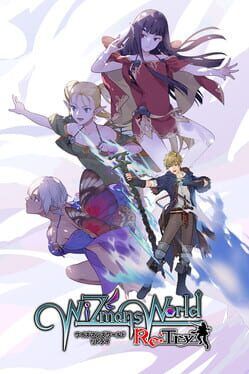
Charting the cult history of WiZman’s World and why the HD remaster WiZmans World Re;Try matters for Radiant Historia and DS‑era Atlus JRPG fans.
WiZman’s World was the kind of JRPG Western fans only heard about in message‑board whispers. A late 2010 Nintendo DS exclusive from Jaleco and Lancarse, it launched in Japan with no localization in sight, then quietly vanished as the handheld era wound down. Import fans compared its strange, self‑contained city and intricate combat to the likes of Atlus’s DS work, but for most players it became one more name on the long list of “maybe someday” fan‑translation hopes.
“Someday” ended up arriving in a different form. WiZmans World Re;Try, an HD remaster handled by City Connection and Lancarse and published in the West by Clear River Games, is finally giving the game a proper global release in early 2026. For DS JRPG diehards, it is not just a curiosity pulled out of the vault, but a chance to revisit a very specific style of handheld RPG design that has mostly disappeared.
From sealed‑off cult classic to global remaster
On paper, WiZman’s World always sounded like something Atlus might have slipped onto DS between Radiant Historia and its dungeon crawlers. It blends melancholy worldbuilding with crunchy systems and just enough weirdness to stand out.
The story centers on Claus, a young wizard searching for his missing mentor, the genius alchemist Giselle. Their quest leads to Wizarest, a city that sealed itself off from the outside world more than a century ago. Inside, nobody can remember much about their past, dungeons sprawl beneath the cobblestones, and reality itself feels frayed. Claus is joined by three homunculi created by Giselle, who act as both party members and the core of the game’s progression systems.
Lancarse was already known among genre fans for its work with Atlus, including Etrian Odyssey and later contributions to Shin Megami Tensei spin offs. You can feel that lineage in WiZman’s World. There is a focus on considered turn based battles, attrition over long dungeon crawls, and story beats that push players to question what their party is really doing to this broken world.
The original DS release built a small but vocal cult following among importers and Japanese players who were drawn to its mix of tactical combat and morally gray narrative choices. But with no localization and the DS on its way out, WiZman’s World had little chance to break out.
That is where WiZmans World Re;Try comes in. Rather than a ground up remake, it is a carefully modernized remaster that brings the DS game’s systems, story, and art forward to modern platforms while smoothing away a lot of old hardware cruft.
What Re;Try actually changes
City Connection and Clear River Games are positioning WiZmans World Re;Try as a faithful HD remaster. The essence of the game is untouched: the same story about Wizarest’s sealed fate, the same core party, the same emphasis on tactical turn based combat and monster fusion. The upgrades are mostly about presentation, accessibility, and flow.
The most immediate shift is visual. The original DS release ran on a 4:3 dual screen layout with relatively low resolution sprites and backgrounds. Re;Try rebuilds that presentation for modern displays with enhanced 2D pixel art in HD and a 16:9 layout. Character sprites, monster designs, and battle effects all have more clarity without throwing out the original aesthetic, which matters for a game whose identity is rooted in its oddball monster designs and expressive homunculi.
Audio has been given similar attention. The remaster features remastered and rearranged music with updated sound design, retaining the moody, slightly off kilter tone fans remember while taking advantage of modern audio fidelity. For a game that spends a lot of time in dungeons and in the quiet streets of a half memory city, atmosphere matters a lot, and this is where an HD remaster can subtly reshape the experience without rewriting it.
On the systems side, Re;Try layers in a suite of quality of life changes that speak directly to its DS heritage. The developers are adding save anywhere functionality, something older handheld RPGs were often strict about. There are now dialogue skipping options and general text fast forward, making repeated story scenes less of a barrier on retries or New Game+ runs. Progression flow is being streamlined, with modernized menus and UI that make party management and fusion less of a chore.
The remaster also expands the Monster Encyclopaedia, surfacing more information about the creatures you fight and fuse. Given how central experimentation is to WiZmans World’s party building, better in game documentation means less needing to keep a wiki at your side.
Finally, there is broader language support and a full localization for Western release. For a game that once felt like it might only be approachable through fan patches, seeing it appear with official translations across multiple languages is a major shift.
Tactical combat and the Anima Fusion hook
Underneath the remaster’s polish is the game that import fans have been talking up for more than a decade. WiZmans World is not a pure tactics game in the grid based sense, but it is a tactical JRPG in the way it demands you think about turn order, attribute matchups, and multi character coordination.
Battles hinge on setting up chain attacks and exploiting element and attribute weaknesses, then using your homunculi to flex into roles your human characters cannot cover. Each of the three homunculi can absorb monster souls through a system known as Anima Fusion. When a homunculus fuses with new monster anima, its stats, skills, and even appearance shift, often into elaborate “monster girl” forms that were a talking point for the DS version.
In play, this functions like a hybrid of Radiant Historia’s position based combos and the demon fusion of Shin Megami Tensei. You are not fusing demons to summon them separately, but rather reconfiguring your existing allies, with tangible tradeoffs whenever you overwrite an older form. Different fusions can emphasize support magic, elemental coverage, burst damage, or defensive tanks, and because your three homunculi are the backbone of the party, each build decision matters.
Layered on top of this is a structure that encourages replays. Player choices influence relationships, quest outcomes, and ultimately which of the game’s multiple endings you see. With New Game+ integrated directly into Re;Try, the remaster is embracing that loop, counting on the new QoL features to make seeing alternate routes far less of a slog than it might have been on a DS cartridge.
Why it matters to Radiant Historia and Atlus style fans
If you spent the DS years devouring Radiant Historia, Devil Survivor, and the Etrian Odyssey series, WiZmans World Re;Try is targeting you. It shares that era’s fondness for dense systems and morally loaded storytelling, but it tilts in its own direction.
Radiant Historia players will likely appreciate Wizarest as a setting. Like Vainqueur’s looping timelines, Wizarest feels like a place under constant quiet threat, where every new piece of information reframes what you thought you knew about the world’s history. The memory loss conceit gives the script room to drip feed revelations in a way that feels adjacent to Radiant Historia’s layered narrative, without copying its time travel gimmick.
Fans of Atlus’s strategy tinged RPGs will find familiar pleasures in the combat. WiZmans World encourages careful turn planning, buff and debuff juggling, and the satisfaction of locking enemies into devastating chains. It is less punishing than a full on Shin Megami Tensei game, but it rewards the same mindset of building toward synergies rather than just grinding out raw stats.
Where it stands apart is in the homunculi dynamic. Instead of summoning a revolving door of demons or personas, you are attached to three core characters who grow and change in sometimes unsettling ways as you feed them monster souls. That gives the fusion system more emotional weight, and it ties directly into the story’s questions about what kind of world you are saving and at what cost.
For players who missed the DS original entirely, Re;Try offers a chance to plug a surprising hole in that era’s JRPG landscape. You are getting a fully intact snapshot of 2010 handheld design sensibilities wrapped in an HD presentation that respects your time and your modern display.
Platforms, release window, and where it fits in 2026
WiZmans World Re;Try is set to release in early 2026, with several outlets and the game’s Steam page pointing to February 19, 2026 as the Western launch date. The remaster will be available on PlayStation 5, PlayStation 4, Nintendo Switch, and PC via Steam, giving it a footprint comparable to other recent classic JRPG revivals.
On PC, the game is already available to wishlist, and Clear River Games has been pushing it as part of a broader strategy of rescuing older Japanese titles that never received their due internationally. For console players, the combination of portable friendly design and modern conveniences makes the Switch version particularly appealing, but the crisp HD pixel art should sing on a PS5 as well.
In a release calendar that is increasingly filled with remakes and remasters, WiZmans World Re;Try occupies an interesting niche. It is not a nostalgia trip for something everyone played. Instead, it is an excavation project, taking a once obscure DS cartridge and giving it a second life as a mid tier, system heavy JRPG in an era where that tier has thinned out.
For JRPG fans who still remember flipping through import lists and wondering which games would never leave Japan, this remaster feels like an overdue correction. For everyone else, it is a chance to discover why a forgotten DS experiment could sit comfortably on a shelf next to Radiant Historia and the best of Atlus’s handheld catalog.