
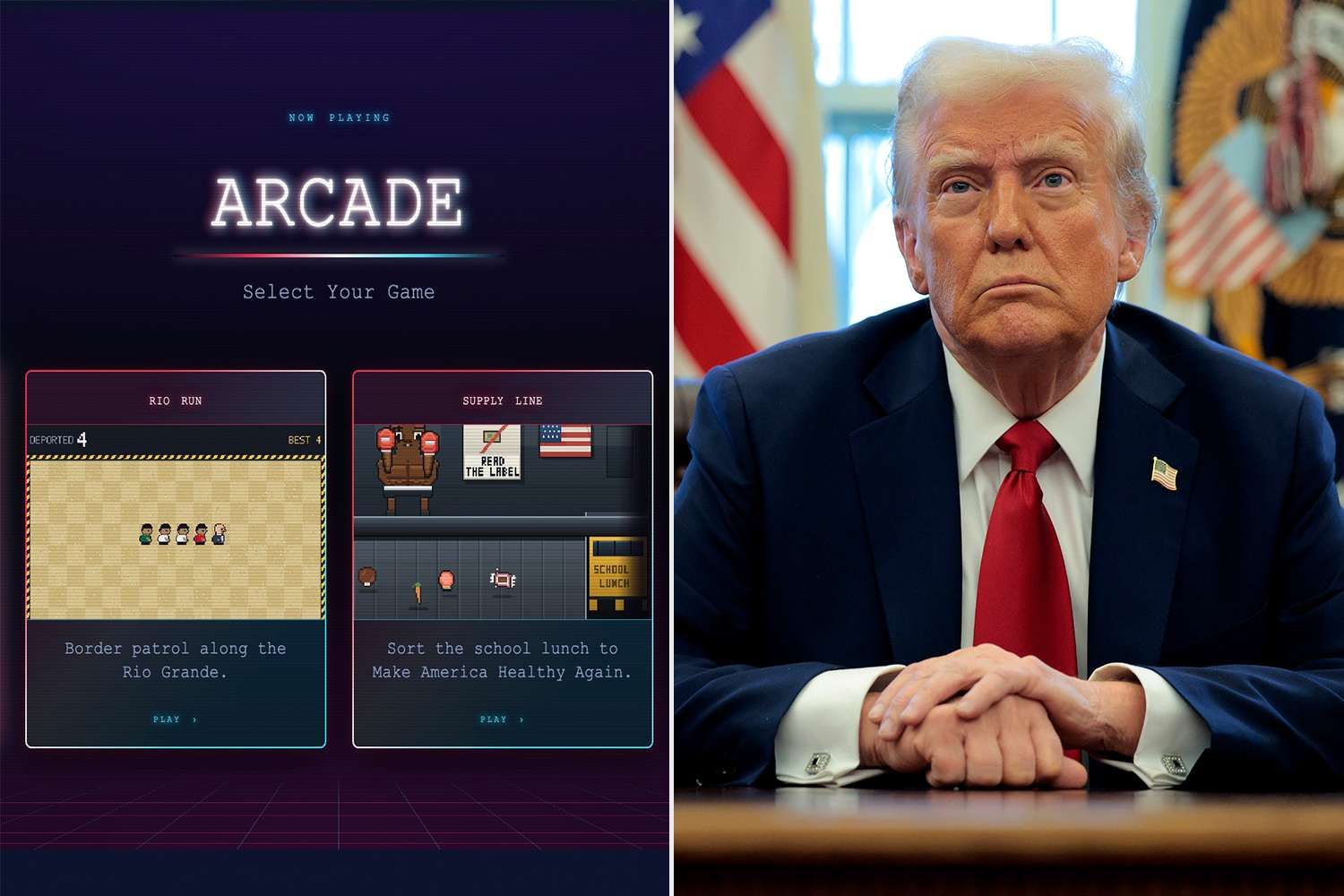

The White House arcade site has drawn gaming controversy over five retro-style political video games, familiar clone formats, immigration messaging, and possible gaming IP questions.
Image: people.com
A federal arcade turns policy into browser games, and the reaction was immediate
The White House launched a dedicated arcade page on September 3, 2026, with five low-resolution browser games tied to President Donald Trump’s policy agenda, according to reporting from Shacknews and TechTimes. TechTimes reported that the games are playable through whitehouse.gov/arcade and arcade.gov, while Al Jazeera described the rollout as five arcade-style games on the White House website, each believed to promote a different administration priority.
That concrete launch is the center of the White House arcade site controversy. The site is not a commercial game release, a campaign microsite hosted elsewhere, or a parody page from an outside group. The sources describe it as a federal web property carrying playable games that package policy themes as arcade mechanics.
The backlash has two connected fronts. The first is political and moral: immigration enforcement, border security, nutrition policy, legislation, and child savings accounts are being converted into score-chasing loops. The second is a gaming IP question: multiple outlets report that the games and promotional material resemble well-known game formats and console branding, raising questions about how far the government’s use of familiar gaming language, mechanics, logos, and audio cues can go before it becomes a rights issue.
The five games use familiar arcade rules as policy delivery systems
Across the coverage, the same five titles appear: Build the Wall, Rio Run, Supply Line, Flappy Bill, and Trump Savings Tycoon. They are presented as retro-style browser games, with the White House social account promoting the arcade on X with language including “Build the wall. Deport. Fill a Trump Account,” according to Kotaku’s reproduction of the post.
Build the Wall is the most obvious gaming clone format in the set. Shacknews, Kotaku, The Guardian, Time News, and TechTimes all describe it as a Tetris-style or Tetris-like game. The premise, as reported by Shacknews and TechTimes, is to stack wall sections or blocks to protect the border “from the coming horde.” Kotaku noted that, unlike Tetris, completed rows do not disappear, which changes the underlying game logic even while the visual and structural reference remains clear.
Rio Run is described by Kotaku, Time News, TechTimes, and Shacknews as a Snake-style game. Sources describe the player gathering or rounding up border crossers, who then trail behind the player. Kotaku reported that the figures are shown in orange jumpsuits after being picked up, while Al Jazeera described the game as gathering border crossers along a fence.
Flappy Bill draws from Flappy Bird, according to Al Jazeera, Shacknews, and The Guardian. In that game, sources say a bald eagle carries legislation over the National Mall. Supply Line is described by Al Jazeera and Time News as a conveyor-belt sorting game centered on “Make America Healthy Again” standards, with players rejecting foods that fail the game’s criteria. TechTimes compared the format to Tapper, while The Guardian described a version in which the player punches junk-food items away from a conveyor belt. Trump Savings Tycoon, according to Al Jazeera and The Guardian, has players catching cash, gold bars, bills, or coins to fill children’s “Trump Accounts,” a reference to the administration’s child savings program.
The political backlash is focused on dehumanization, timing, and seriousness
The strongest criticism has centered on the immigration games, especially Build the Wall and Rio Run. Al Jazeera reported that rights groups and border advocates condemned the arcade format. Amerika Garcia Grewal, co-director of the Frontera Federation in Eagle Pass, Texas, told AFP, as quoted by Al Jazeera, “They’ve been playing games with people’s lives for years, now they’ve made a video game of what they’re doing.” Adriana Jasso of AMIGOS San Diego Community told AFP the games showed a fundamental “lack of seriousness,” according to the same report.
The criticism is not only that these are political video games. Political games have existed for decades, and public agencies have long used interactive media for education, recruitment, and messaging. The sharper objection in the supplied reporting is that enforcement actions, border crossings, and detained or captured people are being turned into collectible objects, obstacles, or fail states.
That design choice matters in the way any strategy system matters: the scoring rules tell players what the game values. In Rio Run, the loop described by outlets rewards collecting people. In Build the Wall, the fail condition is framed around stopping a “horde,” according to Shacknews and TechTimes. Critics cited by Al Jazeera argue that those mechanics trivialize real human consequences. The Guardian and Kotaku go further in their commentary, characterizing the games as dehumanizing and racist. Those are outlet judgments rather than neutral descriptions, but they reflect the dominant axis of the backlash in games media coverage.
Al Jazeera also placed the launch against wider pressure on the administration, including rising living costs, the economic effects of the war on Iran, tariff disputes, and inflation concerns. Senator Matt Lesser wrote on X, according to Al Jazeera, “Heating oil is near an all-time high but hey you can play Border Czar Tom Homan in a video game.” That response captures the second political complaint: critics see the arcade as a communications stunt arriving while voters face material economic and foreign-policy problems.
The IP issue is less settled, but the signals are hard to ignore
The White House gaming IP question is separate from the political backlash, although the two are feeding the same gaming controversy. The available sources do not include a court ruling, takedown notice, or statement from Microsoft, Nintendo, Sega, Sony, Dong Nguyen, The Tetris Company, or other rights holders about this specific arcade launch. What the reporting does establish is resemblance and alleged unauthorized use, not a resolved legal outcome.
Shacknews reported that White House social media promotion used altered imagery associated with Microsoft, Nintendo, Sony, and Sega. Its article says the Xbox 360 logo was transformed into a sphere with an “A,” the GameCube mark was similarly altered, and Sega’s chime was changed to say “MAGA.” Kotaku also reported that the trailer used a “MAGA” logo in the style of Sega’s iconic lettering. TechTimes described the launch as using Xbox, GameCube, and Sega branding that companies had not authorized, though the supplied source text does not include direct statements from those companies.
On the gameplay side, outlets consistently identify the arcade games as riffs on familiar formats rather than wholly original systems. Build the Wall is compared to Tetris, Rio Run to Snake, Flappy Bill to Flappy Bird, and Supply Line to Tapper. Game rules and genres are not automatically protected in the same way as logos, characters, music, or source code, so a clone-like format is not by itself proof of infringement. The stronger possible IP questions, based on the provided reporting, involve promotional branding, sound cues, trade dress, and the closeness of any audiovisual presentation to recognizable game properties.
Shacknews framed the launch as part of a continuing pattern, reporting that the US government had previously used Pokémon and Mario imagery in social posts and that Japanese officials had asked the government to stop using those properties. TechTimes likewise described the arcade as formalizing a broader pattern and reported that Japan’s Ministry of Foreign Affairs had made two formal diplomatic protests. Those claims are attributed here to those outlets because the supplied material does not include the underlying diplomatic documents.
This is a communications meta shift, not a normal game launch
From a strategy perspective, the arcade is best understood as a shift in political communications toward playable memes. A meme image asks viewers to recognize a reference. A browser game asks them to perform the message repeatedly. That changes the economy of attention: time-on-site, score sharing, social replies, and outrage cycles all become part of the distribution plan.
The White House’s own framing supports that read. TechTimes reported that Kaelan Dorr, White House deputy assistant to the president and head of digital strategy, described the launch as “policy you can interact with.” Time News reported that supporters praised the platform as an innovative communication tool and shared high scores online. In other words, the arcade is designed to turn policy identity into a feedback loop. The player is not reading a policy page. The player is stacking, catching, sorting, dodging, and collecting according to rules written around the administration’s preferred outcomes.
That is why the clone format is strategically useful. Tetris, Snake, Flappy Bird, and conveyor-belt arcade games are instantly legible. They have low onboarding cost, especially in a browser. The player understands the loop before the political message arrives. The risk is that familiar design vocabulary can launder harsh framing through nostalgia. Pixel art, chiptune-adjacent branding, and old arcade pacing soften the surface while the underlying verbs remain politically loaded.
The practical consequence for game companies is awkward. If a government account borrows console-era branding or makes near-copies of iconic formats for partisan messaging, silence can look like acceptance to some players, while public objection can push a company into a partisan fight. That is the long-term tension behind the White House arcade site: the more official political actors use gaming’s visual language, the more publishers and platform holders may be pressured to police association, even when the legal line is uncertain.
What is confirmed, what remains unanswered, and what readers can do now
What is confirmed by the provided sources is that the White House launched an arcade page with five browser-style games tied to administration policy themes, promoted it through official social channels, and drew swift criticism from games outlets, rights advocates, and political critics. The games named in the reporting are Build the Wall, Rio Run, Supply Line, Flappy Bill, and Trump Savings Tycoon. Multiple outlets describe the formats as resembling Tetris, Snake, Flappy Bird, Tapper-style conveyor play, and cash-catching arcade loops.
What remains unconfirmed in the supplied material is whether any rights holder has sent a legal demand over this specific arcade site, whether the White House obtained any permissions for branding-like references, who developed the games, how they were procured or funded, and whether the arcade will expand beyond the five launch titles. Kotaku reported that the site promised more games to come, but the sources do not provide a schedule, budget, contract record, or developer credit.
For readers looking for practical guidance, this is a browser-based political arcade rather than a game release with platforms, price, system requirements, or a storefront page. There is no source-provided indication of a paid version, console release, Steam page, ESRB rating, or mobile app. If you are tracking it as a gaming IP story, the next meaningful developments would be rights-holder statements, takedown actions, procurement disclosures, or changes to the arcade’s promotional material. If you are tracking it as a political video games story, the key question is whether playable propaganda becomes a repeatable government communications tactic or remains a one-cycle outrage engine.
Either way, the backlash is not only about whether the games are crude clones. It is about what happens when the grammar of arcade games, with its simple rewards and punishments, is placed on an official federal site to sell contested policy.