

Why Boltgun’s mobile jump is a perfect fit for the boomer shooter revival, how touch controls could reshape its chainsword ballet, and what makes it one of the best modern Warhammer adaptations.
Warhammer 40,000: Boltgun always felt like a game you should be able to pull out of your pocket. It is a retro FPS that treats 40K like a box of blood-soaked toys, throwing you into chunky corridors and vast arenas full of demons, cultists and heretics just begging to be turned into pixelated paste. With Warhammer 40,000: Boltgun Boom bringing that experience to iOS and Android, the boomer shooter revival is about to collide with the biggest gaming platform on the planet.
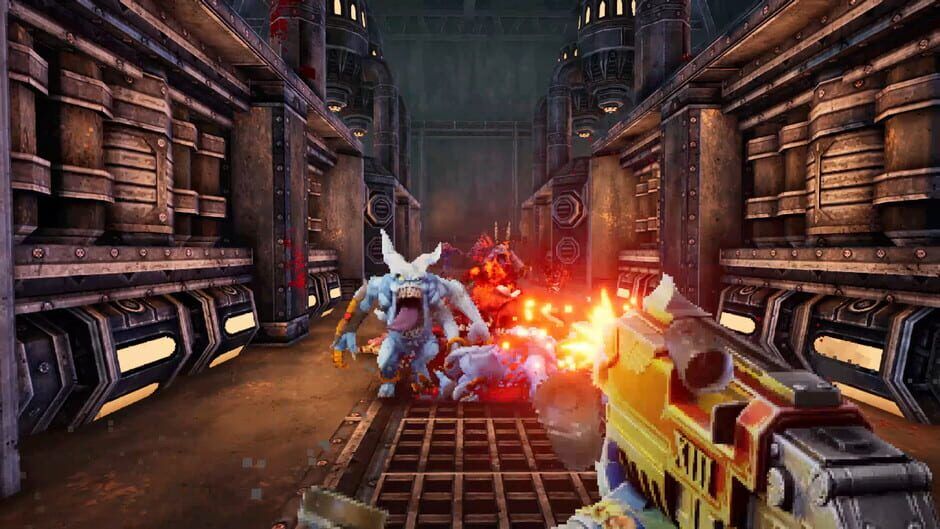
Pocket Gamer’s report confirms that Nitro Games is handling the mobile version, aiming for a 2026 launch. Rather than a cut-down spin-off, Boltgun Boom is pitched as a full translation of Auroch Digital’s original, from its heavy-metal pacing to its pseudo-16‑bit gore. It even keeps Ultramarine Malum Caedo as the star, which means the same swaggering, one-man Astartes army stomping through massive levels filled with secret routes and kill rooms.
That last part is crucial, because the heart of Boltgun is not nostalgia, it is rhythm. It is a shooter built around momentum, strafing and weapon cycling, with enemies that encourage you to blast, swap guns and dive into the next pack without ever easing off the trigger. Bringing that rhythm to a touchscreen is the big challenge Nitro Games has to solve.
Why boomer shooters thrive on handheld screens
The term “boomer shooter” has become shorthand for a very specific flavor of FPS design. It leans on fast movement instead of cover mechanics, simple keycard objectives instead of quest logs, and readable enemies over elaborate animations. These games are built on clarity and speed, which makes them unusually well suited to handheld play.
On a phone or tablet you want information quickly. Retro shooters serve that up in big sprites and bold silhouettes. Boltgun’s Chaos hordes are basically walking action figures, with designs pulled directly from actual Warhammer miniatures. You can tell at a glance which target is a priority, which projectile will hurt the most and where the next threat is coming from. That makes the experience legible even on a smaller screen, where realistic detail would simply blur into noise.
Boomer shooters also break neatly into short, intense bursts. A single level can deliver a complete loop of exploration, combat and payoff in ten or fifteen minutes, perfect for a commute or a waiting room. Boltgun’s design doubles down on that structure, offering a mix of wide arenas and tighter corridors that naturally create bite-sized goals. Clear the next arena, find the next key, survive the ambush and you have hit a satisfying checkpoint, even if the game has not formally saved the run yet.
Mobile hardware also quietly benefits these throwback shooters. Where cutting-edge first-person games often fight for frame rate and clarity, a heavily stylised retro look demands less from the device, which can pay back in smooth performance. In a game like Boltgun, that responsiveness is everything. The art style is not just an aesthetic choice, it is a performance budget that helps keep the game playable on a wide range of phones.
All of this explains why Doom ports, Quake remasters and indie throwbacks like Dusk-like titles have found an eager audience on handheld devices. They work on smaller screens, they tolerate touch controls better than tactical mil-sims, and they still tap into that very specific pleasure of moving fast and shooting faster.
The touch control question
For all that, a virtual joystick can still ruin a good time. Boltgun’s combat is fast enough that even tiny delays or input misses can break the flow. Nitro Games will have to answer the most important question facing any mobile FPS: how do you let players manage speed, precision and weapon variety without a physical controller?
The traditional dual-stick touchscreen layout is a starting point, but it is rarely enough on its own. Boomer shooters thrive when you are circle-strafing, bunny-hopping and constantly switching weapons to fit the situation. That can turn a phone’s display into a crowded mess if every action becomes a separate button.
One answer is to bake more intelligence into the controls. Generous auto-aim, contextual melee, and smart reload behavior can remove some of the busywork without dulling the power fantasy. Boltgun’s arsenal is loud and expressive rather than subtle. When you are firing a boltgun, plasma gun or heavy bolter, you care more about holding the trigger and tracking targets than about pinpoint flick shots. A little aim assist can preserve the thrill of ripping through a horde without demanding perfect thumb dexterity.
Movement is the other half of the equation. Boltgun wants you to stay in motion, constantly chaining jumps and dodges to stay ahead of incoming fire. A good mobile adaptation might lean on auto-sprint and simplified jump inputs, letting you keep one thumb focused on aiming. Even minor tweaks like larger virtual buttons or an adjustable HUD can have an outsized impact when you are trying to juggle strafing, firing and cycling through a nine-weapon loadout.
The port’s announcement hints at “chapters from the Boltgun series,” which raises questions about structure and monetisation. On mobile, that could mean a shareware-like rollout where the first chapter is free and later slices are paid, or it could signal a curated campaign broken into episodes. Either way, it affects how levels are broken down and how often the game can comfortably autosave. Shorter, chaptered missions can work in favor of mobile control schemes, as they reduce the fatigue that comes from long stretches of high-intensity input.
Ideally, Nitro Games will treat touch controls as one option rather than the only way to play. Controller support, gyro aiming and extensive remapping could transform Boltgun Boom from a curiosity into the definitive portable version. The better the game feels across a range of setups, the more its speed and aggression can shine without compromise.
Why Boltgun is one of the strongest modern Warhammer adaptations
For Warhammer fans, the draw is obvious. Boltgun is one of the rare 40K games that truly understands the setting’s tone. It is not a po-faced tactical sim or a lore lecture. It is a wild, overblown power trip that treats Space Marines as the unstoppable, terrifying figures they are made out to be in the fiction, then drops them into a playground built from skulls, gothic architecture and daemonic horror.
A big part of that success comes from the way enemies are presented. Auroch Digital leaned heavily into the look of physical miniatures, from their proportions to their animations. Fired-up Chaos Space Marines and hordes of cultists feel like painted plastic come to life. That makes Boltgun instantly recognisable to tabletop players and helps it stand apart from more generic sci-fi shooters. On mobile, this stylised approach is an asset, keeping characters readable even when your phone is held at arm’s length.
Mechanically, Boltgun keeps the bolter at the center of the experience. The boltgun itself sounds and feels like a cannon, shredding enemies into bloody chunks with every second of sustained fire. Chainswords, plasma weapons and melta guns round out the arsenal, but the core loop never loses sight of what makes a Space Marine fantasy work. You are not a fragile soldier creeping around cover, you are a blue-armored battering ram kicking open doors.
The pacing also respects both retro design and modern sensibilities. There are secrets to uncover and maze-like layouts to parse, yet the game rarely devolves into aimless wandering. Combat arenas are arranged like puzzles built from threat priorities, weapon pickups and environmental hazards. Learn the tune and you can clear a room in seconds, improvising as you go. That combination of clarity and chaos is exactly the sort of thing that works when your attention is split between the game and the world around you on a train journey.
Then there is the simple fact that Boltgun looks and sounds like 40K. The color palette, the architecture, the booming voice lines and the sound of a bolter shell detonating center mass all sell the fantasy. In an era where the Warhammer license is everywhere, from tactics games to co-op horde shooters, Boltgun stands out for feeling both faithful and distinct. It is not just another shooter with aquilas stuck to the walls. It is a specific, confident vision of what a 40K FPS should be.
The future of Boltgun on mobile
The move to handheld devices comes with open questions. Pocket Gamer notes that the phrasing around “chapters” could mean a trimmed-down launch or a game built for gradual expansion. Pricing, content scope and performance on lower-end hardware will all shape how the community receives Boltgun Boom.
Even with those caveats, the fit between genre and platform is hard to ignore. Boomer shooters thrive in spaces where immediacy matters more than simulation, where bold visuals count for more than polygon counts, and where a single frantic level can be as satisfying as a two-hour session. Mobile is all of those things by default.
If Nitro Games can nail the basics of control and performance, Boltgun’s arrival on iOS and Android has a chance to do more than just pad out the Warhammer release calendar. It could become the go-to way to experience one of the most joyous, self-aware takes on 40K in years, always ready in your pocket whenever you feel the urge to let a few thousand bolt rounds fly.