
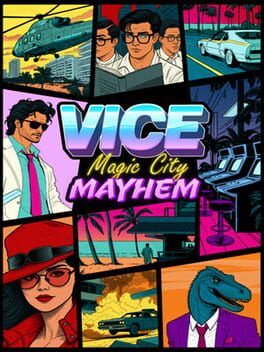

How a tiny team is building an 8-bit open world that feels like GTA: Vice City on a single city map, and why Vice: Magic City Mayhem is one of the most intriguing retro action-adventures headed to Nintendo Switch in 2026.
Vice: Magic City Mayhem is the kind of pitch that sounds like a fever dream: take classic 8-bit, top-down Zelda structure and fuse it with the pastel suits, raunchy humor, and chaotic crime energy of GTA: Vice City. That mashup has already found an audience on Kickstarter, and now the developers at Jurassic Sunset Games are steering their crowdfunded project toward a 2026 launch on Nintendo Switch.
At a glance it looks like a lovingly-authentic NES game. Under the hood it is trying to answer a tricky design question: how do you build an open, crime-riddled city that feels alive when your world is limited to chunky tiles, tight memory, and a single-screen camera? The team’s answer is to emphasize density over scale, layering secrets, dungeons, and crime vignettes across one compact Magic City instead of sprawling across a huge map.
Zelda-style structure in a dirty neon city
You play as Dutch, one of Magic City’s most feared enforcers. When his partner Sophie is kidnapped, the hunt takes him across nightclubs, beach fronts, and even raptor-infested yachts. Structurally it follows the classic Zelda loop: explore the overworld, find a dungeon, conquer its puzzles and boss, walk out with a new tool that opens up fresh corners of the city.
Where Zelda might send you into a forest temple, Vice: Magic City Mayhem sends you into a mob-run nightclub where the dance floor layout doubles as a navigation puzzle. A sunny beach becomes a maze of cabanas, smuggler tunnels, and backroom deals. That tension between the bright 8-bit palette and the grimy subject matter gives the game its immediate identity.
Combat leans into snappy hack-and-slash action, with both melee and ranged options. Enemies telegraph patterns in readable, sprite-based ways, but the team wants fights to feel more like bar brawls than heroic duels. Items slot neatly into the Zelda template yet lean on the crime fantasy: Kevlar-style armor that acts as a shield upgrade, dash boots that feel more like street brawler footwork, and experimental weapons that layer magic and lowlife tech.
GTA: Vice City attitude on a small map
The GTA: Vice City influence is less about 3D open-world freedom and more about tone and atmosphere. Magic City is a pastel-soaked crime playground where every corner is a little bit sleazy, exaggerated, and darkly comedic. The writing targets that mix of high-drama and trash TV energy, while keeping its feet in a tight, top-down adventure structure.
Instead of freeform carjacking and five-star police chases, open-world freedom shows up in how you approach the city’s activities. You can veer off the main rescue mission and explore side rooms, hidden clubs, or shady piers dotted around the overworld. Many locations play double duty as both story backdrop and mechanical challenges, echoing how Vice City’s landmarks also anchor missions.
The camera never leaves that NES-style, top-down view, but within that restriction the team layers personality. Neon signs, glowing club interiors, convertible-lined streets, and harsh police lights are all pushed through a tiny resolution and limited color palettes. The result, if they hit their target, is a city that feels loud and messy even though it is technically a modest tile set.
From Kickstarter pitch to console-bound crime caper
Vice: Magic City Mayhem first surfaced as a Kickstarter project, where its elevator pitch of “Zelda meets Vice City in 8-bit” caught attention immediately. Crowdfunding let Jurassic Sunset Games prove that there was an audience for a raunchier, crime-flavored take on the cozy action-adventure template.
The campaign highlighted a focus on handcrafted design instead of procedural generation. Every alley, nightclub, pier, and yacht is wired with secrets, shortcuts, and puzzle hooks. That philosophy matched backers’ nostalgia for older adventures where you could draw hand maps and slowly come to understand a limited but highly interconnected world.
Crucially, hitting funding goals also meant the team could confidently target Nintendo Switch. For a retro-styled project that is already leaning into Nintendo’s own Zelda heritage, landing on Switch in 2026 brings the entire pitch full circle: a crime-caked, neon 8-bit city running on a modern Nintendo handheld.
Designing an 8-bit open world by compressing the city
From a design perspective, one of the most interesting aspects of Vice: Magic City Mayhem is how the team is trying to create an open-world feel on maps that would fit into an old cartridge budget.
Rather than chasing the sheer sprawl of a modern crime sandbox, Jurassic Sunset’s stated goal is to make Magic City feel like a knot of intertwined neighborhoods. The map is intentionally limited in size, but routes through it keep expanding as you collect new abilities. An alley you walked past in the first thirty minutes might hide a shortcut that becomes crucial once you can break specific walls or dash through danger zones.
The team is building progression around layered gating. Doors locked by simple keys sit next to more exotic barriers that require special tools or knowledge. Some dungeons are off the main path but hold new abilities that recontextualize familiar streets. Others are woven directly into core story beats, mirroring how classic Zelda temples sit at the heart of each region.
By keeping the camera perspective and tile scale consistent at all times, the developers aim to avoid the dissonance that sometimes hits when 2D games bolt on oversized overworld maps. Instead, Magic City’s districts flow into each other in a way that should make it easy for players to mentally map the entire city over a single playthrough.
Small team, sharp goals
Vice: Magic City Mayhem is very much a passion project. Jurassic Sunset Games is a small group, which shapes both scope and priorities.
The team’s first goal is clarity. Enemies, traps, and environmental puzzles need to read instantly at 8-bit scale, even when the screen is packed with flashing club lights or police sirens. That clarity is also why the developers favor distinct, exaggerated silhouettes and color coding for factions and hazards.
Their second goal is replayable exploration. They want players to feel that revisiting a familiar street after unlocking a new tool is exciting rather than tedious. To get there they are packing the city with optional side routes, secret rooms behind suspicious decor, and minor characters with their own trouble to drag Dutch into. Shortcuts between districts act almost like modern Metroidvania connectors, but are wrapped in a crime-and-nightlife wrapper.
Finally, the team is chasing a specific mood. The game may look like it belongs on an old cartridge, but the writing and mission setups lean into age-gated territory. That contrast is deliberate, and the developers have spoken about wanting the humor to land as sharp and absurd while still keeping the moment-to-moment controls approachable.
Why Vice: Magic City Mayhem is a 2026 Switch game to watch
The Switch library is already crowded with retro action-adventures, yet Vice: Magic City Mayhem stands out by dragging the genre into a sleazy neon crime story. It is not trying to be a full-scale Grand Theft Auto clone, and it is not just reskinning The Legend of Zelda. Instead, it is taking the readable structure of one and injecting the attitude and atmosphere of the other.
If Jurassic Sunset Games can keep its map design tight and surprising, Magic City might end up feeling like a single, massive dungeon that just happens to be a crime-ridden metropolis. For players who grew up on 8-bit adventures but also spent years roaming Vice City’s streets, that blend is a compelling pitch.
With a tentative 2026 release window on Nintendo Switch, there is still time for the team to refine its combat, tune its puzzles, and stuff a few more raptor-infested yachts onto the horizon. As retro-inspired projects go, Vice: Magic City Mayhem looks like one of the more daring experiments in what an 8-bit open world can be.