
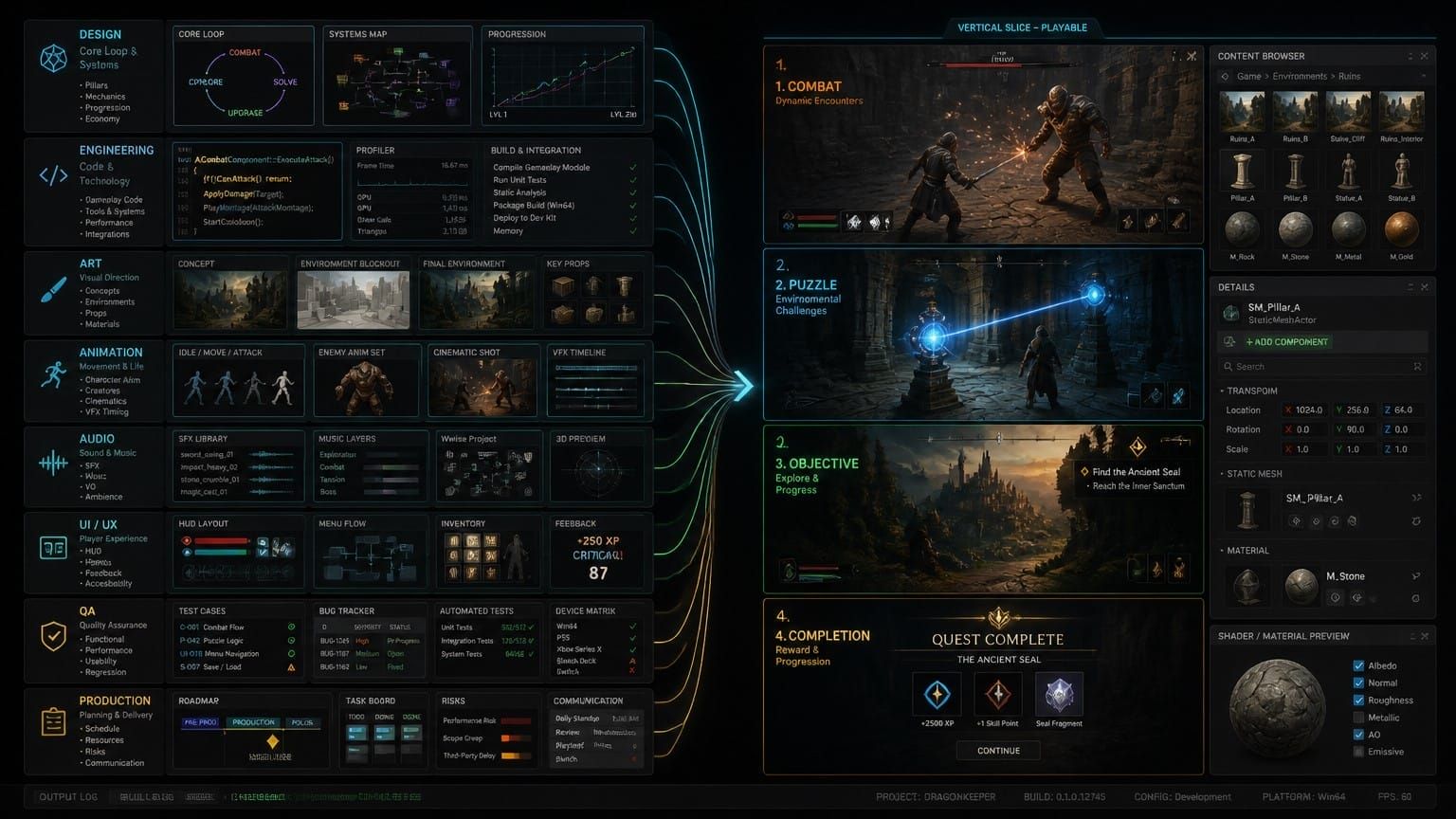

Chris Kerr has launched Vertical Slice, a subscription-funded games trade outlet aimed at developers, worker voices, investigations, and editorial independence.
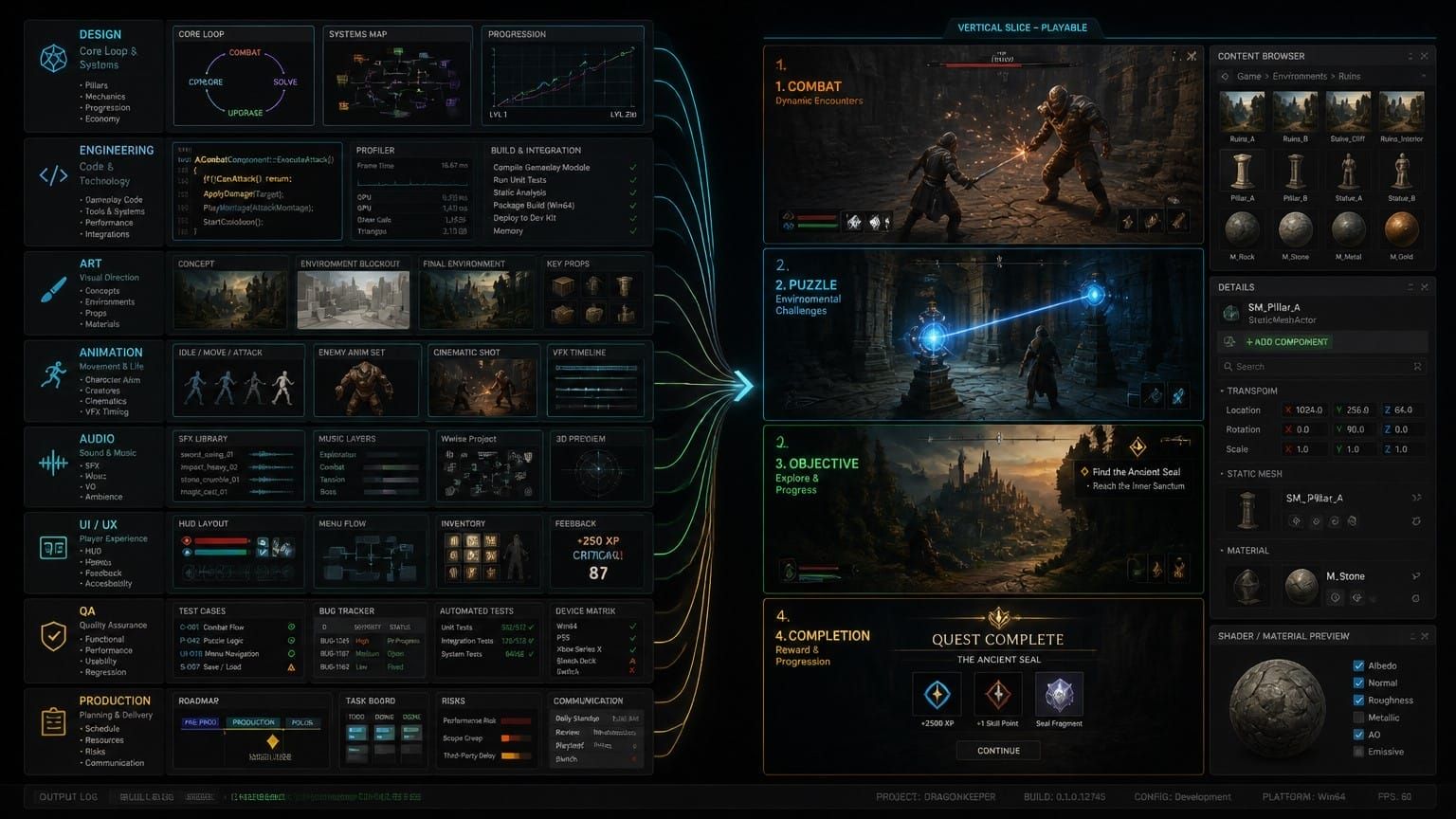
Image: game-developers.org
Vertical Slice opens with a worker-first mandate and a paywall clock
Chris Kerr, the former senior editor of Game Developer, has launched Vertical Slice as an independent games industry trade publication with a stated mission to give workers a voice and hold power to account. GamesIndustry.biz reports that the site launched on October 12 and is free to read until November 2, after which subscription pricing starts at £7.45 per month.
That is the concrete development. The tension sits inside the model. Vertical Slice is entering a games media environment that Kotaku describes as one where long-established publications are shrinking, vanishing, or consolidating, while independent journalism efforts are trying to keep coverage alive. Kerr is moving in the opposite direction of institutional security: leaving a known trade publication, self-funding a new outlet, starting as the only staff member, and asking industry readers to directly finance reporting that may scrutinize the companies and leaders those readers work around.
Kerr described Vertical Slice to GamesIndustry.biz as a publication for developers who care about the art form and the wellbeing of their peers, as well as executives and industry leaders who value uncompromising honesty. The phrasing matters because this is not a consumer site built around reviews, guides, or buying advice. Kotaku reports that Vertical Slice is a news-focused trade publication, with no guides and no reviews, and that Kerr does not intend it to be an aggregation platform. HappyGamer likewise framed the launch around daily news, interviews, and investigative work rather than player-facing coverage.
For readers searching for a Vertical Slice games publication, then, the initial answer is clear: it is a subscription-funded, independent trade outlet aimed at people who make games, run games businesses, cover labor and production issues, or follow the industry from the inside rather than the storefront.
Chris Kerr is betting his trade-reporting track record on independence
The Chris Kerr Vertical Slice launch is also a personnel story, because the publication’s credibility is being carried largely by Kerr’s own background at launch. Kotaku reports that Kerr has covered games for 15 years, has worked the trade beat for about 13 years, and spent around 11 years at Game Developer, ending his time there as senior news editor. GamesIndustry.biz identifies him as the former senior editor of Game Developer, the GDC sibling outlet formerly known as Gamasutra.
Kerr left Game Developer in September alongside several other contributors and editor-in-chief Danielle Rindeau, according to GamesIndustry.biz. That same report notes that Rindeau said honest reporting is “not something one can do without editorial independence.” The sources do not establish every internal circumstance around those departures, so the safer reading is narrower: several Game Developer figures exited, Kerr has now launched an independent outlet, and both GamesIndustry.biz and Kotaku present editorial independence as central to his rationale.
In Kotaku’s interview, Kerr said he felt he could do his best work outside a publication owned by a globally traded corporation with different commercial interests. He also acknowledged the trade-off. Corporate ownership, he told Kotaku, can offer security, including benefits such as a pension. Going independent removes some of that protection but, in Kerr’s view, may allow reporting to be more “punchy” and “fearless.”
That is the strategic wager behind Vertical Slice. Kerr is exchanging institutional resources for editorial control. In games terms, it is a build that sacrifices armor for initiative. The advantage is speed of decision-making and clearer accountability to readers. The weakness is obvious from the reporting: he begins as the sole staff member, with a subscription target that has to support both his livelihood and future editorial expansion.
The business model is small by design, but not without pressure points
GamesIndustry.biz reports that Kerr has self-funded Vertical Slice and expects reader subscriptions to provide the bulk of its revenue. His initial target is 500 monthly subscribers or 650 annual subscribers, a level he said would match his previous salary. After covering that and operating costs, Kerr told GamesIndustry.biz that he wants to put remaining money back into the publication.
That target gives the launch a measurable early test. Vertical Slice does not need mass consumer traffic to validate its first phase. It needs enough trade readers to believe that worker-focused games media is worth paying for directly. That is a narrower audience, but potentially a more aligned one: developers, production leaders, labor organizers, executives, consultants, journalists, and industry watchers who need reporting about how the business actually functions.
The site’s access model has already produced a small sourcing split. HappyGamer, working from the founder’s Bluesky launch announcement, wrote that the announcement did not list a price or paywall and warned readers not to assume anything about access. GamesIndustry.biz, which interviewed Kerr, reported more specific details: the site is free to read until November 2, subscriptions start at £7.45 per month, and after the paywall begins, free users will still be able to access The Repository and select articles while most output will require a subscription. The difference is not necessarily a contradiction. It appears to reflect what was visible in the public launch post versus what Kerr later provided to GamesIndustry.biz.
Vertical Slice will not carry advertising, according to GamesIndustry.biz, except for sponsorship around The Repository, its archive of pitch and design documents. Kerr told the outlet he wants a clear divide between sponsorship of that resource and journalistic output, and said he is working with a third-party sales agency so Vertical Slice reporters, including himself, will not be directly involved in those conversations.
That structure is a deliberate answer to the pressure Kerr identifies, but it does not remove every tension. Subscription funding can free an outlet from advertiser dependency, while also forcing it to satisfy a paying niche. Repository sponsorship can support a useful developer resource, while still requiring clear disclosure and boundaries. The important point is that Kerr has put the trade-offs on the table early, giving readers specific promises they can evaluate.
Daily news and investigations create the hardest editorial balance
Vertical Slice’s launch pitch combines several formats that operate on different time scales. HappyGamer quotes Kerr’s Bluesky announcement describing a new independent trade outlet committed to journalism that “inspires, informs, and interrogates,” with daily news, interviews, investigative work, and more. GamesIndustry.biz similarly reports that the site will carry news and features, while Kotaku says Kerr wants Vertical Slice to be breaking news every day.
That ambition is attractive, but it is also where the plan gets difficult. Daily news rewards speed, source access, and repetition. Investigative work rewards patience, document gathering, legal and editorial review, and the willingness to wait for replies before publishing. A single-staff outlet can do both, but not at the same pace every week unless the workflow is disciplined and the freelance budget grows.
Kerr’s launch plan partially addresses that gap. GamesIndustry.biz reports that he is the sole staff member at launch but plans to reinvest in editorial as soon as the publication reaches sustainability. It also reports that he has already commissioned multiple freelance contributions from Nicole Carpenter, formerly of Polygon. That gives Vertical Slice some early range beyond one byline, though the outlet’s capacity will still be easier to judge after the first month than on launch day.
HappyGamer’s analysis points to a useful reader test: track how much of the site is daily news, how much is interview-driven, and when the first substantial investigative piece appears. That is a fair way to evaluate whether “interrogates” becomes an operating principle rather than launch language. The stronger version of Vertical Slice would use daily news as reconnaissance, interviews as context, and investigations as the late-game pressure. The weaker version would become another rapid news feed with a sharper mission statement.
For now, the confirmed plan is broad but specific enough to monitor. Kerr says the site will publish news, features, interviews, investigative journalism, and developer resources. The unresolved question is how often a one-person publication can do each at the level readers will expect from a paid trade outlet.
The Repository shows Vertical Slice is also chasing practical developer value
One of the more distinctive pieces of the Vertical Slice games publication is The Repository, which GamesIndustry.biz describes as an archive of pitch and design documents intended to serve as a resource for developers. Daily.dev’s summary of the same report says The Repository will remain free after the paywall arrives, alongside select articles. GamesIndustry.biz says the majority of the site’s output will require a subscription after November 2, but free users will retain access to Repository files and selected coverage.
That matters because a trade publication has to justify itself differently from a consumer outlet. Players might pay for reviews, criticism, entertainment, or personality-driven coverage. Developers are more likely to ask whether a subscription helps them understand funding, labor, tools, production risk, business decisions, or career conditions. The Repository appears designed to answer that practical need by making production documents visible and reusable as reference material.
GamesIndustry.biz quotes Kerr saying Vertical Slice wants to provide developers with knowledge required to hone their craft and change the industry for the better. He gave examples that include spotlighting funding initiatives, amplifying unionizing workers, asking experts to contextualize trending stories, producing long-form investigations, and speaking with developers about their work.
That combination positions Vertical Slice across two lanes: accountability reporting and craft knowledge. Those lanes can reinforce each other if the publication connects business conditions to production reality. A story about funding, for example, can be more useful when paired with developer-facing documentation or expert context. A story about worker organization can be stronger when grounded in how studios actually allocate risk, credit, time, and resources.
The caution is that resource libraries and journalism obey different incentives. A sponsored document archive can become a strong public good if managed transparently. It can also create perception risk if sponsors are too close to subjects under coverage. Kerr’s stated separation, reported by GamesIndustry.biz, is therefore a key promise to watch as the site grows.
Vertical Slice enters games industry journalism at a fragile moment
The launch lands during an unsettled period for games industry journalism. Kotaku frames Vertical Slice against a backdrop of established games publications shrinking, disappearing, or consolidating. Sitgi similarly describes the launch as part of a broader trend in which traditional games media outlets shrink or consolidate while independent journalism efforts emerge to fill gaps.
The source material does not provide a full market analysis, so it would be overstating things to claim Vertical Slice can solve the sector’s problems. What is supported is more modest and more interesting: Kerr is one of several journalists trying to build an outlet around direct reader support and editorial independence at a time when corporate ownership and consolidation are part of the public conversation around games media.
GamesIndustry.biz reports that Kerr has spoken with other independent outlets including Aftermath, People Make Games, Game File, and Manchester-based startup The Mill, and that he described those conversations as one of the most affirming aspects of going independent. That places Vertical Slice within a visible independent-media cohort, even if each outlet has a different audience, format, and revenue mix.
For games workers, the relevance is straightforward. Trade journalism shapes what problems become visible to the wider industry. If worker testimony, unionization efforts, misconduct allegations, funding conditions, studio closures, production pressures, and leadership decisions are covered seriously, they become harder to dismiss as isolated anecdotes. Kerr’s own stated mission, as quoted by GamesIndustry.biz, is to cut through noise, find truth, give workers a voice, and hold power to account.
The unanswered question is whether enough people will pay for that mission before the model strains. A publication built for industry professionals can be influential without being large, but it still needs dependable revenue, freelance capacity, source trust, legal caution, and reader patience. Vertical Slice has launched with a clear editorial identity. Its durability will depend on whether that identity can survive the slower economics of independent reporting.
How to read Vertical Slice during its launch window
The practical details are simple. Vertical Slice is live at verticalslice.news. According to GamesIndustry.biz, it is free to read until November 2, with paid subscriptions starting at £7.45 per month afterward. After the paywall begins, The Repository and select articles will remain available to free users, while most of the publication’s output will sit behind the subscription.
Readers should not expect reviews, walkthroughs, or consumer buying guides. Kotaku reports that Vertical Slice is news-focused, with no guides and no reviews. It will have a newsletter summarizing what is on the website, according to Kotaku, but Kerr’s emphasis is on original reporting rather than aggregation.
The best way to evaluate the launch is to treat the first few weeks as a visible proof of concept. Look at whether the daily news cadence holds. Look at whether interviews bring developers and workers into the story rather than recycling company messaging. Look at whether investigations appear with the depth and care that format requires. Look at how clearly sponsored Repository material is separated from editorial coverage. And, once the paywall arrives, judge whether the paid work gives industry readers information they could not easily get elsewhere.
Vertical Slice is entering the field with a strong promise and a lean roster. That makes it vulnerable, but also easy to assess. Kerr has put a worker-focused editorial strategy, a subscription target, a no-advertising pledge for journalism, and a developer resource archive in public view. For games industry journalism, the launch is less about another website appearing on the board and more about whether a focused, independent trade outlet can turn trust into a sustainable reporting operation.