
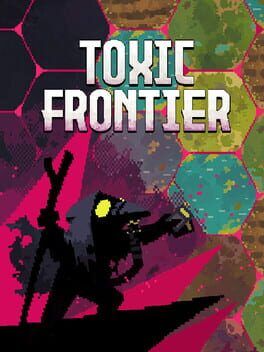

Toxic Frontier has been unveiled for PC as a card-based survival city builder built around hex-grid sludge reclamation, roguelike runs, biome threats, and Steam Deck support.
Image: IGDB
Store links: Toxic Frontier on Steam
Toxic Frontier’s reveal is selling a harsh bargain: purify the map or run out of cards
Toxic Frontier was unveiled during the PC Gaming Show Tokyo Direct 2026 as a card-based survival strategy game for PC, with Meteorbyte Studios and Mint Gate Games presenting a roguelike city builder built around reclaiming a poisoned surface one hex at a time. The concrete hook is easy to grasp and strategically mean: each run begins from a single tile, players place cards onto a traditional hex grid to purify noxious land, and survival depends on building enough score before the deck runs dry.
That structure, described in the Games Press announcement and echoed by GamingOnLinux, gives Toxic Frontier a sharper premise than its radioactive comedy first suggests. This is a Toxic Frontier city builder where expansion is not simply about covering space. Every tile appears to be an economic decision, every card a limited resource, and every biome a rules change waiting to punish a comfortable build order.
The announcement positions the game as a roguelike survival city builder rather than a conventional base-building sandbox. That distinction matters for strategy players because the fail state is already specified. According to the reveal materials, players must reach a target score on each level or “run out of cards,” ending the frontier expedition. The tension is therefore not only whether a settlement looks efficient, but whether the hand, the board state, and the score curve line up before attrition closes the run.
The sludge-reclamation hook turns city building into route planning
The most useful way to read Toxic Frontier’s reveal is as a resource-conversion game. The world is polluted, the settlers are emerging from generations underground, and progress comes from purifying the hostile surface through card placement. Games Press describes the setting as a post-nuclear hex-grid hellscape, with a community of “nuclear nomads” attempting to reclaim wilderness after stories of sunlight, grass, and non-recycled air have faded into legend.
In mechanical terms, the sludge is doing more than providing flavor. The announcement says cards placed on tiles purify the landscape, while newly uncovered tiles and cards react to surrounding tiles and previous card choices. That makes the board itself part of the deck-building puzzle. A card based city builder lives or dies on whether its cards create interesting timing problems, and Toxic Frontier’s early pitch suggests the key questions will be when to spend a card, where to place it, and whether a short-term score boost blocks a stronger synergy later.
This is the promising edge for roguelike fans. If a run starts from a single tile and expands outward, the map can become a draft in spatial form. The reveal materials do not confirm how randomization works, how many cards are in a run deck, or whether players build decks before starting an expedition. What is confirmed is that there are more than 40 unique cards to unlock and collect, according to the press release, and that tile synergies grow increasingly complex. That combination points toward a meta-progression layer without yet explaining how much control players have over their starting tools.
The city-builder label is doing unusual work here
Toxic Frontier is being described by its creators as a “card-based survival strategy game” and by GamingOnLinux as a turn-based roguelike survival city-builder. That blended label is the reason the reveal is getting attention from strategy players: it implies the game is borrowing the planning pressure of city building without promising the long, uninterrupted sprawl associated with larger management games.
The disclosed loop is smaller and more brittle. You start with one tile. You push into the wastes. You purify land with cards. You pursue a level score target. You lose if the card economy collapses first. That puts Toxic Frontier closer to a run-based optimization challenge than to a traditional city-management campaign, at least based on what Meteorbyte Studios and Mint Gate Games have shown publicly.
There is still a settlement fantasy in the premise. The player’s group is trying to “reboot civilization,” and the story asks whether the community will create a haven in the wastes or harness the corrupting power of the Toxic Frontier, according to the announcement. The practical design question is how visible that civilization-building becomes during play. The sources do not confirm population systems, housing chains, production logistics, worker assignment, or long-term infrastructure in the usual city-builder sense. For now, the confirmed city-building element is spatial growth through hex placement and card interactions, with survival pressure coming from score targets, limited cards, biome threats, and run failure.
Biomes, modes, endings, and the shape of replayability
Meteorbyte Studios and Mint Gate Games are already selling Toxic Frontier on variety. The press release says the journey will cross three distinct biomes, each with its own stories, quests, unique mechanics, and fresh ways to kill the travelling community. It also lists four game modes and two story endings, although the sources provided do not name those modes or explain the ending conditions.
For a Toxic Frontier roguelike, those numbers raise the right questions. Three biomes can support meaningful escalation if each one changes placement priorities rather than simply increasing damage or score requirements. A biome that alters adjacency value, contaminates previously safe land, or changes card draw pressure would affect the entire decision tree. The announcement only confirms that each biome has unique mechanics and threats, so any more specific reading remains expectation rather than fact.
The two-ending structure is also worth watching because the press release frames the campaign around a moral and strategic choice: build a bountiful haven or use the corrupting power of the Toxic Frontier. That could become a branching campaign layer, a risk-reward corruption economy, or a mostly narrative conclusion. The public materials do not yet settle that. What they do confirm is that the developers are presenting replayability as a core promise, supported by unlockable cards, tile synergies, multiple modes, biome mechanics, and story outcomes.
Why early PC attention is forming around the mechanics, not the sludge jokes
The reveal’s tone is knowingly grimy, with the Games Press announcement mentioning a “crunchy retro aesthetic,” “worrying slithery shapes,” rat soup, mutant chow, and radiation-poisoned frontier humor. That style may help the trailer stand out, but the reason Toxic Frontier is drawing PC strategy attention is the way its systems stack on top of one another.
GamingOnLinux highlighted the announcement for fans of turn-based roguelike survival city-builders and noted that the game was revealed at the PC Gaming Show Tokyo Direct. PC Gamer’s coverage also signals early curiosity: its headline says the writer “lost hours” to the roguelike card-based city builder, while admitting the genre combination sounds difficult to parse at first. The supplied PC Gamer excerpt does not include the body of that piece, so it should be treated as a sign of hands-on enthusiasm or editorial attention rather than a complete critical verdict.
For PC players, the more concrete platform detail is Steam Deck support. GamingOnLinux and the press materials list “Full Steam Deck support” as a feature. That is a useful promise for a turn-based card and hex-grid game, since these systems can fit portable play if interface scaling, readability, and controller navigation are handled well. The sources do not provide technical requirements, frame-rate targets, verified status, price, or release date, so anyone considering a wishlist should treat platform support as announced intent rather than a performance report.
The unanswered strategy questions will decide whether Toxic Frontier has legs
Toxic Frontier has a strong reveal because its premise makes immediate strategic sense: the land is lethal, the deck is finite, the board is reactive, and the score gate forces commitment. The danger for any card-driven city builder is that synergy can become solved too quickly if the best placements are obvious, or too opaque if the tile reactions are hard to read. The announcement’s promise of complex combos is encouraging, but the long-term health of the game will depend on information clarity as much as content volume.
The biggest unknown is the economy behind the cards. More than 40 cards to unlock and collect gives the designers room for archetypes, but the sources do not explain whether unlocks broaden the pool, upgrade existing tools, or risk diluting consistency. In roguelike strategy design, that detail can define the meta. A wider card pool can create variety, but it can also make reliable planning harder unless the game offers drafting, pruning, rerolls, or strong biome-specific incentives. None of those systems are confirmed in the provided materials.
There is also the matter of what survival means beyond losing cards. The reveal confirms noxious terrain, threats in every biome, target scores, card exhaustion, and a community crossing the wastes. It does not confirm combat, hunger, disease, individual settlers, settlement collapse conditions, or persistent casualties. That is not a criticism at announcement stage, but it is the line between a survival-themed scoring puzzler and a deeper survival city builder.
For now, Toxic Frontier is best understood as an announced PC strategy game with a clean mechanical pitch and several open design questions. If Meteorbyte Studios and Mint Gate Games can make each biome alter the card economy, keep tile synergies readable, and turn the haven-versus-corruption choice into a meaningful strategic fork, this could become one of the more interesting experiments in the growing space between roguelike deckbuilding and city planning. Until release timing, price, and deeper systems are confirmed, the practical move for strategy fans is to track future footage and store-page updates rather than assume the full shape of the run economy from the reveal alone.