
Creative Assembly is finally taking Total War into the grimdark future of Warhammer 40,000, with four launch factions, galactic‑scale campaigns, and full console support.
Total War has conquered history and fantasy. Now it is heading forty thousand years into the future. Total War: Warhammer 40,000 is not just another licensed strategy game, it is Creative Assembly’s attempt to fuse its most popular formula with one of the loudest, grimiest universes in gaming. For strategy fans, it is a big deal because of what Creative Assembly has already confirmed about factions, campaign scope, and platforms, and because it marks a dramatic tonal shift from the wild magic of Warhammer Fantasy to the industrial cruelty of 40K.
A new setting built on a proven formula
Creative Assembly spent almost a decade tuning the Total War: Warhammer trilogy into one of the most beloved strategy series on PC. Those games proved that the Total War structure could handle asymmetric fantasy factions, lurid magic and over the top unit design without collapsing under its own weight. Warhammer 40,000 is the logical but far more ambitious step. Instead of a single fantasy continent, the new game is about a galaxy in perpetual war, where every battle is backed by orbital guns and planet cracking weaponry.
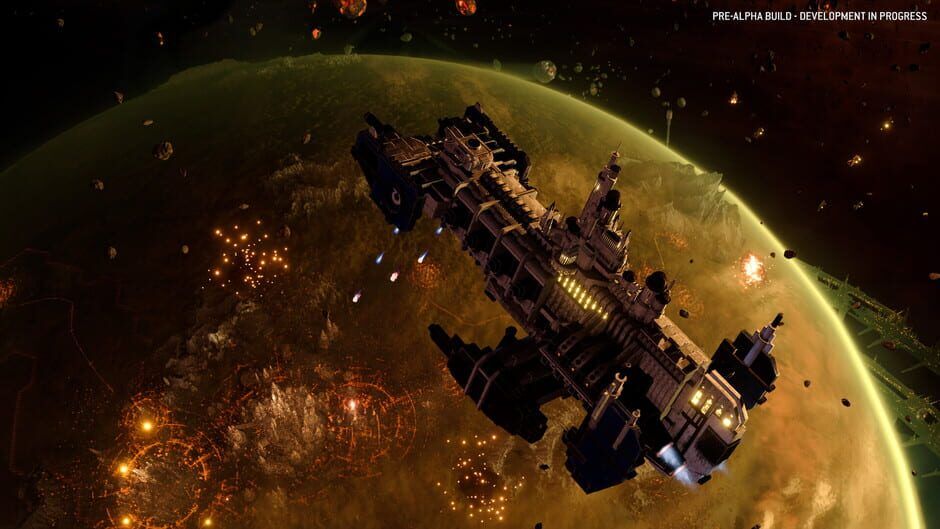
The announcement trailer, revealed at The Game Awards 2025, leans heavily into that contrast. It opens with Ultramarines trudging through ruined cities under smog choked skies, and Ork scrap mechs stomping into view, before cutting to a brief flash of in engine shots that show dense urban warzones rather than open fields. This is still Total War, with massed ranks and a sweeping camera, but the technology and tone are completely different. Tanks roll instead of steam powered artillery, dropships scream overhead instead of dragons, and radiant spell effects are replaced by tracer fire and plasma bursts.
Four launch factions that define the 40K fantasy
Creative Assembly has confirmed four playable factions at launch: Space Marines, Orks, Aeldari and Astra Militarum. If you know 40K, that list reads like a deliberate statement of intent. Instead of immediately piling in fan favourite villains like Chaos or Tyranids, the focus is on the factions that best demonstrate how Total War can stretch to cover every style of sci fi battlefield.
Space Marines are the poster faction, just as they are on tabletop. In Total War terms they are an elite, low model count army built around durable infantry, walking tanks like Dreadnoughts and heavily armed vehicles. Their campaigns are likely to revolve around surgical strikes, reclaiming key relic worlds and leveraging a few exceptionally strong stacks rather than drowning the map in bodies. Where fantasy Total War rewarded building huge numbers of cheap troops for some factions, 40K’s poster boys are about limited but terrifying forces with powerful abilities and wargear.
Orks sit on the opposite side of that spectrum. Every shot of them in the announcement materials sells weight of numbers. They pack the screen with ramshackle machines and swarms of Boyz. In campaign terms, they evoke something closer to the old Greenskins from fantasy Warhammer: momentum, aggression and a taste for constant fighting. Where a Space Marine player might carefully curate a few veteran armies, Ork players will want a rolling WAAAGH of violence that snowballs as victories pile up.
The Aeldari, meanwhile, offer the mobile, high risk high reward playstyle. Lore wise they are few in number but devastating if handled correctly. Think brittle but exceptionally fast units, psykers with battlefield shaping powers and the ability to dictate engagements through superior movement and range. Compared with the sturdy lines of Dwarfs or Empire in fantasy Total War, these are likely to feel closer to a glass cannon version of High Elves, constantly skirmishing and punishing mistakes.
Finally there is the Astra Militarum, the human Imperial Guard. They are the closest thing 40K has to a traditional army. In Total War terms they bridge the gap between history and sci fi. Expect enormous ranks of infantry supported by artillery batteries, armored columns of Leman Russ tanks and defensive doctrines that turn planets into fortress worlds. This is the faction that will probably make historical Total War players feel immediately at home, just with much bigger guns and an even worse casualty rate.
Between these four factions, Creative Assembly is covering elite, horde, skirmish and combined arms archetypes. That is a huge reason strategy fans are paying attention. The roster looks engineered to create sharp asymmetry from day one, in a way that mirrors what made the fantasy Warhammer trilogy work.
A campaign that spans entire planets
The biggest leap from fantasy to 40K is campaign scope. Warhammer Fantasy battles were fought across a single, detailed world map with regional quirks. Total War: Warhammer 40,000 stretches that concept vertically as well as horizontally. The studio’s early descriptions talk about galactic warfare where players manage not just territories but entire planets and the space around them.
Two details stand out from what CA has said so far. First, the ability to call in orbital bombardments on campaign and in battle. Second, the existence of true planet killing weapons. Instead of simply sacking a city and moving on, commanders in this game will warm up orbital guns to reduce fortified positions from orbit or, if they deem a world too corrupted or strategically costly, wipe it off the map entirely.
For strategy fans, this suggests a different rhythm to a campaign. In fantasy Total War, the ultimate tools of destruction were rare super spells or god level characters. They could devastate an army, but they could not remove an entire region from the map. In 40K, a desperate Space Marine chapter or overmatched Astra Militarum commander might choose to Exterminatus a key planet rather than let it fall to the enemy. That is an escalation in both mechanics and narrative stakes that riffs directly on decades of 40K lore.
It also raises fascinating questions about how victory conditions will work. Will factions be able to seal off whole sectors, trading short term economic loss for long term safety? Will certain storylines hinge on whether you are willing to destroy a hive world packed with billions of civilians to deny it to Orks? The fantasy Warhammer games flirted with race specific endgames and apocalyptic crises, but this new setting gives Creative Assembly tools to make those late campaign decisions feel even more permanent.
Console support and a new audience for complex strategy
Another reason this announcement matters is where the game is launching. Total War has dabbled in spin offs on console before, but the mainline series has been fiercely PC focused. Total War: Warhammer 40,000 breaks that tradition with a simultaneous release on PC, Xbox Series X|S and PlayStation 5.
That is possible because of the new Warcore engine the studio has been building for its next generation of games. The 25th anniversary showcase for Total War teased that engine specifically as a way to bring the franchise to modern consoles without gutting its simulation depth. Warhammer 40,000 is the first fantasy or sci fi Total War built fully for that platform.
For strategy fans who mostly live on console, this is a rare opportunity. The genre has historically shied away from gamepads, often offering stripped down versions of PC titles or avoiding the platforms altogether. Creative Assembly committing one of its biggest projects to console from day one signals confidence that deep, pausable real time battles and sprawling campaigns can work on a controller. It also dramatically widens the potential audience for 40K, which already has a strong console presence through shooters and action games.
If the port is successful, it could reshape expectations for future strategy releases. A Total War game that feels at home in the living room as well as at a desk would undercut the idea that complex tactics are a PC only pastime.
From wild fantasy to industrial horror
The shift from Warhammer Fantasy to Warhammer 40,000 is not only about guns replacing swords. It is about moving from baroque mythmaking to industrial scale horror. The Old World had its dark corners, but its art direction leaned on bright color, exaggerated silhouettes and carnival weirdness. 40K is a universe of brutalist cathedrals in space, rusting manufactorums and planets choked by industry.
That tonal change is already clear in the material Creative Assembly has shown. Instead of wyverns soaring over lustrous forests, the sky is polluted by orbital debris and anti air fire. Where fantasy Total War filled the screen with magical vortices and summoned daemons, the new game showcases tracer lines, muzzle flashes and the brutal impact of artillery barrages. It is the same spectacle, but grounded in machines, armor plates and trenches rather than myth.
Mechanically, this opens the door to systems that never quite fit cleanly in the fantasy trilogy. Cover and line of sight are far more important in firefights than in sword clashes, so maps can support dense urban sprawl, ruined hives and industrial labyrinths that matter tactically. Vehicle combat is not just cavalry with treads, it means managing armor facings, limited firing arcs and elevation in a more granular way.
At the same time, 40K is anything but hard science. Psykers still tear open the Warp, daemonic incursions still happen and xenos empires wield technology that looks like magic to humans. That gives Creative Assembly permission to keep the wildest spell like abilities and campaign events that made the fantasy games sing, wrapped in smoke, fire and steel instead of swirling magic.
Why this announcement hits so hard for strategy fans
Part of the excitement around Total War: Warhammer 40,000 is sheer inevitability. For years, players speculated about when Creative Assembly would bring its full weight to the 40K license. The tabletop game has always looked like a perfect fit for large scale RTS and grand strategy, and Relic’s Dawn of War series proved long ago that digital 40K could be more than just a shooter.
What makes this specific announcement stand out is how complete the pitch already feels. We know the launch factions, we know the platforms and we know the thematic pillars of the campaign. That is enough for long time Total War players to start theory crafting about how a Space Marine chapter will cope with a multi planet front, or whether an Ork player will get to seed a sector with scrap filled war worlds.
It also arrives at a moment when Warhammer 40,000 video games are in a confident place. Space Marine 2 has shown that lavish, big budget adaptations can find an audience. Smaller titles like Boltgun have reminded everyone that low fi experiments can work too. Slotting a full fat Total War game into that ecosystem signals that Games Workshop and Creative Assembly see a long future in treating 40K as a foundation for ambitious strategy design rather than just licensed spin offs.
Total War: Warhammer 40,000 does not have a release date yet, and the footage so far is more tone piece than mechanical breakdown. But what Creative Assembly has already outlined is enough to suggest a project that could redefine what Total War looks like and who it is for. If the studio can translate the chaos of a galactic war into coherent, characterful campaigns across PC and consoles, this will not just be another entry in a long running franchise. It will be the moment Total War truly leaves the Old World behind and claims the galaxy.