

Creative Assembly finally brings Warhammer 40K to Total War, with a galactic campaign map, four lore-faithful launch factions, and full console support that could transform the strategy audience overnight.
Total War is finally heading into the grim darkness of the far future. After years of wishlisting and wild speculation from both Total War and Warhammer 40K communities, Creative Assembly has officially unveiled Total War: Warhammer 40,000 at The Game Awards 2025, complete with David Harbour on stage and a cinematic of Ultramarines charging into a sea of Orks.
This is not just “Warhammer 3 but with bolters.” Creative Assembly is reshaping the classic campaign and battle formula to fit a galactic war, layering space-faring conquest over the series’ familiar turn-based strategy and real-time battles. With four launch factions confirmed and full PC and console support from day one, this might be the most ambitious Total War project yet.
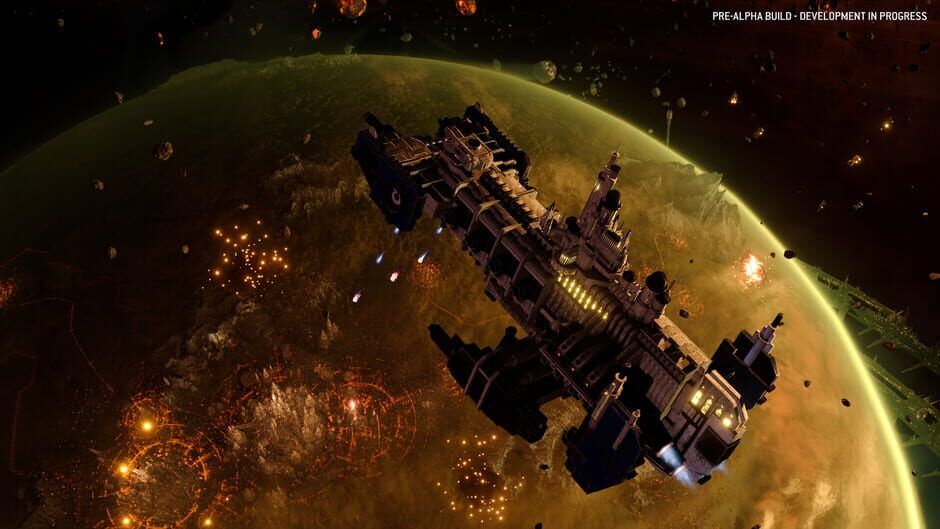
A galactic Total War campaign in the Era Indomitus
Total War: Warhammer 40,000 is set in the Era Indomitus, the current age of the tabletop setting where the galaxy has been split, the Cicatrix Maledictum yawns across the stars, and every major power is clawing for survival. Instead of marching across a single continent or mortal world, you are waging war across multiple planets stitched together into a galactic sandbox.
Creative Assembly describes a campaign that takes the traditional provincial sprawl of Total War and explodes it outward into star systems. Planetary conquest sits at the heart of the map, but now you are not just seizing cities and minor settlements. You are fighting over entire worlds, their orbital approaches and their strategic value within a war-torn sector.
You still plan your moves on a turn-based strategic layer, but those moves now include more than shifting legions across a landmass. Fleets and void routes define how your armies move from planet to planet. War is no longer a matter of simply reinforcing a frontline but of deciding which worlds are worth holding, which are acceptable losses and which may need to be burned rather than taken.
The series’ economic and political layers are being reworked to fit that scale. Traditional resource chains make way for a war economy tuned to 40K’s tone and technology. For the Imperium factions that might mean tithe worlds, forge output and conscription. For Orks it manifests as looted scrap, the size of your WAAAGH and the momentum of ceaseless fighting. Aeldari will lean on more fragile, high-value assets and webway routes, forcing you to think in surgical strikes instead of carpet occupation.
The campaign also leans into the apocalyptic extremes of 40K. Creative Assembly highlights the option to wield planet-killing or cataclysmic weapons as part of your strategic toolbox, not just scripted story beats. That escalates the classic Total War risk–reward calculus. In older games you razed a city to deny it to the enemy. Here you might annihilate an entire planet and permanently alter the shape of the campaign, trading away long-term resources for short-term survival or spiteful victory.
Ground battles reimagined for the grimdark future
Underneath the galactic maneuvering lies the real-time battle layer that defines Total War. Total War: Warhammer 40,000 shifts from cavalry charges and dragon breath to bolter fire, plasma flashes and the grinding advance of tanks, walkers and titanic war machines.
Creative Assembly is pushing battlefield destruction harder than ever. The announcement material calls out terrain that can be torn apart by artillery, air strikes and energy weapons, reshaping the map mid-battle. Trenches become craters, cover turns to slag and new lines of advance open as buildings and barricades are pulverised. That suits 40K’s arsenal, where a single barrage can gouge a city block into a smoking scar.
Armies now blend classic Total War infantry formations with elite squads and signature 40K hardware. Space Marines field small numbers of hyper-efficient units whose staying power and shock value redefine what a “front line” looks like. Astra Militarum troops pack in dense firing lines supported by tanks and artillery. Orks flood the map with green bodies, ramshackle vehicles and improvised engines of war that swamp more disciplined formations. Aeldari rely on speed, range and psychic finesse, punishing exposed units before slipping away.
Abilities further increase the spectacle and tactical depth. Instead of just spells or breath weapons, you are calling in orbital strikes, strafing runs and focused energy blasts that not only kill units but also carve out new cover or strip it away. Combined with the ability to call in reinforcements to sustain your push, battles start to resemble the layered offensives of Dawn of War, but scaled up into the hundreds of units and sweeping vistas that define Total War.
Four launch factions and how they play
Creative Assembly is starting Total War: Warhammer 40,000 with four major factions. Instead of the sprawling rosters built up over three fantasy titles, this game launches with a focused cast designed to cover the core archetypes of the 40K setting and adapt cleanly to Total War’s systems.
The poster boys are the Space Marines. On the tabletop they are elite, durable and flexible, and that vision carries over here. Campaign-side they are expected to field fewer but more powerful armies, leaning on elite veterans, customisable squads and expensive war machines instead of the swarm tactics that suit other races. On the battle map Space Marines mix rock-solid frontline units with mobility and specialised support, giving them options to answer almost any threat if you built your force correctly.
Facing them is the Astra Militarum, the Imperial Guard. They are the hammer made from uncountable human lives, lasguns, artillery batteries and battle tanks. In campaign terms they look ideal for players who love building a broad front and grinding the enemy down with overwhelming firepower and layered defences. Their weakness is individual fragility and dependence on supply lines, positioning and combined arms. If your gunlines are flanked or your armour isolated, they crumble fast.
The Orks represent the opposite philosophy. Their power comes from numbers, aggression and the logic of the WAAAGH, where war itself is a resource. On the campaign map expect mechanics that reward constant fighting, raiding and looting rather than turtling. You will likely depend on momentum more than careful empire management, with your economy growing out of whatever your Boyz can smash and strip. In battle, Orks use density and chaos to overwhelm expert but outnumbered enemies, and their junkyard war machines bring a brutal, comedic edge to the carnage.
Rounding out the launch roster are the Aeldari. They are fast, brittle and exacting. Campaign design appears to lean into delicacy and foresight rather than sheer expansion, with emphasis on protecting precious worlds or craftworld resources and striking where the enemy is weakest. On the battlefield Aeldari excel at skirmishing and positioning. They are likely to demand the most from players: mistakes are punished immediately, but a perfectly executed engagement can erase enemy units before they can react.
Across all four factions, Creative Assembly is drawing heavily from the tabletop hobby side of 40K. You can create and name your own warband, choose colours and iconography, and then back that cosmetic identity with mechanical customisation. The studio talks about shaping each faction’s combat philosophy, which sounds like a blend of doctrines, traits and wargear choices that tweak how your armies operate in both campaign and battle. For long-time 40K players, this is the digital equivalent of writing your own chapter or craftworld rules into a codex.
Why console support is such a big deal
Total War traditionally lived on PC, with a single experimental console outing decades ago that never turned into a sustained presence. Total War: Warhammer 40,000 is different. Creative Assembly and Sega are launching it on PC, PlayStation 5 and Xbox Series X|S, treating console as a first-class platform rather than a post-launch port.
For strategy fans this is huge for several reasons. First, it massively broadens the potential audience. Warhammer 40K already has a large console fanbase thanks to shooters and action games, but deep, system-heavy strategy has rarely been available in the living-room space at this scale. If Creative Assembly can translate Total War’s interface to gamepad cleanly, there is a real chance to pull in players who bounced off the complexity of PC strategy or simply prefer to play from the couch.
Second, it signals that large-scale strategy is no longer assumed to be a PC-only niche. Previous console strategy titles tended to simplify or strip back their mechanics. Total War: Warhammer 40,000 is making the opposite pitch: this is the full-fat Total War formula using the power of current consoles to push unit counts, destruction and AI without gutting the core experience.
Finally, the timing matters. The fantasy Total War: Warhammer trilogy ended on a high with Immortal Empires, but it also left Creative Assembly needing a fresh canvas. By jumping to 40K and hitting consoles from day one, the studio is not only exploring a new part of Games Workshop’s licence but also staking a claim on the next generation of mainstream strategy players.
Between the galactic campaign, apocalyptic weaponry, four distinct factions and a genuine push onto consoles, Total War: Warhammer 40,000 looks set to be more than just another spin-off. It could be the moment Total War stops being “that big PC strategy series” and becomes the default way a whole new audience experiences Warhammer 40K at war.