
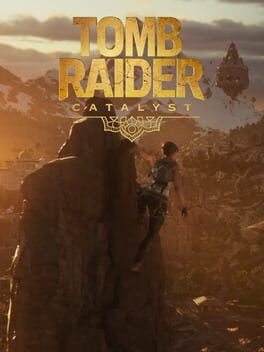
A deep dive into Tomb Raider: Legacy of Atlantis and Tomb Raider: Catalyst, and how Crystal Dynamics and Amazon are using a 1996 reimagining and a UE5 sequel to bridge classic and modern Lara across 2026–2027.
At The Game Awards 2025, Crystal Dynamics and Amazon finally laid their cards on the table for Tomb Raider. Instead of just one new game, Lara Croft is getting two pillars across 2026 and 2027: Tomb Raider: Legacy of Atlantis, a reimagining of her 1996 debut, and Tomb Raider: Catalyst, a brand new UE5-powered adventure billed as her biggest journey yet.
On paper it sounds simple, a remake followed by a sequel. In practice it looks more like a surgical rebuild of Lara’s identity, stitched across three decades of continuity and three distinct eras of design. Legacy of Atlantis aims at the nostalgia nerve, reframing Core Design’s low-poly classic for modern hardware, while Catalyst pushes into a vast new open structure and a more confident, fully formed heroine.
Taken together, they form a two-year plan to unify classic and modern Lara, reconcile the tone of the 2013 reboot with the swagger of the PS1 icon, and position Amazon and Crystal Dynamics with a cross-media ready version of the character.
Legacy of Atlantis: Rewriting 1996 for 2026
Tomb Raider: Legacy of Atlantis is not a one-to-one remaster of the original game. Crystal Dynamics is calling it a reimagining, and that word choice matters. The 1996 Tomb Raider was defined by rigid grid-based levels, puzzle-box tombs, and an isolated atmosphere where you spent as much time counting tiles as you did fighting anything that moved. It made Lara a star, but it is also a product of its time.
Legacy of Atlantis instead aims to retell that origin in a way that sits comfortably beside modern action adventures. Crystal Dynamics has spent the last decade with a far more cinematic, character-driven Lara, starting with the 2013 reboot that re-framed her as a vulnerable survivor who grows into the legend. Now the studio is tasked with bending that arc back toward something closer to the aloof, unshakable aristocrat players remember from the 90s.
Early descriptions point to a tighter, more self-contained structure than Catalyst will have. Where the remake of Tomb Raider I–III earlier this year was a largely faithful visual overhaul, Legacy of Atlantis is positioned as a story-first reconstruction. Familiar beats are returning, like the search for Atlantean relics and the rivalry with Natla, but expect reworked pacing, more developed side characters, and a clearer emotional throughline that sets up who Lara will be by the time Catalyst opens.
One of the most telling signals is the way Crystal Dynamics talks about Lara here. Rather than a frightened graduate pushed into violence, Legacy of Atlantis presents a version of Lara who is already competent and confident, but still relatively untested at the scale Catalyst will demand. She is a bridge between the hard-edged Core Design original and the more human Crystal reboot, shaped to appeal to both old fans who miss the classic tone and new players who came in with the 2013 trilogy.
Catalyst: UE5, scale, and the post-survivor Lara
If Legacy of Atlantis is about re-framing the past, Tomb Raider: Catalyst is about betting on the future. Built in Unreal Engine 5 and co-developed with Amazon Games, Catalyst is pitched as the largest Tomb Raider world yet, a full-blown next-gen showcase.
Crystal Dynamics and Amazon describe it as Lara’s most ambitious adventure so far, with a world that pushes exploration and traversal back to the forefront after the more combat-heavy turn of some recent entries. Polygon, IGN and others highlight that Catalyst is a new mainline entry, not a side story, and it is explicitly set to follow the events of Legacy of Atlantis. In other words, the remake is not just fan service, it is the story primer.
The collaboration with Amazon is noteworthy beyond simple funding. Amazon has been ramping up its publishing portfolio with games like New World and the upcoming Lord of the Rings MMO. With Tomb Raider it has a globally recognized IP and a character who already exists across films, animation, and comics. Catalyst is designed as the pillar that can support that ecosystem, and the shift to Unreal Engine 5 means Crystal Dynamics can lean on mature tools for large-scale environments, detailed character models, and advanced lighting to sell that vision.
What does that mean for actual moment-to-moment play? The early messaging points to a structure that blends the more linear, curated tombs of the classics with the hub-based exploration of the Survivor trilogy. The promise of the “largest Tomb Raider world yet” sounds less like a pure open world and more like a network of dense, interconnected regions that invite backtracking as Lara uncovers ancient mechanisms and modern conspiracies.
Crucially, Lara herself in Catalyst is not a rookie. Amazon and Crystal Dynamics describe her as fully stepped into her legend, a confident, complex adventurer who is no longer discovering whether she can survive, but deciding what kind of legacy she wants to leave behind. That version of Lara has been the missing piece since Shadow of the Tomb Raider flirted with the idea but never truly committed.
Two Lari, one continuity
Stacked back-to-back in 2026 and 2027, Legacy of Atlantis and Catalyst create something the series has never really had: a clean, intentional handoff between an origin story and a mature, globe-trotting saga.
For years, Tomb Raider has bounced between tones. The Core era made Lara a near-mythic figure, a cool and distant professional whose personality came in clipped quips and acrobatics. The Legend/Anniversary/Underworld trilogy softened her, but kept her fundamentally in control. The 2013 reboot tore that down and rebuilt her from scratch as a more grounded, emotionally vulnerable lead.
By pairing a 1996 reimagining with a UE5 sequel, Crystal Dynamics and Amazon are effectively saying that all of those versions can feed into one cohesive character. Legacy of Atlantis becomes the new “Year One” that bakes in the classic Atlantean storyline, modernizes its themes, and quietly plants the seeds for the persona we see in Catalyst.
It also gives the developers space to adjust the dial on Lara’s personality across two games. Legacy of Atlantis can chart her transition away from the wide-eyed survivor of Yamatai toward someone more sardonic and self-assured without needing to cover her entire life story. Catalyst can then assume a Lara who already wears that identity comfortably, giving the writers room to explore her relationships, rival tomb raiders, and the broader implications of her relentless pursuit of lost civilizations.
Designing for two audiences at once
The dual-release strategy across 2026 and 2027 is also a blunt acknowledgment of Tomb Raider’s split audience. On one side are players who fell in love with the tank controls, brutal trap corridors, and stark loneliness of the PS1 games. On the other are those who see Tomb Raider primarily as a cinematic action series born on Xbox 360 and PS3.
Legacy of Atlantis is clearly aimed at the first group, but not exclusively for them. By rethinking level layouts, expanding character moments, and aligning Lara’s presentation with current expectations, Crystal Dynamics is trying to make the old story legible for new players who never picked up a Saturn or PlayStation. Meanwhile, Catalyst’s vast world and Unreal Engine 5 production values are targeted squarely at modern audiences who expect big-budget, platform-defining adventures on PS5, Xbox Series X|S, and PC.
Running the two so close together is risky but smart. Legacy of Atlantis can serve as an onboarding ramp for new fans ahead of Catalyst, and the shared marketing pushes can keep Lara in the conversation for two consecutive holiday seasons. With Amazon’s reach on Xbox and PlayStation blogs, and likely synergy across Prime Video and Twitch, the intent is obvious: keep Lara culturally present long enough for this unified version of the character to stick.
The Amazon factor and cross-media ambitions
Amazon’s involvement in both projects goes beyond a logo at the end of the trailer. The company has been open about wanting franchises that work across games and streaming video, and Tomb Raider is a near-perfect candidate. There is already a Tomb Raider anime in the works and live-action adaptations never seem far behind. Having a clearly defined, modern Lara who emerges from Legacy of Atlantis and strides into Catalyst makes it much easier to craft tie-in stories that feel consistent.
On the production side, Amazon’s cloud infrastructure and publishing arm can help Crystal Dynamics target simultaneous global launches, robust online support, and potentially live updates or expansions after release. Even if Tomb Raider remains primarily a single-player experience, it lives in a market where post-launch content and ongoing community engagement are expected. A two-year plan offers a ready-made scaffold for that.
Bridging classic and modern across 2026–2027
Looking at the calendar, the strategy comes into focus. In 2026, Legacy of Atlantis aims to remind everyone why Lara Croft became an icon in the first place, but filtered through a lens that makes that story feel contemporary. In 2027, Catalyst is tasked with proving that a fully modern Lara, built in Unreal Engine 5 and backed by Amazon’s publishing muscle, can stand toe-to-toe with the biggest action-adventure games on the market.
For Crystal Dynamics, it is an opportunity to close the loop they opened in 2013. For Amazon, it is a test case for how to steward a beloved, long-running IP in an era of transmedia universes. For players, it is a promise that whether you came for the blocky swan dives of 1996 or the cinematic set pieces of 2013, there will soon be a version of Lara Croft that speaks to your memories and a future adventure that pushes her somewhere new.
If Legacy of Atlantis can honor the cramped, eerie tombs of the original while updating its design sensibilities, and Catalyst can make its enormous world feel like a place of mystery rather than a checklist, Crystal Dynamics and Amazon may finally deliver what Tomb Raider has been chasing since the reboot: a Lara who is both the legend from our past and the explorer who still has something left to discover.