

Timberborn has finally hit 1.0, bringing Factorio‑style automation, new maps, and a visual overhaul to its post‑human beaver city builder. Here’s why the full release is the ideal moment to dive in.
Timberborn has been quietly gnawing away at the city‑builder space for years, but with its 1.0 release, the lumberpunk beaver sim has finally finished its dam and opened the floodgates.
If you bounced off early access a couple of years ago, or just filed Timberborn away as "the beaver game" while you played yet another human colony sim, now is the time to come back. The 1.0 update does more than tick a version number. Automation redefines the late game, the early hours are smoother and clearer than ever, and the beaver fantasy has never felt more distinct in a crowded genre.
Automation turns late‑game Timberborn into a gentle Factorio
In early access, Timberborn’s biggest weakness showed up after your first few drought cycles. You had a gorgeous, vertically stacked colony, you had figured out your irrigation and food loops, and then the game asked you to keep babysitting the same water gates and power chains day after day. Surviving was satisfying, but it could feel like a chore.
Version 1.0 attacks that problem head‑on with automation.
The new system layers a simple but powerful logic toolkit on top of Timberborn’s existing machinery. Sensors watch water levels, contamination, and power throughput. Timers and counters let you sequence events. Logic relays tie everything together so buildings and floodgates respond to the world on their own. If you have played Factorio or shapez, the mental model will feel familiar, but here it is woven into a city builder instead of a pure factory sim.
In practical terms, this transforms how late‑game colonies work. Instead of manually sliding floodgates every time the river swells or a drought sets in, you can wire them to maintain a target level downstream. As badtides and long dry spells hit in the new maps, you can route water automatically into reserve basins, then bleed it back into irrigated districts when sensors detect low soil moisture. Power networks can spin up extra engines when demand spikes, or shed nonessential loads at night while batteries top off.
The result is not just less micromanagement, but a different flavor of play. Early Timberborn is still about basic survival and smart dam placement, but the endgame is now about designing resilient, semi‑autonomous systems. Your brain shifts from “watch every bar” to “design the circuit that keeps these bars healthy without me.” It feels like building a beaver‑run SCADA system, and it gives veteran players something crunchy to chew on long after their first stable colony.
Crucially, automation is opt‑in and incremental. You do not need to master advanced logic to enjoy 1.0. Basic setups, like a sensor‑controlled floodgate that mimics the old sluice behavior, are easy to understand, while more elaborate water routing and power grids are there for players who want to push difficulty and city size.
Leaving early access actually reshapes the experience for new players
A lot of 1.0 launches in the city‑builder space quietly ship a “version number plus a couple of scenarios” and call it a day. Timberborn’s exit from early access feels more like a ground‑up pass on how the whole game flows, especially in the first ten hours.
The tutorial has been reworked to introduce its core systems with more clarity and less text‑dumping. Early access builds could frontload players with icons and meters before they truly understood why water behaves the way it does. Now, the game walks you more deliberately from “beavers need drinking water” to “rivers can be stored, redirected, and elevated” without losing you in the details. The learning curve into drought management feels less like hitting a wall and more like climbing a ramp.
New and reworked maps support that smoother onboarding. Early maps showcase simple river layouts and predictable drought lengths, giving you room to learn the rhythm of wet seasons and dry spells. Later maps introduce nastier geography, more extreme badtides, and interactive world objects like aquifers, water seeps, and geothermal fields that reshuffle how you think about placement. Timberborn’s iconic verticality benefits too, as terrain and new objects encourage building up and into cliffs, not just along riverbanks.
Visuals have been polished across the board. Water reads more clearly, lighting sells the passage of time and season, and the animations do a better job of conveying what your buildings actually do. It is not about raw graphical fidelity so much as readability. When you can glance at your colony and immediately understand which districts are stressed and which systems are humming, you spend less time clicking menus and more time planning expansions.
For someone arriving fresh at 1.0, Timberborn feels like a complete, confident game rather than a promising prototype. The friction points that used to send new players to wikis or YouTube are sanded down, and the step from early game subsistence to big‑picture engineering is smoother and more intentional.
The beaver‑city angle still matters in a packed strategy market
The last few years have been absurdly good for city builders and colony sims. Frostpunk 2 is looming, Anno‑likes are everywhere, and Steam is full of clever indie management games. On paper, “post‑apocalyptic beavers build dams” sounds like a gimmick designed just to stand out on a store page.
In practice, Timberborn’s beaver‑city angle still earns its place because it is baked deep into the systems.
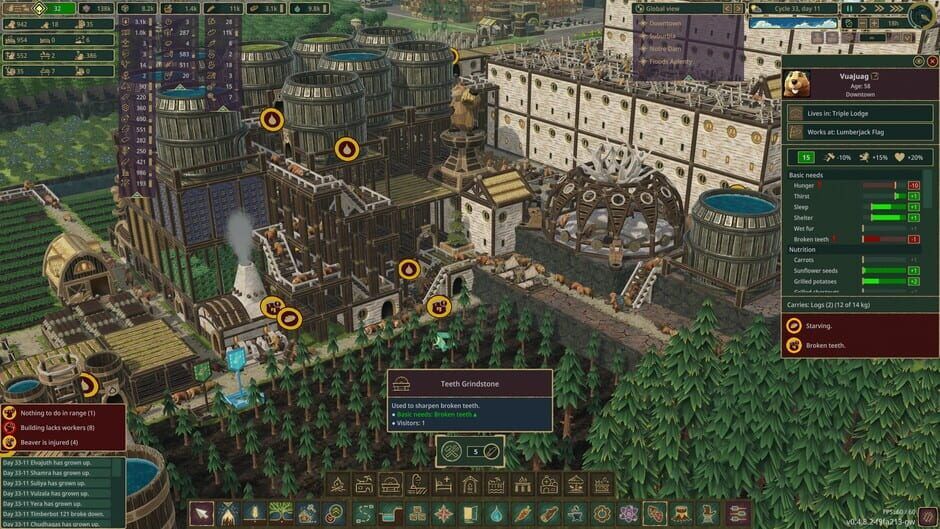
Water is not just another resource, it is the central actor in every story you tell. Because you are a species that lives in and around rivers, controlling water levels, redirecting flow, and stacking structures vertically is both thematically and mechanically coherent. Your city is not a flat grid of streets, it is a layered maze of platforms, lodges hanging off cliff faces, terraced farms, and multi‑story industrial blocks that feed off shared power shafts.
The factions lean into that identity instead of dodging it. The nature‑bent Folktails and the more industrial Iron Teeth approach growth, resource extraction, and automation differently, giving you distinct playstyles that still revolve around beaver needs and behavior. You are not just humans in fursuits managing generic “citizens.” You are adapting a species that can swim, gnaw through trees, and reshape its world through dams.
Mechanistry has also doubled down on post‑human environmental storytelling. New map objects and the broader visual overhaul make the ruin of the old world feel more present, but it is not a grim, ashen wasteland. Cracked highways, buried machinery, and strange post‑apocalyptic artifacts sit alongside thriving forests and shimmering reservoirs. It sells the idea that beavers are not just surviving humanity’s mess, they are inheriting and repurposing it.
In a genre where many games still default to faux‑European human cities and familiar tech trees, Timberborn’s mix of lumberpunk aesthetics, chunky wooden machinery, and beaver‑centric design reads as genuinely fresh rather than a meme.
Why now is the moment to start your first colony
Put all of this together and Timberborn 1.0 feels like a sweet spot that is hard to time in live‑service‑adjacent genres.
If you jump into many early access city builders, you are signing up for half‑finished tech trees, balance swings, and save‑breaking updates. If you wait too long, you sometimes arrive after the core community has moved on and the discourse has cooled. Timberborn is in that rare place where the game is feature‑complete, deeply tested by years of early access, and freshly energized by a major systems addition.
For new players, that means the best possible onboarding: a polished tutorial, a stable feature set, and a wealth of community knowledge, maps, and guides if you decide to dig deeper. You can learn the basics of drought survival and vertical construction on approachable maps, then organically graduate into automation once your colonies are big enough to need it.
For returning players, 1.0 is almost a soft sequel layered on top of what you know. Your old instincts about where to place dams and when to expand districts still apply, but automation, new world objects, and the visual refresh give you plenty of reasons to rethink your favorite maps. Late‑game megaprojects, from self‑regulating water basins to fully automated industrial districts, finally feel like a core part of the experience rather than a self‑imposed challenge.
Timberborn has always had a strong hook: survival city building powered by dams, droughts, and vertical lumberpunk machinery. With version 1.0, it now has the systemic depth, late‑game automation, and refined onboarding to match that pitch.
If you have ever wanted a colony sim where the endgame is not just “more of the same, but bigger,” and you like the idea of a gentle Factorio‑flavored city builder starring extremely hardworking beavers, there has never been a better time to start gnawing your way into Timberborn.