
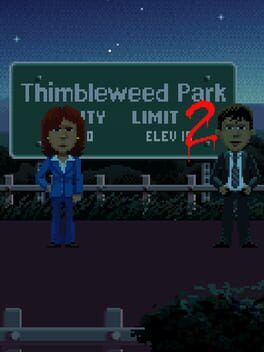
Ron Gilbert has started production on Thimbleweed Park 2 for an early 2028 release, backed by an anonymous private investor instead of Kickstarter or a traditional publisher.
Image: IGDB
Store links: Thimbleweed Park 2 on Steam
Thimbleweed Park 2 is real, and its backer is the story
Ron Gilbert has confirmed that production has started on Thimbleweed Park 2, with the game due in early 2028 and self-published with help from a private investor. The announcement came through Gilbert’s Grumpy Gamer blog, where he also confirmed that several members of the original Thimbleweed Park team are returning, including Mark Ferrari, Gary Winnick, David Fox, Octavi Navarro, Robert Megone, and composer Steve Kirk.
That alone would be enough to make Thimbleweed Park 2 one of the more closely watched point and click adventure projects on the calendar. The sharper turn is how it is being made. According to reporting by Bloomberg, later summarized by Kotaku and Nintendo Life, the sequel is being funded by an anonymous wealthy individual outside the games industry who is a major fan of adventure games and Thimbleweed Park specifically. Gilbert told Bloomberg that a friend connected him with the investor after he had ruled out both Kickstarter and traditional publisher offers.
For a genre built on locked doors, strange inventories, suspicious locals, and delayed payoffs, the production setup has its own mystery-room tension. A Monkey Island creator is returning to the format that made his name, but the path back is neither nostalgia crowdfunding nor the familiar publisher model. It is closer to patronage: one fan with enough money to let Terrible Toybox build the game on terms Gilbert considers fair.
Gilbert is avoiding the usual sequel machinery
The original Thimbleweed Park was crowdfunded in 2014, with Kotaku reporting that Gilbert and Terrible Toybox raised more than $600,000 on Kickstarter. Nintendo Life puts the figure at more than $620,000. The game launched in 2017 as a retro-inspired graphic adventure in the LucasArts tradition, the same lineage that ties Gilbert to Maniac Mansion and Monkey Island. Kotaku also reported that Thimbleweed Park has apparently sold more than 300,000 copies.
For Thimbleweed Park 2, Gilbert chose a different route. Kotaku, citing Bloomberg’s interview, reported that he did not want to return to Kickstarter. Nintendo Life adds that he had interest from traditional publishers but rejected those options as well. Gilbert’s explanation to Bloomberg is the key business detail behind this Ron Gilbert new game: “I don’t mind the publisher earning back their money. It’s just that once they have earned back their money and become whole, they still want the majority of the money. Or there are really goofy terms, like you don’t make anything unless it’s a major hit. I always felt that was unfair.”
That quote cuts through the romance of the announcement. Thimbleweed Park 2 is not happening because the adventure genre suddenly became easy to finance. It is happening because Gilbert found a way around deals he viewed as unfavorable. Nintendo Life reports that he proposed a budget for roughly two years of development, above the more than $1 million required for the original, with inflation and fair pay for the team in mind. The investor agreed. Gilbert told Bloomberg, according to Nintendo Life, that “this deal is a lot more fair in that he gets whole very quickly, and then it’s a reasonable split.”
A sequel to a game built like a locked-room joke
The creative hook is also unusually loaded. Thimbleweed Park was sold on the appeal of classic point and click adventure design: verbal sparring, layered puzzles, an eerie small-town murder setup, and the peculiar rhythm of wandering between leads until the right absurd object finds the right absurd use. PC Gamer described the 2017 game as a LucasArts-style point-and-click adventure about a murder in a small town, led by LucasArts veteran Gilbert.
Gilbert has not laid out the plot for Thimbleweed Park 2 in the provided announcements. On his blog, the most revealing exchange came in the comments, when a reader said they could not imagine how a sequel would work given the first game’s ending. Gilbert replied, “That’s half the fun!” That is a tease, not a synopsis, and it should be treated as such. PC Gamer’s headline on the announcement described Thimbleweed Park 2 as “not really a sequel, not really a prequel,” but the supplied source material does not include a fuller explanation of that phrasing.
For players who come to adventure games for clean canon answers, that uncertainty is the point to watch. Gilbert’s best-known work often treats structure as part of the joke, asking players to think about the machinery behind a scene while still enjoying the scene itself. The risk for a Thimbleweed Park sequel is obvious: a follow-up must return to a town and tone that already played with expectations without simply repeating the trick. The opportunity is just as clear. A mystery adventure can build suspense without combat, using pacing, clue placement, character switches, and comic timing as its set-piece design.
The returning team gives the project continuity, not a guarantee
Gilbert’s announcement names a significant group of returning contributors from the original Thimbleweed Park. Mark Ferrari, Gary Winnick, David Fox, Octavi Navarro, Robert Megone, and others are listed as coming back, while Steve Kirk is confirmed as composer. David Fox also appeared in the Grumpy Gamer comments to say he was excited to be working on the game and with the team again.
That continuity matters because point and click adventures rely heavily on authored texture. The puzzle chain is only one layer. The mood of a room, the weight of a background gag, the timing of a line read, and the way music nudges a scene from creepy to comic all shape whether the player feels clever or merely stuck. In action terms, Thimbleweed Park’s “combat rhythm” is the back-and-forth between observation and deduction. A sequel needs that cadence to land early, then keep changing the angle before the player settles into autopilot.
Still, a returning roster does not answer the design questions. Gilbert has confirmed production has started, not that the game is near release. An early 2028 target gives the team a long runway, but it also means systems, story, platform certification, localization, and release plans can shift. The announced funding deal may protect the game from publisher milestones that bend a project toward market demands, but it does not remove the usual adventure-game problems: puzzle readability, pacing, scope control, and making a retro form feel deliberate rather than museum-bound.
Platforms are clearer than the Steam page initially suggests
Gilbert’s blog post points readers to wishlist Thimbleweed Park 2 on Steam, and the Steam listing is live at the URL he provided. He also added platform clarifications directly in the same announcement. According to Gilbert, Steam did not show it yet at the time of the post, but the game will support Mac, Windows, and Linux. He also confirmed a GOG version and a Switch version.
That last point is worth stating carefully because one source shows the hazards of early platform reporting. Nintendo Life initially wrote that Thimbleweed Park 2 had not been confirmed for Switch or Switch 2, then corrected itself to note that Gilbert’s Grumpy Gamer post had confirmed Switch. Based on the provided material, Switch is confirmed by Gilbert, while Switch 2 is not confirmed. There is also no supported information here about PlayStation, Xbox, mobile versions, price, physical editions, save transfers, or performance targets.
For practical purposes, players can wishlist on Steam now and expect the PC ecosystem to include Windows, Mac, and Linux, with GOG and Switch planned. Anyone waiting on Switch 2, other consoles, or mobile should treat those as unannounced until Terrible Toybox says otherwise. The current release window is early 2028, which is a target from Gilbert’s announcement rather than a locked launch date.
The fan funding model raises useful questions for adventure players
The anonymous investor angle is easy to frame as a charming oddity, but it also exposes the squeeze around modern adventure games. The genre has a loyal audience, a long memory, and a proven ability to punch above its budget when the writing and puzzle craft are strong. It rarely commands blockbuster financing. Crowdfunding can validate demand, but it also turns development into a public obligation machine. Publisher money can stabilize production, but Gilbert’s Bloomberg comments describe terms he found increasingly poor.
A private fan investor solves some problems and creates questions of its own. The reported upside is straightforward: Gilbert says the deal lets the investor recoup quickly and then move into a reasonable split, while Terrible Toybox self-publishes. The investor is also described by Nintendo Life, citing Bloomberg, as someone outside the games industry who requested anonymity and wanted to fund the game as a fan of adventure games and Thimbleweed Park. The unanswered parts are also important. The sources do not name the investor, disclose the exact budget, publish the contract terms, or explain what creative influence, if any, the investor has.
For fans of classic point and click games, the most encouraging confirmed fact is that Thimbleweed Park 2 is in production with key original talent and a release target. The most consequential business fact is that it is being made outside the usual publisher and Kickstarter lanes because one fan-funded deal cleared a path Gilbert was willing to take. If the game reaches early 2028 in strong shape, the sequel will be watched not only as a return to Thimbleweed Park’s strange little stage, but as a case study in how veteran-led adventure games can still get made when the standard doors stay locked.