
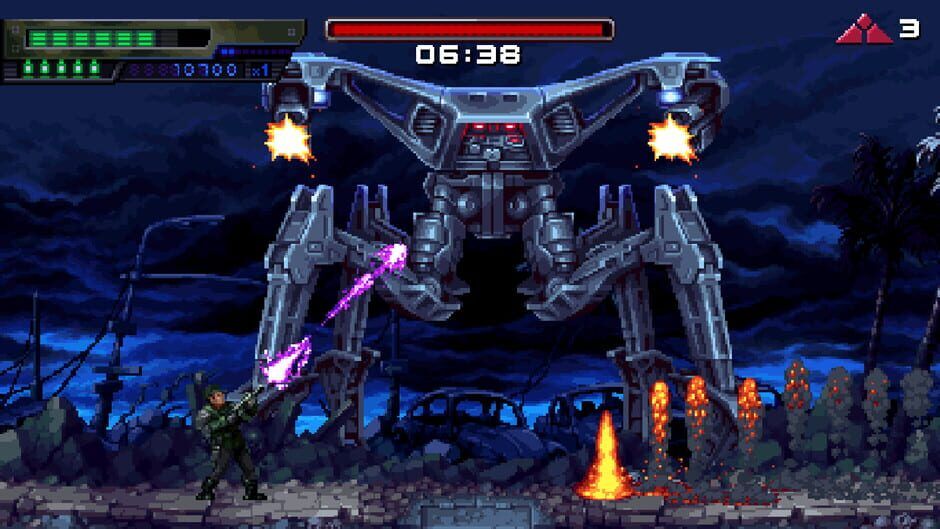

Follow-up impressions of Terminator 2D: No Fate on consoles, covering feature parity with PC, performance across living-room systems, and how the arcade-style action holds up on gamepad and in couch co-op.
Now that Terminator 2D: No Fate has marched onto Xbox, PlayStation, and Switch, it feels less like a cult PC curio and more like the living-room throwback it always wanted to be. Bitmap Bureau’s pixel-art spin on Judgment Day was already a sharp, short-burst arcade shooter on PC. On consoles, the big questions are simple: does it keep feature parity, does it run smoothly, and does it actually feel good to blast through the apocalypse with a controller and a co-op buddy?
Feature parity with PC
If you played No Fate on PC at launch, you are not missing anything by shifting to console. The full campaign structure carries over, from the early canal chase and Cyberdyne raid through to the expanded future-war material. The mix of film recreations and original side stories is intact, as are the multiple routes and alternate endings that let you bend the “no fate but what we make” slogan into different outcomes.
Character selection is also unchanged. You still swap between Sarah, the reprogrammed T-800, and a battle-hardened John Connor depending on the mission setup. Each keeps their familiar weapon loadouts and movement profiles, so Sarah’s more grounded, desperate firefights feel different to the T-800’s heavier, stomping approach or John’s resistance-flavored skirmishes.
Progression systems, difficulty options, and the arcade-style stage select all mirror the PC version. The score-chasing hooks that made short runs appealing on mouse and keyboard remain present, and nothing significant has been cut or reshuffled to fit into console storefront slots.
If there is a distinction between platforms, it is largely in quality-of-life rather than content. PC still benefits from higher-end options like ultrawide and very granular visual toggles. Console menus streamline those choices down to a few presentation presets, but the underlying game logic and level layout are the same.
Performance on Xbox, PlayStation, and Switch
No Fate is not a technical showpiece, but it is the sort of 2D action game where even minor stutters quickly feel like enemies. On the more powerful consoles, the adaptation avoids that pitfall. On PlayStation 5 and Xbox Series X, the frame rate targets a consistent 60 frames per second and sticks to it through the bulk of the campaign. The chunky explosions and busy resistance shootouts fill the screen with sprites and particles without introducing hitching.
Series S and PlayStation 4 hold up surprisingly well given their older hardware. Visual differences are modest: slightly softer image clarity and fewer subtle post-processing touches, but the key point is that the action stays responsive. Even in set pieces with multiple vehicles, turrets, and large bosses sharing the screen, controls remain tight. The rare drops tend to crop up when the camera is panning across multiple parallax layers at once, and even then it is more of a brief wobble than a sustained slowdown.
Switch, as usual, is where the trade-offs are more visible. In docked mode, the game still aims for smooth animation, but hectic firefights have a higher chance of dipping just under the ideal frame time, particularly in co-op. In handheld play the visuals hold up thanks to the small screen and the bold pixel art, but bursts of slowdown during screen-filling explosions are more noticeable. It does not break the game, but if you are sensitive to stutter, the hybrid system is the platform where you are most likely to feel it.
Overall, though, Terminator 2D is technically well suited to consoles. Bitmap Bureau’s retro roots show in a solid engine that keeps input latency low and enemies predictable, which lets you learn patterns and route stages without fighting your hardware.
Gamepad controls and feel
Translating No Fate’s brisk arcade pacing to gamepad was always going to be crucial. The developers have leaned into a console-native layout rather than simply mapping keyboard inputs to buttons, and it pays off almost immediately.
Movement sits on the left stick with aiming on the right, which gives a modern twin-stick shooter feel even though the level design sticks to a side-scrolling plane. Firing, secondary weapons, dodges, and context actions occupy the shoulders and face buttons, and there is a generous aim assist that subtly nudges your reticle toward priority targets without removing control.
The analog sticks’ resistance does slightly blunt the razor-fast turns you could pull off with a mouse, but the game’s encounter design already favored deliberate aggression over twitch-perfect micro-adjustments. Once you get used to flowing between running, short hops, and snap-aiming with the right stick, the console version feels built for a pad rather than compromised by it.
The one area that takes some adjustment is vertical precision. Aiming up or down ladders and staircases with a thumbstick is less immediate than flicking a mouse, and it can be easy to overshoot enemies on overhead platforms in the busiest firefights. There are sensitivity sliders, and taking a minute to tweak them goes a long way toward making the controls feel natural.
On modern controllers, haptics make a small but welcome difference. Fire bursts from rifles and heavier weapons give distinct feedback, and getting clipped by a T-1000 strike has a heavier thud. It is not a transformational feature, but it does reinforce the sense that this is a console-first build and not a straight PC transplant.
Couch co-op in the living room
No Fate’s co-op feels tailor-made for consoles. Local multiplayer lets a second player drop in and out from the same system, with the camera prioritizing keeping both characters in view rather than tethering them too tightly. On a big television this keeps firefights readable, though it can still get chaotic when the action pushes both players to opposite sides of a large arena.
The core co-op loop is simple but effective. One player might draw aggro from heavier machines while the other clears out smaller drones, or you split objectives during more open missions so that one character handles switches while the other covers them. The missions were already compact on PC, but on console they become ideal “one more run” sessions for two players who want to carve through familiar film scenes together.
The biggest practical test for couch co-op is input clarity. On older displays with input lag or in setups where audio and video sync is slightly off, 2D shooters can feel mushy. Here, the tight base engine and responsive pad layout mostly sidestep that problem. Provided your TV is set to a low-latency mode, co-op feels just as responsive as solo play.
Online functionality is not the focus, and if you were hoping for elaborate matchmaking or cross-play, the console ports do not bolt that on. This is a local-first co-op game that wants you and a friend on the same sofa, arguing about who gets the rocket launcher on the Cyberdyne roof.
Verdict: a natural fit for consoles, with caveats
Taken as a follow-up to the PC version, Terminator 2D: No Fate on consoles is reassuringly straightforward. The content is all here, the performance is strong on most living-room systems, and the gamepad controls are tuned well enough that the conversion sometimes feels like the primary way to play. Couch co-op pushes the whole package closer to the spirit of the arcade tie-ins the game is riffing on.
The remaining rough edges are mostly platform-specific. Switch players will need to live with occasional performance dips, and anyone chasing perfect vertical precision may still prefer a mouse for top-tier score chasing. But for most players, grabbing a pad and tearing through this reinterpretation of Judgment Day from the sofa feels exactly right for what No Fate is trying to be.
If you bounced off the PC version because it felt a little clinical on a monitor, the console ports might be the excuse you needed to revisit it under dimmed lights and a loud soundbar. For a game about rewriting destiny, this is a pretty fitting second shot.