
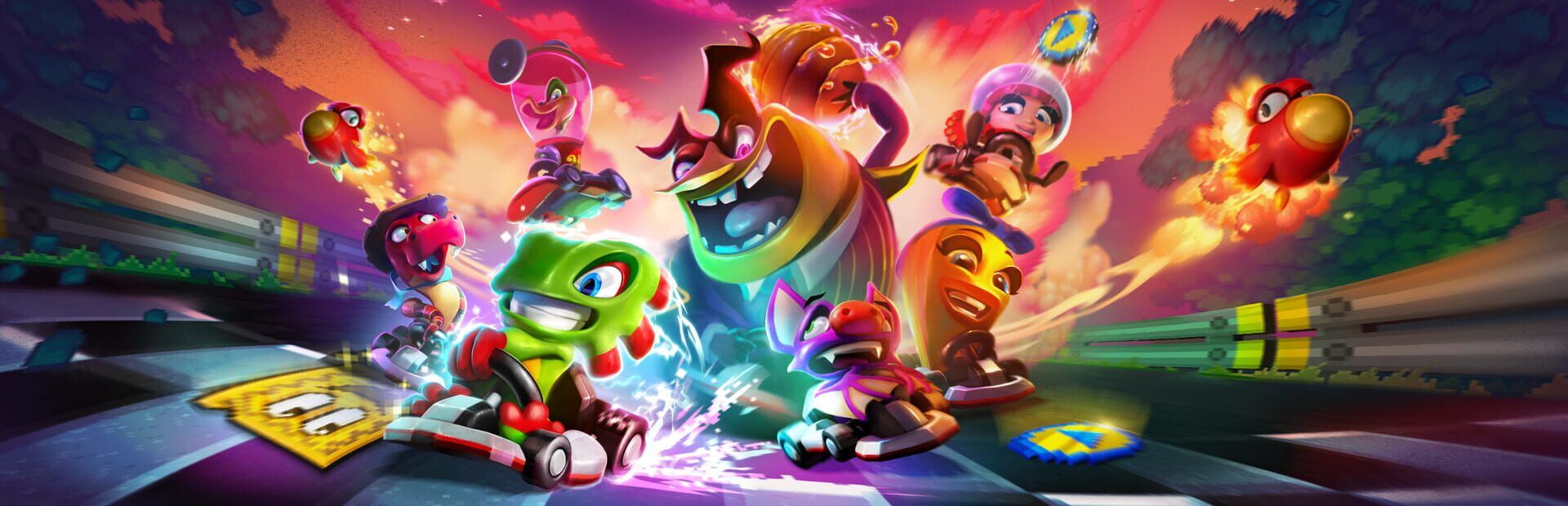

How Super Yooka-Laylee Kart channels Diddy Kong Racing’s spirit, leans into a retro pixel look, and fights to matter in a crowded kart-racer market.
Super Yooka-Laylee Kart is not Playtonic’s first nostalgia play, but it might be the studio’s clearest statement of intent yet. Instead of simply riffing on N64-era platformers, the team that helped shape Diddy Kong Racing is now taking another run at karting, with a racer that wears its retro roots proudly while quietly chasing modern competitive depth.
At a glance, it looks like a lost 16-bit kart game that somehow escaped onto modern hardware. The pixel-art presentation is chunky and saturated, the karts are exaggerated boxes on wheels, and the tracks pop with color and parallax. Beneath that throwback veneer though, Playtonic keeps talking about mastery, “tactical rivalries,” and “revenge-fuelled comebacks,” signaling something that wants to sit closer to a fighting game in mentality than a party racer.
A deliberate retro karting direction
The decision to go pixel-based rather than chase the plasticky CG sheen of Mario Kart 8 or Crash Team Racing is doing several things at once. Artistically, it gives Super Yooka-Laylee Kart a strong identity. It reads instantly in screenshots and trailers, but more importantly, the simplified art helps clarity in motion. Items, hazards, and rival karts are all readable at a glance, even when the screen is crowded in 8-player split-screen.
The retro look also matches the mechanical pitch. Playtonic describes this as an arcade racer built around high-skill driving. There is less of the heavy rubber-banding and autopilot feel that dominates the genre. Lines matter, boost timing matters, and learning each track’s quirks is meant to feel like labbing a stage in a fighting game rather than just following a minimap. That pairing of old-school visuals and demanding handling helps the game feel like a love letter to an era when you could spend months just getting good at a single kart racer.
Diddy Kong Racing’s fingerprints
Playtonic is not shy about the Diddy Kong Racing connection, and it should not be. Veterans like designer Martin Wakeley and artist Kevin Bayliss are on the project, and you can feel that DNA in how Super Yooka-Laylee Kart positions itself.
Where Mario Kart is almost purely about short, repeatable races, Diddy Kong Racing framed its karting around an adventure. You explored a hub, unlocked new areas, tackled boss races, and replayed tracks with extra conditions. Super Yooka-Laylee Kart is not a one-to-one revival of that structure, but its focus on a “deep” story campaign and rival-driven progression clearly echoes the older Rare classic.
You can see the influence most clearly in how the game talks about rivalries and comeback mechanics. Diddy Kong Racing always felt a little nastier than Mario Kart, with tighter tracks and more direct item play. Super Yooka-Laylee Kart pushes this further with a Rage system that builds as you take hits and slip in the pack. Cashing out that meter lets you fire off powerful revenge options that can swing a race back in your favor if used smartly. It is less about random lightning bolts from the sky and more about managing a resource you have earned through racing.
At the same time, Playtonic is careful about expectations. They have mentioned that they are not simply recreating Diddy Kong Racing’s Adventure Mode beat for beat. There is no promise of a hub world where you fly between islands or hop into hovercrafts, at least not yet. Instead, the old Rare talent is being funneled into pacing, track variety, and the feeling that the campaign is a journey rather than a long menu.
Story campaign ambitions
Most kart racers, even beloved ones, treat single-player as an elongated tutorial for multiplayer. Super Yooka-Laylee Kart is trying to go further. Playtonic keeps describing its campaign as “deep,” and the feature set suggests something closer to a proper story mode than a simple Grand Prix ladder.
The campaign is built around rival races, escalating challenges, and a sense of character. Yooka, Laylee, and familiar faces from the platformers are back in playable and rival roles. The idea is that you are not just chewing through cups, you are developing grudges against specific drivers, learning their behaviors, and then leaning on the Rage and item systems to get your own back. That kind of personality-driven structure is rare in the genre, outside of Diddy Kong Racing and a handful of budget experiments.
On top of that, Playtonic is promising variety in objectives. Time trials, special challenge events, and bespoke conditions should break up the standard three-lap routine. Combined with a track roster that riffs on locations from the Yooka-Laylee series and other Playtonic-adjacent properties, there is potential here for a campaign that feels like a tour of the studio’s history as much as a racing ladder.
If the team can back that up with meaningful difficulty scaling and unlocks that reward skillful play, Super Yooka-Laylee Kart’s solo offering could be what finally convinces more competitive-minded players to take it seriously and not just treat it as another party game to break out for a night and forget.
Karting as a fighting game
One of the more intriguing soundbites out of early previews is Playtonic saying they want the game to feel like a fighting game. That is not about fireballs so much as it is about interaction and expression. In a traditional kart racer, you mostly race the track and endure items. In Super Yooka-Laylee Kart, the goal is to have constant push and pull between players.
The Rage mechanic is one layer of this. Getting pelted by rockets or slammed off the line is not just frustrating, it is fueling your eventual counterplay. Choosing when to cash in that meter turns every item exchange into a small mind game. Do you blow it early to secure a mid-race overtake, or hold it for the final corner when everyone expects a clean finish?
Advanced movement techniques are another. Preview impressions talk about tight handling, meaningful drifting, and movement tech that separates casual driving from high-level play. The best kart racers always have this hidden depth, but Super Yooka-Laylee Kart is foregrounding it in the marketing. The message is clear: this is a game you can grind, experiment with, and eventually use to express your own style.
Standing out in a crowded kart-racer market
The kart space is busy. Mario Kart 8 Deluxe continues to dominate, Crash Team Racing had its resurgence, and a stream of licensed racers come and go every year. Super Yooka-Laylee Kart cannot hope to out-budget Nintendo, so it is attacking from the edges.
Aesthetic identity is its first weapon. The pixel-art approach immediately distinguishes it from glossy mainline competitors. It evokes memories of Mode 7 racers and late 16-bit experiments, but with the screen density and effects of a modern PC game. It also runs up to 8-player split-screen, a feature that is rare enough in 2026 to be a selling point on its own for couch multiplayer fans.
The second advantage is structure. Many kart racers live and die on their multiplayer lobbies. Playtonic is clearly aware of this, with online support and plans for beta tests focused on network play. Yet it is the promise of a meaty story campaign, rival races, and customizable tournaments that gives the game a shot at longevity, even if online populations ebb and flow.
Finally, there is the systems-first mentality. By leaning into skill-based driving, Rage management, and highly configurable rulesets, Super Yooka-Laylee Kart invites communities to form mini-metas. Groups of friends can tune item frequency, race formats, and tournament rules until they feel right. That flexibility helps it appeal to both people who want chaotic Friday-night sessions and those who want to quietly grind time trials.
The nostalgia play that might actually have teeth
Playtonic has made its name selling specific kinds of nostalgia. Super Yooka-Laylee Kart could have been a safe, colorful spinoff that rode on that goodwill and little else. Instead, the studio is pitching something sharper: a retro-styled racer that borrows the adventure-minded spirit of Diddy Kong Racing, wraps it in a meaningful story campaign, and introduces modern systems that reward rivalries and comebacks.
If the handling feels as good as early previews suggest, and if the campaign delivers on its promise of depth rather than padding, this could be the rare kart racer that matters even in a world where Mario Kart 8 is still on every shelf. For now, Super Yooka-Laylee Kart looks like a thoughtful blend of old and new, and a welcome return to a kind of racing game that has been missing for a long time.