
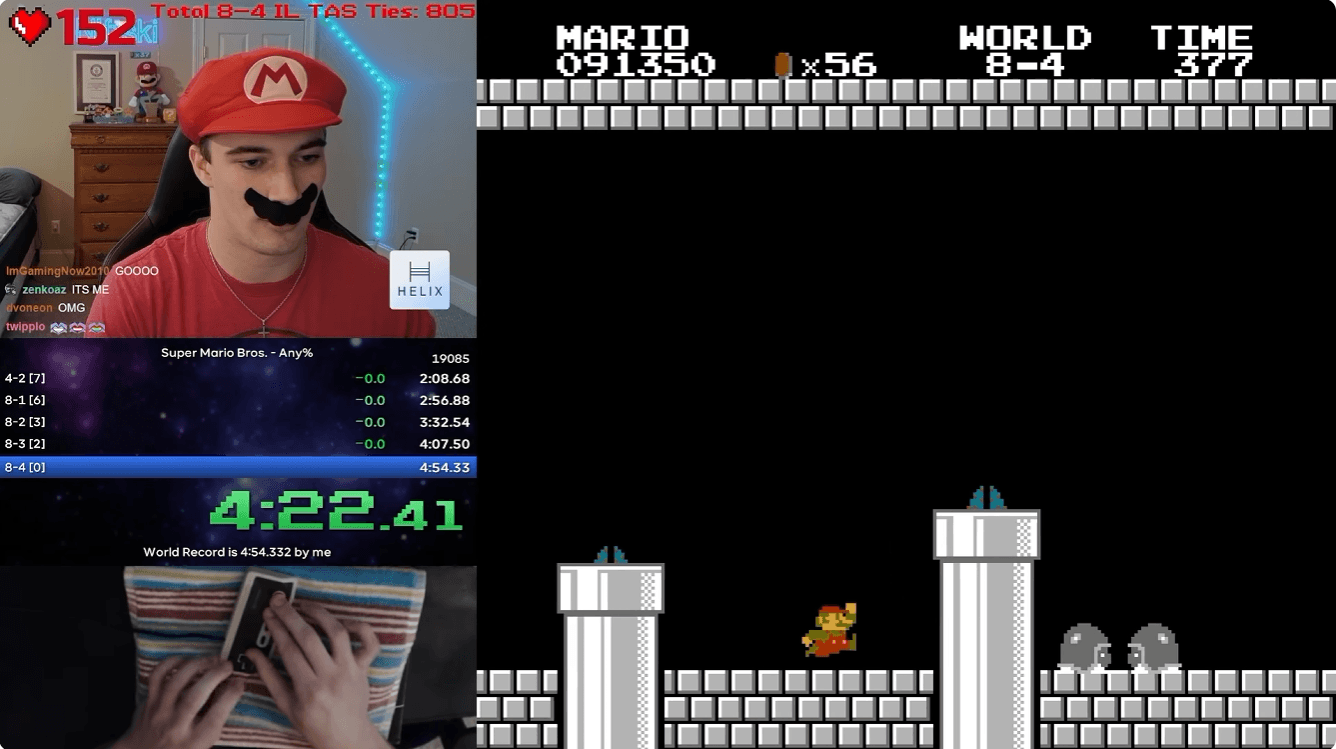

Niftski set a new Super Mario Bros. any% world record of 4:54.299 while dressed as Mario, bringing the run within two frames of a rules-compatible TAS benchmark.
Image: 7mmo.com
A 4:54.299 run in a costume, and a two-frame problem
Niftski set a new Super Mario Bros. any% world record on Halloween, finishing Nintendo’s 1985 platformer in 4:54.299 while dressed as Mario and performing the character’s voice on stream. Kotaku and Dexerto both report the final time as 4 minutes, 54 seconds, and 299 milliseconds, improving on Niftski’s August 2026 record of 4:54.332 by 33 milliseconds.
That number is the center of the story because it leaves the Super Mario Bros speedrun frighteningly close to a boundary the community has been chasing for years. In a post shared after the run, Niftski wrote that “only 2 frames (33 milliseconds)” separate the new record from “absolute perfection / TAS tie,” naming 4:54.265 as the next target.
There is a small source conflict worth spelling out. IGN’s article correctly embeds Niftski’s post showing 4:54.299, but later states that the record moved from 4:54.332 to 4:54.229, which appears inconsistent with Niftski’s own post and with Kotaku, Dexerto, and Digg’s aggregation. IGN also describes the gap as “two milliseconds” in one passage, while Niftski, Kotaku, Dexerto, and Digg frame the gap as two frames, or 33 milliseconds. For this piece, the confirmed figure supported across the strongest supplied sources is 4:54.299, with a two-frame gap to 4:54.265.
The joke that made the precision visible
The run began with the texture of a Halloween stream rather than the atmosphere of a record attempt. Kotaku reports that Niftski opened the stream in costume, eventually leaning into a Mario voice during a broadcast that ran around five hours. Moments before the record, he said, “Hopefully I don’t get this today because that would be very stupid.” The absurdity landed because he immediately did the very thing he said would be stupid.
After the final Bowser fight and the rescue of the Princess, the celebration was tangled up with the bit. Kotaku quotes Niftski shouting, “IT’S MARIO!” and “WHAT IN THE WORLD I CANNOT BREAK CHARACTER!” while reacting to the record. IGN reports that he later credited the goofiness with changing the feel of the attempt: “It made me not nervous at all,” he said. “It doesn’t even feel real. It felt so casual.”
That casualness is part of why the Halloween speedrun traveled outside the usual speedrunning audience. A world-record Super Mario Bros. run is normally a study in invisible inputs, frame windows, and tiny route optimizations. This one had the same technical density, but it arrived wrapped in an instantly readable image: the best-known Mario speedrunner on Earth dressed as Mario, doing a shaky character voice, and somehow playing at the edge of human possibility.
Two frames is tiny until Super Mario Bros. explains itself
Dexerto identifies the relevant theoretical target as 4:54.265, a tool-assisted speedrun benchmark made under rules compatible with real-time attempts. A TAS uses frame-by-frame inputs to explore how quickly a game can be completed under a given ruleset. Dexerto also notes that a faster 4:54.032 tool-assisted time exists, but uses simultaneous left-and-right inputs that are banned from human attempts on a standard NES controller. That distinction matters: the chase here is not toward every possible input a machine can invent, but toward the practical TAS line accepted for this category’s human rule environment.
The gap is cruelly small. Dexerto reports that Super Mario Bros. runs at 60 frames per second, making each frame roughly 16.7 milliseconds. Niftski’s own post describes the remaining gap as two frames, or 33 milliseconds. IGN reports that Niftski said those frames were lost early, with slightly imperfect fast accelerations in the first and second rooms costing one frame each.
That is where Super Mario Bros. becomes fascinating as craft rather than nostalgia. The any% route is not about seeing most of the game. It is about reaching the ending as quickly as the rules allow, using warps, exploits, and years of community knowledge to skip everything that can be skipped. At this level, the run is no longer judged by broad mistakes. It is judged by whether Mario reaches full speed at exactly the right instant, whether a room exit catches the right timing cycle, and whether the runner can keep hands, routing, and nerves aligned for under five minutes.
Niftski owns the summit, but the chase has not been solitary
Kotaku describes Niftski as a 22-year-old speedrunner who sits atop Super Mario Bros. records for warpless, glitchless, and any%. IGN likewise reports that he holds records across those categories, with any% being the Halloween record he improved. The supplied Wikipedia text summarizes him as an American speedrunner active since 2019 and says he was the first person to beat Super Mario Bros. in under 4 minutes and 55 seconds.
Dexerto adds the competitive context that keeps this from becoming a simple one-runner coronation. According to Dexerto, Brazilian runner LeKukie briefly claimed the world record in June 2026 with a 4:54.365, cutting the gap to the theoretical limit to six frames before Niftski reclaimed the top spot in August with 4:54.332. The Halloween run pushed that record down again to 4:54.299.
That back-and-forth changes the tone of the “only Niftski can beat Niftski” narrative. The leaderboard may currently be his, and the supplied sources repeatedly place him at the top, but the record’s recent history includes pressure from another runner. The category is also shaped by a broader community that tests routes, studies timings, and treats each frame as a shared research problem before it becomes one person’s execution problem.
The record is a platforming lesson in disguise
As a platformer, Super Mario Bros. is famous for clarity: run, jump, accelerate, brake, survive. As a speedrun, that clarity becomes brutal. The player has fewer mechanics to hide behind, which makes every mechanic louder. Niftski’s reported lost frames in the opening rooms are a good example. A small acceleration flaw at the start of a stage is not a cosmetic wobble. At record pace, it becomes the difference between a new best and the closest possible miss.
Dexerto’s explanation of 21-frame level-end cycles helps decode why Super Mario Bros world record attempts can look confusing to casual viewers. In most stages, the game’s timing cycles can absorb a few lost frames if the runner still reaches the next cycle. That means not every visible imperfection changes the final time. The pressure spikes because some frames matter immediately, while others matter only if they push the runner past a cycle boundary.
This is also why the Halloween stream made a clean entry point for viewers who do not normally watch speedruns. The costume provided the hook, but the run itself taught the scale. A familiar childhood game became a precision instrument. A plumber costume and loose accent made the moment shareable, then the number 4:54.299 made it staggering.
How a Halloween clip escaped the leaderboard
The reaction around the run shows how presentation can widen the audience for a highly technical achievement. IGN quoted one fan asking what happens if someone matches the TAS and whether the category is “just over.” Another viewer quoted by IGN joked that Niftski had “frame-perfect hands” and a less precise Mario voice. Kotaku highlighted the costume mustache, the character voice, and Niftski’s struggle to stay in character after the record.
Digg’s aggregation page, drawing from Kotaku and Dexerto, listed hundreds of thousands of combined views and substantial engagement across likes, comments, saves, and reposts. Those numbers are not a formal measure of the speedrunning community, but they do support the obvious read: the clip moved because it worked as a sports highlight, a comedy beat, and a technical milestone at once.
Speedrunning often asks outsiders to care about fractions of a second before they understand the stakes. This clip reversed that order. Viewers could understand the image first: Mario, on Halloween, accidentally becoming history. Then the technical explanation arrived behind it, making the joke sharper rather than replacing it.
The next Super Mario Bros speedrun record may be almost invisible
Niftski’s stated target is 4:54.265, the rules-compatible TAS benchmark identified by Dexerto and referenced in his own post. If the current understanding of the category holds, the remaining improvement is two frames. IGN frames that as possibly leaving only two more world records in the category, though that depends on no future strategy changing the ceiling. That is an important condition, not a guarantee.
For viewers who want to watch the run rather than read around it, IGN links to Niftski’s YouTube upload, and Kotaku links to the Halloween livestream. The practical takeaway is simple: the new Mario speedrunner record is not merely an incremental personal best. It is one of the clearest public moments in the long squeeze toward a human run that ties the accepted TAS benchmark.
If that 4:54.265 ever happens, the conversation will shift. Some fans will treat it as the category’s perfect ending. Others will keep looking for new rule interpretations, cleaner execution in adjacent categories, or discoveries nobody has proven yet. For now, the confirmed result is already strange and beautiful enough: on Halloween, in costume, Niftski pushed one of gaming’s most studied platformers to within two frames of its practical limit.