
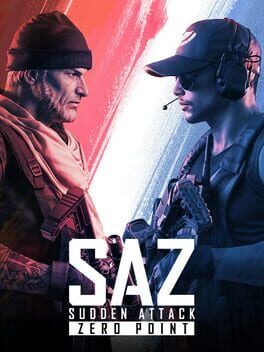

Sudden Attack Zero Point heads to Steam Early Access on July 30, while missing interview pages leave Nexon’s tactical shooter revival to be judged by its beta changes, weapon systems, maps, and roadmap.
Image: IGDB
Store links: Sudden Attack Zero Point on Steam
Nexon has a date, a build, and a missing interview trail
Sudden Attack Zero Point will enter Steam Early Access on July 30 for PC, according to coverage of Nexon’s announcement from Noisy Pixel, Gamers Heroes, and DayOne. The free-to-play release is being positioned as a remaster of Sudden Attack, a long-running South Korean online shooter, and its first public Early Access package tells us a lot about Nexon’s tactical shooter revival plans.
The tension is that the new Sudden Attack Zero Point interview material attached to this assignment is not currently accessible in the provided source text. The Monstervine page titled “Director Kim Tae-hyun on Custom Weapons and Early Access” returns an “Error 404” message. The Gamers Heroes interview page titled “Director Kim Tae-hyun Talks Community, Black Market & More” also returns a 404 page. That means there are no attributable director quotes in the supplied material to verify what Kim said about custom weapons, community features, the Black Market, or Early Access goals.
What can be reported is still substantial. Nexon’s plan, as reflected in press release coverage and beta reporting, is to revive a legacy competitive FPS by keeping the core fast, compact, and tactical while widening the surrounding systems. The confirmed Early Access build includes Bomb Defusal maps, close-quarters maps, practice tools, bot play, weapon customization, character variety, a player-trading Black Market, and a seasonal roadmap. For an older shooter trying to earn modern attention on Steam, that is a clear signal: Nexon is not chasing the hero shooter lane. It is trying to make an old-school tactical FPS feel current without sanding off the speed and lethality that define the format.
The revival is built around short rounds, fast kills, and familiar tactical pressure
Noisy Pixel described Sudden Attack Zero Point as a Counter-Strike-inspired FPS built around Bomb Defusal, fast time-to-kill combat, and compact maps where positioning and aim matter. DayOne’s coverage, drawing from Nexon’s announcement language, called it a “pure” tactical FPS where aim, positioning, fast reactions, and split-second decisions decide fights.
That matters for the shape of the game, because Sudden Attack Zero Point is not being pitched around classes, ultimates, long rotations, or hero counters. The confirmed mode emphasis is Bomb Defusal, backed by close-quarters combat maps and team deathmatch against bots. That points to a game that wants the round-to-round rhythm of classic tactical shooters: take space, clear angles, punish over-peeking, win trades, reset quickly.
As an FPS buyer’s read, the key question is whether Nexon can make that pacing feel sharp in 2026. Fast time-to-kill only works competitively when hit registration, sound, map readability, and weapon feedback are reliable. None of the supplied sources provide details on tick rate, server regions, anti-cheat, matchmaking rules, ranked modes, or latency targets. Those are not small omissions for a tactical shooter revival. They are the infrastructure questions that decide whether a clean aim duel feels fair or random.
Still, the confirmed content mix shows Nexon understands the entry problem. A tactical FPS can be brutal for new players if it only offers live PvP and no runway. Practice mode and Bot Team Deathmatch, both listed by MMOBomb, Gamers Heroes, Noisy Pixel, and DayOne, give new players somewhere to learn recoil, sightlines, and timing before getting deleted in Bomb Defusal. For a franchise trying to reach beyond its existing audience, that is practical design, not window dressing.
Weapon customization is the biggest modernization play, and the biggest balance risk
The most modern part of Sudden Attack Zero Point’s confirmed package is its weapon system. Noisy Pixel and Gamers Heroes report that Early Access includes 13 primary weapons and four secondary weapons. Gamers Heroes and DayOne also cite more than 200 exclusive weapon parts and 36 shared weapon parts for primary weapons, with various skins. DayOne’s feature text says the customization system can modify parts to affect recoil, reload speed, appearance, and other weapon behavior.
That is where Nexon’s revival strategy gets interesting. A legacy tactical shooter lives or dies on weapon identity. Players need to know what an AK-style rifle does, what a sniper angle costs, how much a reload exposes them, and what happens when they swing into a close-range duel. If Zero Point lets players alter recoil and reload speed through parts, it can create meaningful expression. It can also create a balance problem if the best configuration becomes mandatory or if visual parts start hiding performance differences.
The supplied sources do not say how parts are earned, whether any part stats are locked behind monetization, or how Nexon will separate cosmetics from gameplay-affecting components. That is especially important because the game is free-to-play. A free Nexon FPS with hundreds of weapon parts will immediately face player scrutiny around fairness, grind, and pay pressure, even if the sources only confirm access to parts and crates, not a specific monetization model.
MMOBomb reported that the final closed beta added more weapons, 13 primary and four secondary, plus “quite a few” weapon parts after feedback from the previous test period and Steam Next Fest demo. That feedback loop is the encouraging part. Nexon is already using test data to expand the arsenal before Early Access. The competitive concern is whether the studio can keep that arsenal readable when every player starts bringing personalized builds into fast-kill rounds.
Maps show Nexon protecting the old competitive spine
Across the Early Access coverage, the map count is consistent: two maps specialized for close-quarters battle and four maps for Bomb Defusal Mode. MMOBomb reported the same additions during the final closed beta, including two new close-quarter combat maps and four Bomb Defusal maps. That combination says Nexon is splitting the experience between immediate firefights and objective-based tactical play.
For Sudden Attack Zero Point, compact maps are a double-edged design choice. They support the fast, low-downtime identity that Noisy Pixel and DayOne describe. They also reduce the margin for weak spawn logic, noisy sightlines, and overpowered utility or weapon setups. In a slower tactical shooter, a flawed lane can sometimes be mitigated by rotation time or economy decisions. In a compact, fast-kill shooter, a bad angle becomes the meta within hours.
The sources do not provide layouts, callouts, player counts, economy details, or utility rules, so there is no basis yet to judge map quality. What we can say is that Nexon is leading with Bomb Defusal rather than burying it behind arcade modes. That is the right signal if the studio wants returning Sudden Attack players and Counter-Strike-adjacent FPS players to take the revival seriously.
The presence of Bot Team Deathmatch also gives Nexon a useful testing ground. If weapons are heavily customizable, players need a place to feel recoil changes before entering objective play. If the bot mode is competent enough to teach routes and gun handling, it can reduce the early churn that often hits tactical shooters when new players are thrown straight into veteran angles.
The Black Market could strengthen community, but Nexon has to explain the economy
The Black Market is one of the most consequential confirmed systems. Gamers Heroes reports that it will be available in Early Access and will allow players to freely trade acquired items with one another. Noisy Pixel similarly describes it as an in-game marketplace for trading weapon skins, parts, and other items earned through gameplay. DayOne’s coverage also lists The Black Market as a key feature.
For a tactical shooter, a trading economy can create long-term investment. Skins, weapon parts, and item ownership give players reasons to log in outside pure match results. It can also create pressure points. If gameplay-affecting parts are tradable, the market becomes part of the competitive ecosystem. If only cosmetics and non-power items dominate the market, the risk is lower, but the sources do not define those boundaries clearly enough.
There is also the Open Weapon Parts Crate. Gamers Heroes says players can access it to obtain weapon parts and skin parts, while Noisy Pixel says the crate will be included at launch for additional weapon components and cosmetic items. The phrase “crate” will raise predictable questions for free-to-play players, but the provided sources do not state pricing, drop rates, purchase rules, duplicate handling, or whether crates can be earned only through play. Any claim beyond the crate’s existence and general contents would be speculation.
MMOBomb’s beta report adds another unresolved point. Nexon hosted in-game events during the final closed beta that provided items such as currency, Key Cards, an epic skin parts crate, and more. MMOBomb specifically said it was uncertain whether any of those items would carry over into launch. Players who participated in tests should treat carryover as unconfirmed unless Nexon states otherwise through an official channel.
The roadmap expands the game, but the launch questions are still competitive ones
Nexon’s post-launch plan, as reported by Noisy Pixel and DayOne, runs through Seasons 1 to 3. Planned additions include a clan system, new maps, weapons, character skins, and Vampire Mode, with Vampire Mode scheduled for Season 2 in the reported roadmap. That is a broad Early Access runway: social structure, content growth, cosmetics, and a mode that sounds deliberately less traditional than Bomb Defusal.
The clan system may be the most important piece for competitive longevity. Tactical shooters survive when players form squads, scrim habits, rivalries, and routines. A clan system gives Zero Point a social layer that can hold players beyond the first week of curiosity. New maps and weapons are expected live-service fuel, but they also increase balance load. Every new rifle, attachment, or layout has to fit the fast time-to-kill environment without turning the meta into a one-build checklist.
Vampire Mode is a different signal. It suggests Nexon knows Sudden Attack Zero Point needs casual variety alongside its competitive core. That can be healthy if it gives players a pressure release without undermining the main identity. It can be damaging if limited development bandwidth pulls attention from netcode, anti-cheat, ranked structure, and map tuning. The supplied sources confirm the mode’s roadmap placement, not its rules or scope.
For now, the practical guidance is simple. Sudden Attack Zero Point is free-to-play and scheduled for Steam Early Access on PC on July 30, so curious tactical FPS players can try it without an upfront purchase. Players looking for a finished competitive ladder, confirmed server specifications, or a fully explained item economy should wait for Nexon to publish those details or for Early Access players to stress-test the build. The promise is a lean, fast Nexon FPS revival with modern customization and community systems. The test is whether those systems sharpen the gunfights or clutter them.