
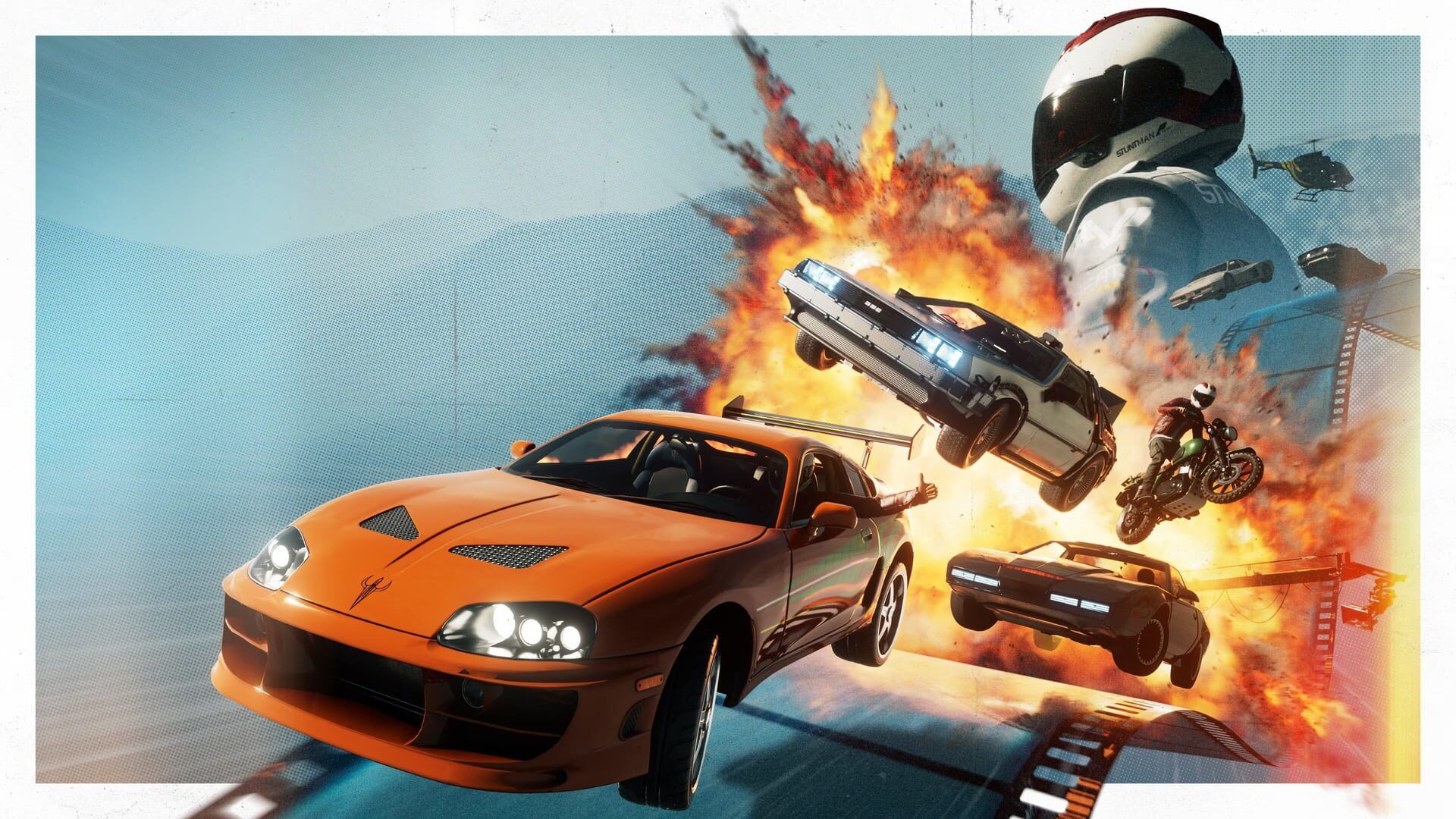

How Saber Interactive is reviving the long-dormant Stuntman franchise with cinematic car chaos, film-inspired vehicles, and stunt-first systems in a modern racing landscape.
Stuntman has been dormant long enough that a lot of today’s players know it more as a name you see in retrospectives than a series you can actually buy. On PlayStation 2 it carved out a strange, brilliant niche: a driving game that was not really about racing at all. You were a jobbing stunt driver hitting your marks on a virtual film set, threading cars through explosions while a director barked orders in your ear.
With Stuntman: Hollywood, Saber Interactive is trying to bring that idea forward without sanding off what made it distinct. Instead of chasing the open-world car culture trend, it doubles down on being a game about making scenes. The twist this time is that those scenes lean heavily on real film and TV inspirations, with licensed vehicles and sequences that are clearly built to tap into decades of car-obsessed screen history.
A dormant cult series gets another shot
The original Stuntman and its follow up Stuntman: Ignition sat in a weird spot between sim and arcade. You were not really racing rivals, you were racing a shot list. Every near miss, handbrake turn and jump had to land exactly where the director wanted it, which made the experience more about choreography than pure speed. It could be punishing, but when a take finally came together it felt like nailing a rhythm game track while driving a movie car.
That formula never really found a huge mainstream home, and the series went quiet as racing pivoted toward huge maps, car collecting and online competition. For years the most obvious descendants lived in other genres, from Burnout’s crash junctions to Split/Second’s TV-show demolition races.
Stuntman: Hollywood arrives in a very different market. Today, the racing shelf is crowded with service-heavy sims and open worlds on one side and tightly scoped arcade throwbacks on the other. Saber’s pitch is to occupy a lane almost no one else is using: a linear, stunt-driven campaign that cares more about framing the perfect shot than crossing a finish line.
Saber Interactive’s vision for a modern stunt game
Saber Interactive comes to this with solid experience in licensed, spectacle-first projects like World War Z and Space Marine 2. Stuntman: Hollywood follows that same philosophy. It is not pretending to be a neutral driving sandbox. It is very deliberately a game about movie making where the cars happen to be your tool and your weapon.
Structurally, it is built around episodes that function like self-contained productions. Each episode focuses on a different flavor of car action, with its own palette of vehicles, camera work and stunt grammar. One might push you through neon-soaked chases echoing Miami Vice, another into grungy arena runs that look closer to Death Race.
The team also cites Burnout and Split/Second as key inspirations, which tells you a lot about the intended feel. Expect fast, chunky handling, exaggerated crashes and plenty of environmental chaos. The challenge is not just following a driving line, it is reading a constantly changing set and reacting in time to hit your cue before the explosion behind you goes off.
Licensed film-inspired vehicles without losing the stunt identity
Earlier Stuntman games felt like homages, with fictional films riffing on Bond, The French Connection and other touchstones. Stuntman: Hollywood steps over that line and reaches straight for licensed material. Confirmed appearances include the DeLorean from Back to the Future, the iconic Knight Rider KITT, and vehicles from Miami Vice and Death Race, with marketing also teasing Mad Max style sequences even if the exact licensing boundaries remain a little fuzzy.
The risk with leaning on familiar brands is that a game can start to feel like a museum of cameos instead of a cohesive experience. The way Stuntman: Hollywood seems to avoid that is by using these vehicles as anchors for the design of each episode rather than as collectible trophies. A Knight Rider shoot revolves around high tech pursuit fantasy, with night-time highways and stunts built around KITT’s speed and agility. A Back to the Future inspired sequence nudges you toward set pieces that play with timing, sudden direction changes and narrow escapes.
Instead of freeroam car culture, the fantasy is that you are a professional who gets called onto these wildly different productions because you can handle any wheel the director puts you behind. That keeps the focus on the craft of stunt work, even when the car you are driving is a pop culture icon.
Systems built around precision, not position
At the core of Stuntman: Hollywood is the same basic loop that defined the old games: survive a gauntlet of scripted mayhem, hit your marks, then do it again, cleaner and faster, until it looks like something you would believe on a big screen.
Each run through a scene is broken into objectives. Drift precisely around a burning tanker without clipping it. Thread through oncoming traffic while squibs pop off nearby cars. Hit a ramp at the correct speed to clear a collapsing bridge. These are not optional flourishes. They are your checklist for the take, and missing them means a lower rating.
Performance is tracked through a star system. Completing primary objectives earns a baseline payout, while chaining clean execution and nailing bonus challenges fills in extra stars. Those stars are your progression currency, feeding back into unlocks for later episodes and extra content for your garage. By rewarding both survival and stylistic precision, the system encourages you to replay scenes until you find the ideal line that balances aggression with control.
There is an inherent tension in this approach. Lean too hard into demanding, memorization-heavy challenges and you risk alienating players used to more forgiving racers. Simplify it too much and you lose the satisfaction that comes from finally putting down a perfect take. Saber appears to be targeting the same sweet spot occupied by modern arcade racers: handling models that are easy to read in the first minute but have enough nuance that mastery becomes about timing, corner entry and knowing when to commit to a stunt.
Cinematic chaos in a crowded racing landscape
Slotting Stuntman: Hollywood into today’s racing market highlights how unusual it is. Where most big budget racers try to be platforms, with long term progression, seasonal content and player-defined goals, this is a game that is comfortable being about authored scenarios and finite challenges.
That makes it stand out in a way that could cut both ways. On one hand, there is an appetite for focused, replayable arcade experiences, especially among players who feel exhausted by endless checklists and massive maps. A stunt-first structure means every minute is dense with designed moments. On the other, success hinges on Saber’s ability to keep the stunt language evolving so repetition stays satisfying rather than grinding.
The heavy use of recognizable film and TV touchpoints is also a sharp contrast with the car culture focus of series like Forza Horizon or Need for Speed. Instead of meeting other drivers at a festival, you are working with fictional crews whose job is to capture the perfect shot. Where other games sell fantasy through ownership and customization, Stuntman: Hollywood leans into professionalism. The thrill is not that this is your car, but that you are good enough to handle it for long enough to hear the director yell cut.
In that context, Saber’s revival looks less like a nostalgia play and more like a deliberate attempt to widen what counts as a modern driving game. By putting stunts first and racing second, and by structuring the whole experience as a series of film shoots powered by licensed vehicles, Stuntman: Hollywood aims to occupy a space that has been mostly empty since the original games went quiet.
If it can capture the old rush of threading a car through chaos while still feeling approachable to players raised on open worlds and rubber band AI, it has a chance to turn a cult favorite concept into something that feels sharp and relevant again.