

Lepton and FEX appearing publicly on Steam gives the clearest look yet at Valve Steam Frame software, compatibility strategy, and the limits still facing its ARM headset.
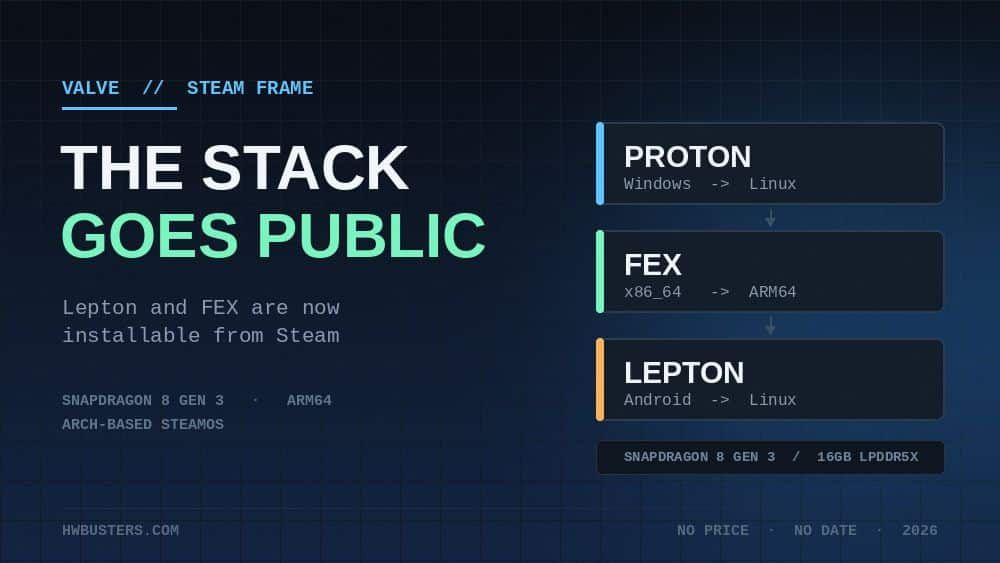
Image: hwbusters.com
Valve’s quiet Steam uploads reveal the shape of Steam Frame compatibility
Valve has made Lepton and FEX publicly visible on Steam, according to SteamDB-linked reporting from GamingOnLinux, VideoCardz and Hardware Busters. That is the strongest concrete development around Steam Frame this week: two background compatibility components tied to Valve’s ARM headset are no longer hidden away as internal plumbing.
The tension is that Valve still has not attached the consumer-facing answers players usually want. Hardware Busters notes that there is still no price or ship date for Steam Frame. GamingOnLinux frames the timing as a sign the device may be close, but that remains an expectation based on back-end activity rather than a Valve announcement. PC Gamer’s headline similarly treats the uploads as a possible sign that Valve is putting the finishing touches on the software stack, not confirmation of a launch date.
What is confirmed is more useful than a vague countdown. Lepton and FEX are not games. They are service-layer tools meant to help Steam Frame run software built for ecosystems that do not naturally match the headset’s hardware. GamingOnLinux points to SteamDB histories for Lepton and FEX becoming fully public on Steam, while VideoCardz reports that Lepton is classified as a free Linux service tool with a public install of around 1.07 GiB. Hardware Busters adds that Lepton’s store link does not resolve like a normal Steam product page, instead redirecting back to the storefront because it is a background component.
For a platform strategist, that is the interesting move. Valve is not only preparing hardware. It is exposing the compatibility machinery that decides whether Steam Frame launches with a viable library, a fragile promise, or a pile of exceptions.
The three-layer plan: Proton, Lepton and FEX each solve a different library problem
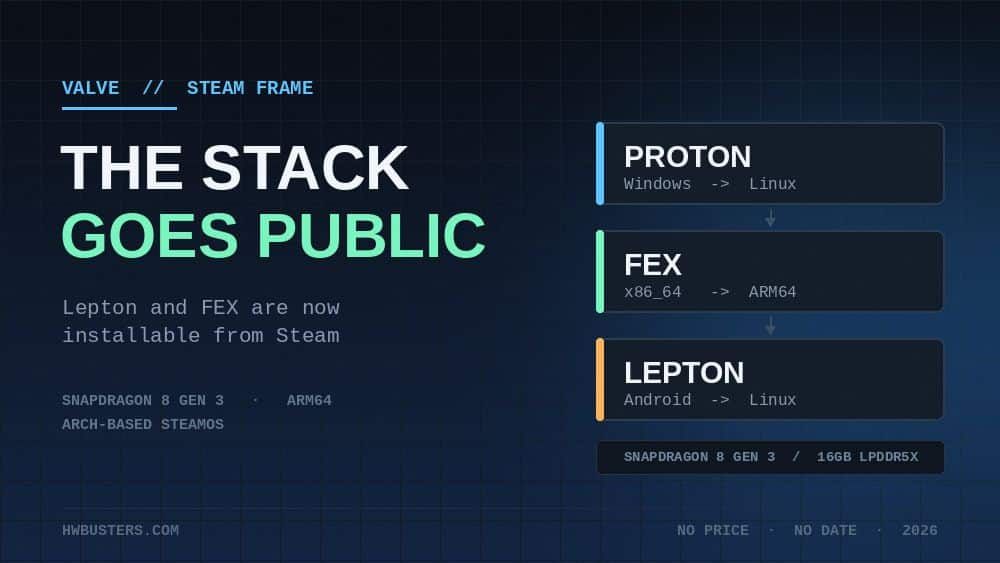
Valve’s own Steam Frame compatibility documentation, quoted by GamingOnLinux, lays out three routes for standalone games. Windows games can run through Proton. Android games can run through Lepton. x86 32-bit and 64-bit games can run through FEX, which translates x86 code to ARM64 instructions while forwarding API calls to native host libraries such as OpenGL or Vulkan to reduce emulation overhead.
That matters because Steam Frame is reported by GamingOnLinux and Hardware Busters as an ARM64 device built around Qualcomm’s Snapdragon 8 Gen 3. GamingOnLinux specifies the 4 nm Snapdragon 8 Gen 3 and calls it an Arm processor. Hardware Busters describes the headset as running an Arch-based build of SteamOS with 16GB of LPDDR5X. This is a very different target from the Steam Deck, which runs SteamOS on x86 AMD hardware. The Deck’s biggest compatibility challenge was Windows-to-Linux. Steam Frame adds an architecture shift on top.
The cleanest path is Android via Lepton. Valve’s documentation, as quoted by GamingOnLinux, describes Lepton as an Android compatibility layer that runs Android games on Linux using a container to minimize overhead. VideoCardz similarly describes Lepton as running Android software inside containers so the Android environment and host Linux system can share hardware resources with limited overhead.
FEX is the architecture bridge. Valve’s documentation says FEX translates x86 compiled games to ARM64 instructions, forwards API calls to native host system libraries, and uses code caching to reduce in-game stuttering as much as possible. That last phrase is important because it is not a promise of zero stutter. It is a design goal inside a translation stack that still has to hit VR frame-time targets.
Proton remains the Windows layer. Valve’s documentation, via GamingOnLinux, describes Proton as a compatibility layer based on a modified Wine plus graphics API implementations such as DXVK, translating DirectX to Vulkan, which Steam Frame uses natively. In the most complicated case, a Windows x86 game may need both Windows compatibility and ARM translation. That is the high-risk lane, and also the one tied to the largest portion of the existing Steam catalog.
Lepton on Steam points at a real Android publishing route, not a side experiment
The Lepton listing is significant because Steam Frame has to compete with a standalone VR market where Android is already central. Hardware Busters says Lepton is aimed at standalone VR content that currently lives on Meta Quest, and VideoCardz reports that Steam developers can create an Android depot containing an APK plus optional OBB data, select Android as a supported operating system, and configure the APK as the Steam launch executable. VideoCardz also reports Steam Cloud support for save data stored in the Android external data directory.
That is a bigger structural change than a hidden emulator package. If developers can ship APKs through Steam, Valve can approach Android VR software as part of Steam’s distribution system rather than asking every developer to produce a native Linux ARM build before launch. Hardware Busters characterizes this as a working Android publishing pipeline inside Steam.
There is still a gap between pipeline and catalog. None of the provided sources lists confirmed Android games shipping for Steam Frame, and the presence of Lepton does not automatically mean every Quest-style Android title will arrive. Rights, store agreements, input assumptions, entitlement systems, platform services and performance targets can all decide whether a game appears. The confirmed development is that Valve’s tooling now appears prepared for Android packages on Steam, not that a specific Android VR library has been secured.
From a strategy angle, Lepton gives Valve leverage. It can tell developers that Steam Frame does not necessarily require a full native port on day one. That lowers the cost of testing the market. For players, it suggests Valve is trying to make Steam Frame a standalone headset with access to Android-style software, while keeping Steam as the storefront and account layer.
FEX is the harder bet because Steam’s back catalog was built for x86
FEX appearing on Steam is the part that speaks most directly to Steam Frame compatibility with traditional PC games. GamingOnLinux links FEX’s SteamDB history and quotes Valve’s compatibility documentation: FEX handles x86 32-bit and 64-bit translation to ARM64, forwards API calls to native host system libraries, and uses code caching to reduce stutter.
That design is sensible because full-system emulation would be too expensive for a headset-class power budget. Forwarding graphics API calls to native OpenGL or Vulkan libraries avoids treating every layer as an opaque black box. Code caching, meanwhile, tries to prevent repeated translation work from causing hitching after code paths have already been encountered.
The challenge is the workload. Steam’s Windows PC catalog was not built around Snapdragon ARM hardware. Proton already has known variability from game to game on Linux. FEX adds another decision point: the game’s CPU instructions must be translated, and the result still has to cooperate with graphics drivers, input, VR presentation, anti-cheat where applicable, middleware, launchers and SteamOS integration. The sources do not provide benchmark data, compatibility percentages, latency measurements, battery estimates or game-by-game certification results.
That is where the analyst’s caution has to override the launch-window excitement. Lepton FEX Steam listings are a strong signal that Valve has moved key components into public distribution. They are not evidence that demanding Windows games will feel native on Steam Frame. A translation stack can be a strategic advantage and a performance liability at the same time, depending on the title.
The ARM64 Compat List suggests Valve is sorting games by route and risk
GamingOnLinux also reports that a “Steam Frame ARM64 Compat List” appeared in SteamDB metadata as app 3043620. According to that report, the metadata shows games tagged with different compatibility routes, including The Long Dark using “proton-arm64ec-4” and Streets of Rage 4 using “proton-arm64ec-experimental.”
This is one of the more revealing pieces of the puzzle because it implies Valve is not treating Steam Frame compatibility as a single yes-or-no switch. A list that distinguishes Proton ARM64EC variants and experimental branches suggests an internal or back-end process for routing games through specific compatibility configurations.
That should sound familiar to Steam Deck owners, but the problem space is broader. Steam Deck compatibility labels had to account for controls, display, Linux behavior, text readability and performance. Steam Frame adds ARM translation and, for VR use, much stricter sensitivity to uneven frame pacing. VR.org makes the same broad technical point by comparing this kind of translation effort to Apple’s Rosetta 2 transition, while also noting that a stereoscopic display at high refresh rates is less forgiving of frame-time spikes than normal desktop use.
The confirmed fact is the SteamDB-visible ARM64 compatibility metadata reported by GamingOnLinux. The interpretation is that Valve is building a matchmaking layer between games and compatibility tools. If that read is correct, the health of Steam Frame at launch may depend less on one miracle translator and more on Valve’s ability to pick the right route for each game, ship per-title fixes, and communicate limitations clearly to buyers.
Launch timing looks closer, but Valve has left the commercial board covered
The timing cluster is hard to ignore, but it should not be overstated. GamingOnLinux reported on August 3 that Lepton and FEX became fully public on Steam as the weekend arrived. VideoCardz published that Lepton and FEX appeared at almost the same time. VR.org reports that the entries landed days after the FCC granted Valve equipment authorization for the headset on July 29. Hardware Busters says Valve had announced Steam Frame in November 2025 alongside the second-generation Steam Machine, and that pricing and release details had slipped by February.
Those are launch-adjacent signals. Public service tools, compatibility metadata, developer-facing Android packaging and regulatory movement all tend to happen when a product is moving from concept to operational readiness. Still, no provided source includes an official Steam Frame release date, preorder date, regional availability plan, final price, bundle contents or launch software lineup.
For readers deciding whether to wait, the practical advice is simple. If you are interested in Steam Frame because of PC VR streaming, GamingOnLinux says the headset will also be able to stream games directly from your PC, but the provided sources do not detail network requirements or performance. If you are interested in standalone play, watch the compatibility list and Android depot support closely. If you are interested in running your existing Windows Steam library locally, wait for game-level compatibility labels and independent performance testing before assuming Steam Deck-like reliability.
Valve’s next hardware push appears to be built around a familiar strategic pattern: make the software layer absorb as much platform friction as possible, then let the Steam library create the economic gravity. Lepton and FEX appearing on Steam do not answer every Steam Frame question. They do show the outline of Valve Steam Frame software, and that outline is ambitious: Android containers, Windows compatibility, x86-to-ARM translation, and SteamOS all converging on a Snapdragon headset.