

Valve has dressed up Steam’s Discounts & Events page for Black Friday 2026, but this is not a store-wide Steam sale. Here is how the limited window, personalization, cooldown rules, and Winter Sale timing affect PC game deals.
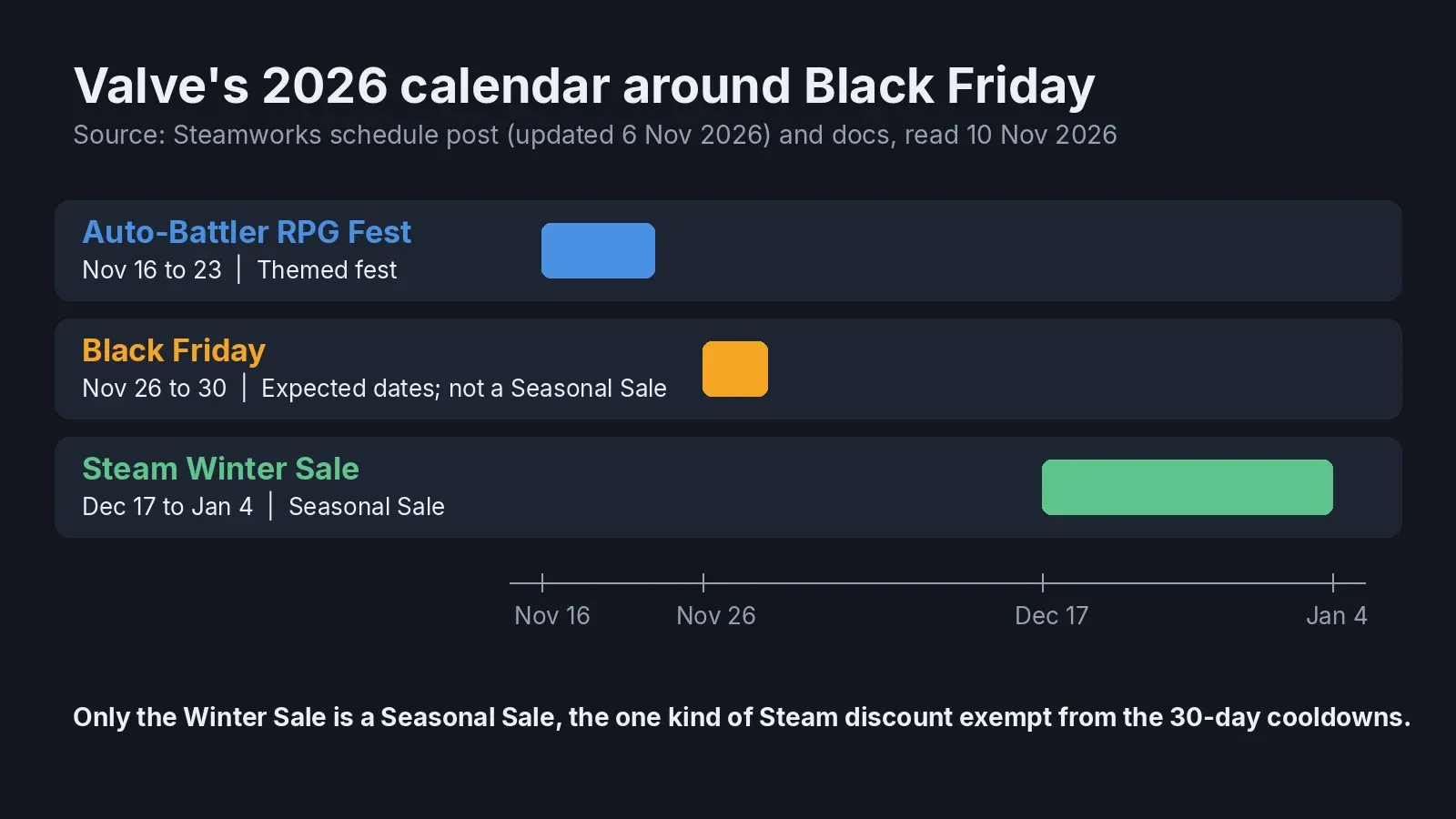
Image: gamebrief.net
Valve’s Black Friday hub is live, but this is not a traditional Steam sale
Valve’s clearest Black Friday 2026 move is on the store page itself: Steam’s Discounts & Events section is now labeled for Black Friday and presents “thousands of games on discount,” according to the live Steam Special Offers page. The tension for shoppers is that this looks like a Black Friday Steam sale, but the sources around Valve’s own developer calendar describe something narrower.
GamingOnLinux reported on November 27 that Valve “may not directly run a Black Friday type of sale,” but did update the Discounts & Events page for the season. SteamDB, citing Valve’s Steamworks event calendar for developers, says Valve wrote that “just like in 2025, Steam is not hosting an official Black Friday fest of its own.” PC Gamer similarly points to Valve’s Steam news update as saying Steam is not running an official Black Friday fest, even while the Discounts & Events page is wearing Black Friday branding.
That distinction matters for anyone planning Steam Black Friday 2026 purchases. Valve is not presenting this as one of Steam’s major seasonal sales. The confirmed change is a themed, promoted discounts hub that gathers publisher and developer discounts already being run through Steam. In practical terms, the page is useful, but it should be treated as a discovery layer over individual store discounts rather than a single, Valve-controlled sale with one fixed rule set.
What changed on the Valve Discounts and Events page
The visible change is straightforward. Steam’s Special Offers page now carries the heading “Discounts & Events Black Friday” and the line “Celebrate with thousands of games on discount.” Its Top Picks area shows deal labels including Hot Deal, Top Seller, First-Time Discount, Last Chance Deal, and 90% Off or More. In the captured Steam listing provided in the source material, examples include Cyberpunk 2077 at 70% off, Red Dead Redemption 2 at 75% off, Baldur’s Gate 3 at 30% off, Crusader Kings III at 70% off, Detroit: Become Human at 90% off, and several games marked as first-time discounts.
GamingOnLinux adds the more important structural change: Valve has made the page more personalized. According to that report, the categories and games shown use data from what a player has played, with the aim of surfacing titles they are more likely to want. The live Steam page supports that direction by telling signed-out visitors to “Sign in to view additional items selected just for you.”
For PC players, that means the page is no longer only a broad bargain bin. It is closer to a strategy map for your own library habits. A player with a long history in grand strategy, CRPGs, racing games, or horror should expect Steam’s signed-in version of the page to weight recommendations differently than a generic public view. That can save time during a short sale window, but it also means the page may hide good deals outside your usual lanes unless you deliberately browse by genre, theme, feature, or the wider highlights areas listed on Steam.
The key Steam sale dates are short, and the window closes before December
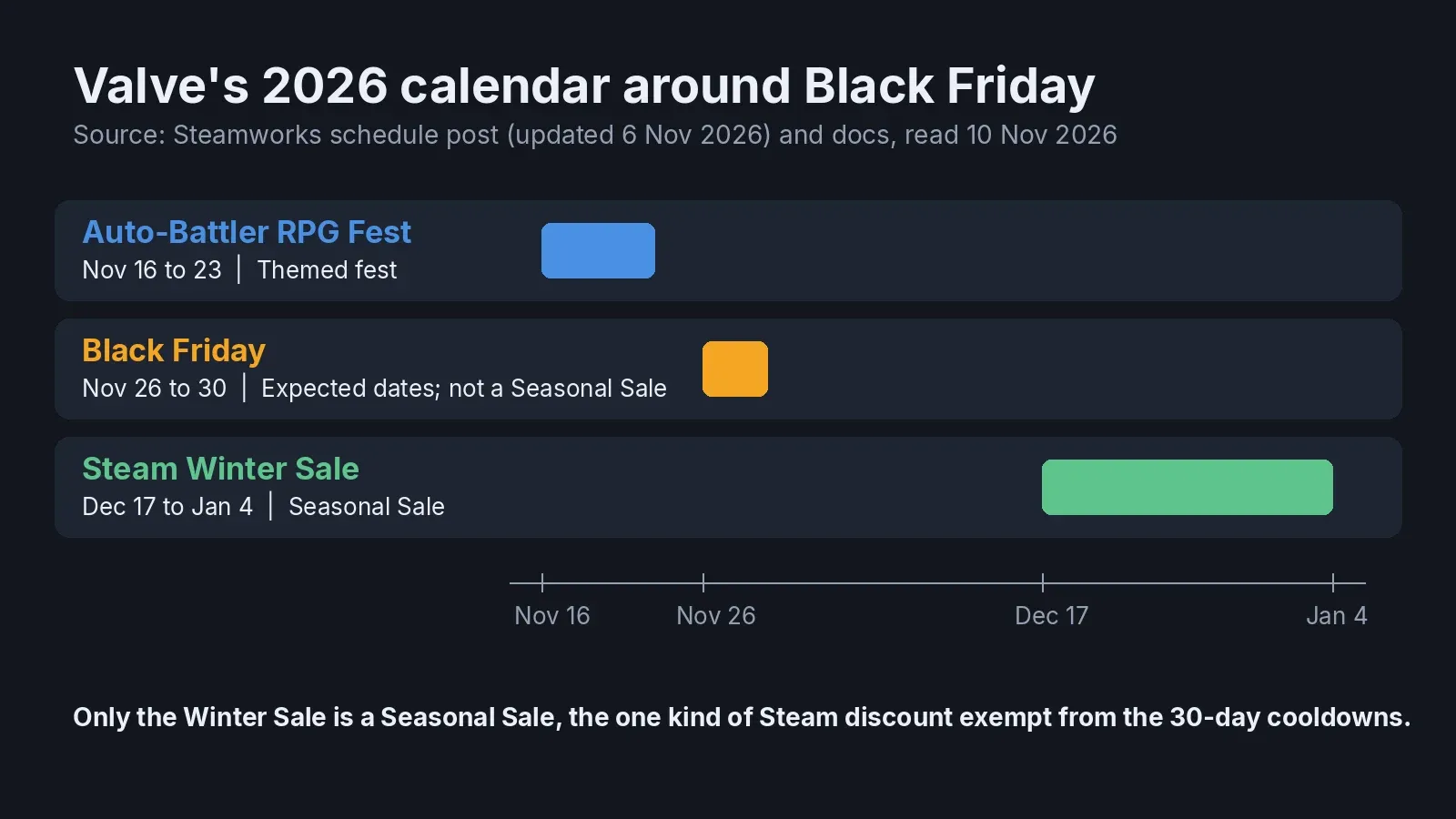
The Black Friday treatment is a limited event window. SteamDB reports that Valve scheduled the themed Discounts & Events presentation from Thursday, November 26 at 10:00 a.m. Pacific time, which is 18:00 UTC, until Monday, November 30 at the same hour. Shattered.io, citing a November 14 report, gives the same November 26 to 30 window and frames it as Black Friday styling for the Discounts & Events area rather than a store-wide Steam sale.
That short duration is the central planning problem. If you are waiting for the Black Friday Steam sale as though it were a full seasonal event, the page may disappear back into Steam’s usual daily, midweek, and weekend deal rhythm before you make a decision. SteamDB says those regular deal formats return afterwards. GamingOnLinux also notes a second deadline in the same period: nominations for the 2026 Steam Awards close Monday, November 30 at 6 p.m. UTC, with voting starting alongside the Steam Winter Sale on December 17.
The next confirmed major Steam buying moment in the provided sources is the Winter Sale start on December 17. SteamDB says voting for the Steam Awards opens with the Winter Sale on that date, while Shattered.io identifies the Winter Sale as the next major seasonal sale after the Black Friday presentation. If a game you want is not discounted during the November 26 to 30 window, the evidence points to December 17 as the next major checkpoint rather than another late-November Steam-wide promotion.
Publisher-set discounts make this a fragmented shopping event
The biggest difference between this Black Friday hub and a full seasonal sale is who controls the offer. SteamDB says developers decide which games get cheaper and by how much. Shattered.io makes the same point, reporting that publishers and developers set the discounts that qualify, not Valve. Valve’s role is presentation, theming, and storefront visibility.
That creates a fragmented deal economy. One publisher may treat November 26 to 30 as its main holiday push. Another may skip it and wait for the Winter Sale. A smaller developer may use the event to test a first-time discount, while a larger publisher may recycle a familiar percentage cut. The Steam page itself reflects this mix through labels such as First-Time Discount, Hot Deal, Top Seller, and Last Chance Deal.
For players, the useful move is to read those labels as signals, not guarantees. A First-Time Discount tells you the game has newly entered discount territory on Steam, but it does not prove the current price is the lowest it will reach later. A Last Chance Deal should get attention during the Black Friday window, but the listing text in the provided source does not specify a universal end time for every individual offer. A Top Seller tag tells you about marketplace momentum, not necessarily value. The page is strongest when you combine Steam’s presentation with your own wishlist priorities and, where needed, external price-history checks.
Cooldown rules could decide whether to buy now or wait for Winter Sale
SteamDB’s developer-facing detail is the most important planning rule in the source material: Valve’s standard discount cooldown still applies over Black Friday. SteamDB quotes Valve’s rules as saying “a product cannot be discounted within 30 days of another discount,” and notes that only Steam’s four seasonal sales, in spring, summer, autumn, and winter, are exempt. SteamDB also says Valve reminded developers that Black Friday is not exempt in the way seasonal sales are.
The practical result is subtle. If a game runs an ordinary Black Friday discount that ends on November 30, SteamDB says it cannot receive another ordinary discount before December 30. That would block a quick return through a daily deal, publisher sale, or other non-seasonal promotion. The Winter Sale is the exception because seasonal sales ignore that cooldown. So the real fork is not simply “buy in November or never see the price again.” It is “buy in November if the current cut is good enough, or accept the risk that the publisher may hold a better or similar offer for the Winter Sale.”
A strategy-minded buyer should separate games into three mental buckets. Wishlist games with deep cuts, short labels, or historically rare discounts are stronger Black Friday candidates. Games with modest 10% to 20% discounts and no urgency may be safer to reassess on December 17. Games that are not discounted at all should stay on the wishlist, because the current hub cannot manufacture a deal that the publisher did not choose to run.
How to use the page without missing PC game deals
The first step is to sign in. The public Steam page shows broad Top Picks, but Steam says signed-in users can view additional items selected for them, and GamingOnLinux reports that the refreshed page uses play data to personalize categories and games. That turns the Valve Discounts and Events page into a filter for your own habits, especially if your library history is consistent enough for Steam to infer what you usually play.
The second step is to avoid letting personalization become tunnel vision. Steam’s page lists browsing routes by genre, theme, and feature, and those matter during a compressed four-day window. If you normally buy strategy games, the recommendation system may be efficient at finding Crusader Kings III-style offers, but it may do less to surface a strong racing, horror, or co-op deal unless you check those areas manually. Treat the personalized feed as the opening scout report, then use category browsing to look for off-meta bargains.
The third step is to check timing before checkout. SteamDB says the Black Friday presentation runs from November 26 to November 30 at 10 a.m. Pacific. GamingOnLinux says Steam Awards nominations close on November 30 at 6 p.m. UTC. SteamDB says the Winter Sale begins December 17. Those are the relevant decision points in the supplied sources. If a game is discounted now and you would play it immediately, the short window favors action. If it is a backlog purchase and the discount is ordinary, waiting for the Winter Sale start is a reasonable risk-controlled choice.
Finally, verify price quality, especially on expensive releases. SteamDB’s article points readers to its sale calendar and price-history tools to see whether a Black Friday discount is the lowest so far. That is useful because the Steam page’s labels emphasize discovery and urgency, while price history answers the harder buyer question: whether the current number is actually worth locking in before December.