
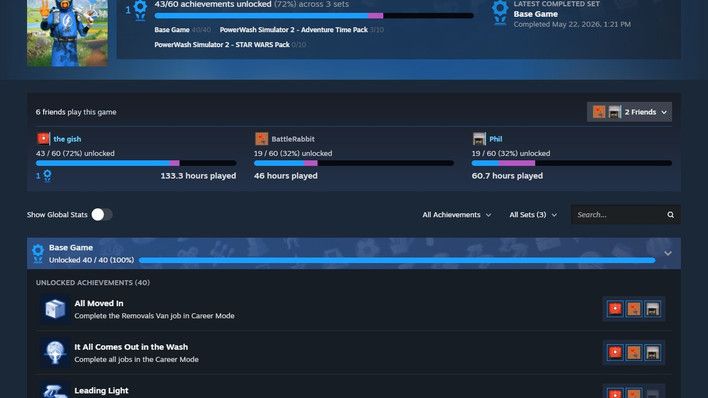

Valve’s Steam Achievement Sets beta lets developers split achievements into base-game, DLC, multiplayer, class, and seasonal groups, preserving cleaner completion tracking while adoption remains limited to beta-supported games.
Image: news.instant-gaming.com
Valve is changing the completion math on Steam
Valve has put Steam Achievement Sets into beta, giving developers a way to split a game’s achievement list into separate groups rather than one ever-growing checklist. The immediate tension is familiar to completionists: a player can finish every achievement in a base game, then lose that clean 100% status when a later DLC pack, season, or update adds new goals to the same list.
In Valve’s Steam News announcement, the company frames Achievement Sets as an answer to games that now live through expansions, seasons, and recurring updates. In games that support the feature, achievements still unlock through normal play. The difference is in how Steam presents them afterward. Instead of one long list, Steam can show developer-created sets with their own progress bars and a “set complete” trophy when a set is finished.
That makes Steam Achievement Sets a small interface change with larger consequences for how players read progress. A completed base game can remain visibly completed even if a studio later attaches a DLC campaign, a multiplayer mode, or a holiday event. For players who treat achievements as a long-term strategy layer across a library, the system finally separates past mastery from new optional work.
DLC achievements no longer have to poison the base-game ledger
The clearest use case is Steam DLC achievements. Valve says developers can create new sets as a game grows, allowing added content to sit in its own group while preserving prior completion status until a player returns. Video Games Chronicle highlighted the old problem directly: DLC achievements added after release could break a game’s completion status for players who had already earned everything in the base game.
Inven Global reports that sets are divided into Base Game sets and DLC sets, with Base Game achievements available to any player and DLC achievements tied to add-on ownership. According to Inven, DLC sets are not counted toward overall game progress until the DLC is owned. If implemented consistently, that changes one of Steam achievements’ most annoying economic pressures: players would no longer be pushed out of a completed status simply because they did not buy later content.
The feature does not stop developers from making demanding DLC lists, and it does not make a weak achievement design stronger. It does, however, gives studios a cleaner accounting model. A roguelike expansion, a grand-strategy content pack, or a racing game car pack can be measured as its own challenge set instead of rewriting the player’s original contract with the game.
Live service games get a cleaner seasonal tool, if developers use it well
Achievement Sets also matter for Steam season achievements. Valve says developers can archive individual achievements or whole sets, and it specifically points to season-based games and time-limited holiday achievements as examples of where temporary sets could work. VGC quotes Valve’s guidance that any achievement that can no longer be unlocked should be archived.
That archived status is the crucial rule. According to Valve’s explanation as reported by VGC and The Verge, archived achievements remain visible for players who earned them, but they do not appear on the profile pages of users who missed them and do not block progress toward completing a set or game. In practical terms, a Halloween event can reward the players who were there without leaving everyone else with a permanent impossible blank space.
This is where the feature becomes strategically interesting for live games. Seasonal design often relies on urgency, but permanent achievement systems punish late arrivals when limited-time objectives vanish. Archivable sets let developers preserve the record of a season while lowering the long-term damage to completion tracking. The better studios use the tool, the less often players will have to research whether an achievement is still possible before committing to a 100% run.
Single-player, multiplayer, classes, and dead modes can finally be separated
Valve’s examples go beyond DLC. Developers can split achievements by single-player and multiplayer, by class, or by other categories that fit the game. Rock Paper Shotgun noted that a developer could separate a base game from individual DLC packs or divide achievements by class, while VGC pointed to the possibility of solo players earning completion status for the part of a game that applies to them.
That has obvious value for older games with multiplayer achievements attached to modes that are quiet, unstable, or dependent on servers. Valve has not announced an automatic rescue system for impossible multiplayer achievements, so players should not assume every abandoned online trophy will disappear overnight. But the archive rule gives developers a sanctioned way to remove achievements that can no longer be unlocked from active completion requirements.
For strategy and service-heavy games, the set structure also creates clearer goal planning. A player can decide whether they are chasing the campaign set, a multiplayer set, a class set, or a DLC set rather than reading one mixed list where every activity has the same visual weight. That matters because achievements often influence how players route a game, when they return, and whether they abandon a completion attempt as too messy to justify.
The achievements page is being rebuilt around progress comparison
Alongside the Valve achievements beta, Steam is testing an overhauled achievements page. Rock Paper Shotgun reports that the new page shows overall progress, progress in each Achievement Set, and individual achievement details in one place. Global Stats, previously on a separate page, are now available as a toggle, and search has expanded to filter by specific sets as well as locked or unlocked achievements.
The same report says players can compare totals with up to three friends. HappyGamer also listed friend comparison, rare achievement comparison, locked and unlocked filters, completed sets on profiles, and Family Sharing games in the Games List among the beta’s surrounding changes, attributing the discovery to a post by Pirat_Nation on X. Valve’s own framing, as quoted by The Verge, confirms the refreshed achievements page and set-specific progress bars.
This is the meta layer Valve has been slow to formalize. Steam achievements have always had global unlock rates, profile displays, and Perfect Games style bragging rights, but the interface often treated all goals as one pile. Sets make achievements legible as categories of mastery. If the beta survives into the main client, players will have a better way to compare whether a friend finished the base campaign, the DLC ladder, the seasonal event, or the hardest optional bucket.
The beta is useful now, but limited by adoption and developer discipline
There are two important limits. First, Steam Achievement Sets are currently in the Steam Client Beta, so players need to opt into the beta client to try the redesigned achievement experience. The Verge reports that the new achievement features are available in the latest Steam client beta, and Rock Paper Shotgun points readers to Steam’s beta opt-in instructions.
Second, the system depends on developers. Sets are developer-created, and the number and organization of sets are up to each game’s team, according to Inven Global’s summary of Valve’s announcement. That means old achievement lists will not magically reorganize themselves unless the developer updates them. A studio can create elegant base-game and expansion groups, but it can also make confusing categories or choose not to support the feature at all.
There is also a source-listing wrinkle worth flagging. Valve’s supported-game list, as reproduced by The Verge and Rock Paper Shotgun, includes 17 games: Against the Storm, Age of Wonders 4, American Truck Simulator, Call of Duty: Modern Warfare 4, Crusader Kings III, DREDGE, Euro Truck Simulator 2, Forza Horizon 5, Flock Around, He is Coming, LEGO Batman: Legacy of the Dark Knight, Left 4 Dead 2, Portal 2, PowerWash Simulator, PowerWash Simulator 2, Team Fortress 2, and Victoria 3. VGC says 17 games have added sets but its published list in the provided text omits Crusader Kings III and Forza Horizon 5, leaving only 15 entries. Given the agreement between Valve-linked reporting from The Verge and Rock Paper Shotgun, readers should treat the 17-game list including Crusader Kings III and Forza Horizon 5 as the fuller current list while recognizing that beta support can change.
How to read your completion status during the beta
For now, the practical guidance is simple. If you want to test Steam Achievement Sets, use the Steam Client Beta and check games known to support the feature. Do not expect every game in your library to display organized DLC or seasonal categories yet, and do not assume an impossible achievement has been archived unless the game’s achievement page actually shows that behavior.
If a game supports sets, look at progress set by set rather than treating the overall percentage as the only truth. A completed base-game set should be a cleaner signal than the old global list, especially for games with expansions. DLC sets should help distinguish content you own from content you have not bought. Seasonal sets should become less punishing if developers archive expired achievements as Valve recommends.
The larger shift is that Steam is beginning to treat achievements as a living record rather than a single static checklist. That fits the modern PC catalog, where games expand, rotate events, sunset modes, and return players years later. The beta does not solve every legacy achievement problem, and it leaves a great deal in developers’ hands. But for completionists, DLC buyers, and live-service players, Valve’s new structure offers a cleaner way to see what you finished, what you skipped, and what is actually still possible.