
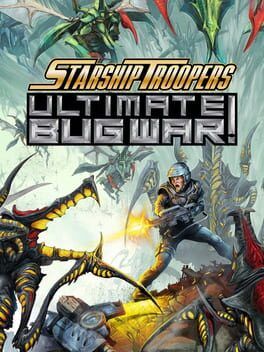

Starship Troopers: Ultimate Bug War’s new Bug Mode finally lets you play as the Arachnids. After hands-on time, we break down how swapping Troopers for bugs changes pacing, objectives, and balance, and whether this horde-style co-op variant has the legs (or mandibles) to last.
Playing Starship Troopers: Ultimate Bug War as a Trooper is all about desperate last stands. You sprint between ammo caches, weld doors shut, and pray the next wave of chittering claws does not crest the ridge before your turret cooldowns reset. Bug Mode flips that rhythm completely. Once you cross over to the Arachnid side, the same maps and chokepoints you once defended turn into hunting grounds, and the game’s tempo shifts from panicked defense to predatory pressure.
From the start, Bug Mode frames its role reversal with series veteran John Rico lecturing that to beat the bugs, you must think like them. In practice that means ditching iron sights and recoil charts in favor of swarming, flanking, and overwhelming focus fire. Instead of juggling guns and gadgets, you juggle bodies in motion. Where Trooper runs are about survival efficiency, Bug Mode is about cruelty efficiency, measuring success by how completely you erase human cohesion.
That change in perspective immediately alters pacing. As a Trooper, you are reactive, waiting for sensor pings and hive roars before repositioning. As a bug, you set the tempo. You decide when to reveal the swarm or hold it just out of sight to bait a misstep. Rounds start almost quietly, with scouting drones and smaller skittering forms testing defenses, then escalate as you unlock nastier strains. The traditional horde “build to a boss wave” curve is still there, but it is you doing the building, escalating from harassment to full-scale slaughter.
Objective structure shifts along with that tempo. Trooper missions revolve around protecting uplinks, evacuating civilians, or holding fixed lines until dropships arrive. In Bug Mode those same objectives become points on a demolition checklist. Your tasks run along sabotage and disruption instead of survival. Rather than defend an uplink, you are burrowing under it to collapse the foundations, or coordinating a pincer that hits power relays at the exact moment a human airstrike comes off cooldown. The best moments are not about a single heroic stand, but about orchestrating such perfectly timed chaos that the Troopers never get to have one.
The most striking mechanical difference comes from how the Arachnid roster moves and fights. Core warrior bugs operate almost like melee bruisers, but Bug Mode quickly opens up specialist strains that push you to think like a living toolkit instead of a weapon loadout. The headline creature is the Assassin bug, and it is the clearest statement of intent. Where Trooper classes typically fall into neat archetypes, the Assassin blurs roles with three distinct modes that let it function as an infiltrator, artillery piece, or aerial terror.
In its first mode the Assassin feels like a stealth skirmisher, built for darting through shadows and picking off stragglers or overextended supports. Shifting into its ranged stance turns the same carapace into a living sniper nest, spitting projectiles into firing lines from unexpected angles. The third mode takes advantage of its wings and mobility, letting you vault over makeshift barricades and slam into rooftop nests the humans think are safe. Learning when to switch between these forms becomes a micro-game inside the broader swarm tactics, and it fundamentally alters how you perceive level geometry you thought you had mastered as a Trooper.
That mobility is where Bug Mode really diverges from the typical co-op horde feel. Trooper runs in Ultimate Bug War are grounded, literally and figuratively. You advance in careful chunks, hugging cover and funneling bugs into crossfire. Playing as the Arachnids makes verticality feel natural and enticing. Ledges that used to offer safety are just launch points for pounces or bombing runs. Bottlenecks that once saved your life now look like perfect kill funnels. The map knowledge you built up as a human becomes a weapon, and it keeps familiar arenas from feeling stale.
Balance between Troopers and bugs hinges on asymmetry rather than mirroring. Bug Mode does not try to make an Arachnid equivalent for every rifle or gadget. Instead it leans into swarm logic. Individually, even the scarier strains are fragile if caught in the open by concentrated fire. Your real power comes from timing and numbers. Charging blindly into a fortified firing line is still suicidal, but sending disposable front ranks to soak ammo while your Assassins glide in from the flank can shred a bunker in seconds. The tension feels less about your personal survivability and more about how quickly you can reconstitute pressure after a failed push.
That design is crucial for long-term appeal. Traditional horde shooters live or die on build variety and the never-ending loot treadmill. Bug Mode’s fantasy is different. You are not here to chase a purple assault rifle, you are here to perfect the art of coordinated annihilation. Auroch Digital seems to understand that, emphasizing mutation paths and strain synergies in place of weapon rarities. You tweak the composition of your swarm and the order in which you field units, aiming for macro-level mastery instead of micro stat optimization.
Co-op fans will find plenty to chew on in how the mode divides responsibilities. One player might specialize in directing burrowers that destabilize fortifications beneath the Troopers’ feet, while another pilots airborne strains that punish any attempt to relocate. A third can lean into brute-force warriors, acting as the visible threat that draws fire and panic. The satisfying part is how these roles interlock. Organizing a synchronized strike, where underground tunnellers erupt just as aerial Assassins sail over the walls, scratches the same itch as a perfectly timed ultimate combo in more traditional hero shooters.
The pacing within individual matches supports that cooperative choreography. Early waves serve as scouting and testing phases, where you prod defenses and identify weak links in the human chain. Mid-match, once Troopers upgrade their arsenals and deploy heavier turrets, Bug Mode shifts into an adaptation puzzle. You swap out strains, adjust which objectives you prioritize, and look for small cracks in their formation. Late game is where it becomes a pure stress test, both for the humans on the other side of the barrel and for your ability to maintain pressure without overcommitting fragile high-value bugs.
There is a risk that the fantasy of being the unstoppable swarm could have flattened the challenge, but the mode avoids that by keeping Trooper tools lethal and scripted events threatening. Well-positioned machine guns still melt careless charges, and failing to coordinate often means watching your expensive special strains die in the open. The feeling of power comes not from individual durability but from the knowledge that you can reconfigure and strike again. That loop, where failure teaches you how to better encircle and suffocate your quarry, has the kind of granularity that should keep runs feeling fresh.
For co-op horde fans, the real question is whether Bug Mode has the systems depth to sustain months of play. Based on this early slice the answer leans positive, but with caveats. The strength of the mode lies in its battlefield choreography, the interplay of roles and strains, and the satisfaction of dismantling human defenses one mistake at a time. As long as Auroch Digital continues to feed it new strains, mutation paths, and objective twists, Bug Mode has room to grow into the kind of nightly staple that Left 4 Dead and Vermintide veterans look for.
If support stalls and the roster of bugs or scenarios stays static, the novelty of playing as the Arachnids could cool after a few dozen runs. The maps are doing heavy lifting because of the role reversal, but long-term health is going to depend on how often the sandbox evolves. Co-op squads chasing high skill ceilings will want leaderboards, mutators, and brutal difficulty tiers that truly test the ceiling of organized swarms. The underlying design, with its emphasis on asymmetric roles and positional dominance, is sturdy enough to support that kind of expansion.
Even in this early form, though, Bug Mode already accomplishes something valuable. It makes familiar Starship Troopers firefights feel strange again. Running across trenches you used to die in, now as the nightmare clawing out of the dust, is a rare kind of perspective flip. The pacing is more aggressive, the objectives more predatory, and the balance more about mental pressure than raw DPS. For anyone who has spent years mowing down waves of AI fodder, finally stepping into the carapace of the horde feels like the right kind of evolution.
Starship Troopers: Ultimate Bug War launches March 16 on PS5, Xbox Series X|S, PC, and Nintendo Switch 2. If Auroch Digital can keep Bug Mode mutating with fresh strains and clever twists, co-op horde fans may have just found their next long-term infestation.