
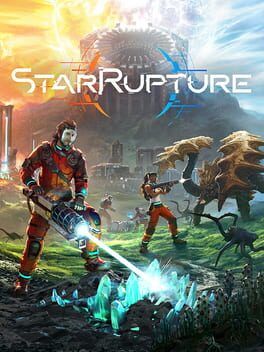
How StarRupture’s Satisfactory‑meets‑No Man’s Sky loop works in practice, what early‑access players are already loving, where it still needs time to grow, and why its launch discount makes it hard for factory‑sim fans to ignore.
StarRupture has only just drilled its way into Early Access, but it is already behaving like a breakout factory hit. It shot up Steam’s new‑release charts with a “Very Positive” rating, it is getting called a “gem in the making” by veteran automation fans, and it has the kind of discount that makes it tempting to any player who has ever lost a weekend to conveyor belts.
For now, StarRupture is very clearly a work in progress. That is also the reason it is interesting. It is less a clone and more a moving target, trying to sit somewhere between Satisfactory’s spaghetti‑factory bliss and No Man’s Sky’s hostile, beautiful sci‑fi frontier.
How StarRupture’s hybrid loop actually works
StarRupture drops you on Arcadia‑7 as a disposable convict contractor for a faceless megacorp. Your job is simple on paper and exhausting in practice. Strip the planet for resources, turn that ore into profit, and survive long enough for the next corporate directive.
The early hours feel familiar if you have played Satisfactory. You land with almost nothing, poke around the alien landscape, then start hammering together the bones of an industrial chain. Nodes of iron or copper become the anchors of your plan. You place extractors on top of them, feed their output into smelters, then into assemblers that craft more complex materials. From there, belts and pipes begin to snake across the terrain as you scale up production.
The No Man’s Sky side of the formula kicks in through the planet itself and the way you move through it. Arcadia‑7 is not just a flat factory canvas. It is a volatile, shifting world with dramatic weather, a day‑night cycle, and pockets of danger that make exploration feel like a deliberate trip into the unknown rather than a casual jog between nodes. New biomes hold rarer materials that push your tech tree forward, but they also increase the chances that something with teeth takes an interest in your operation.
What binds those influences together is the constant tug of war between your growing industrial footprint and Arcadia‑7 pushing back. The more you expand, the more you have to move through the world and the more aggressive the threats become. This, in turn, forces you to upgrade both your production lines and your personal gear. In practice, the loop looks like this: scout and survey, plant the next set of machines, wire them into your existing belts, then dash back to shore up defenses before the next attack hits.
Early access impressions: promising, scrappy, and already addictive
Looking across early reviews and impressions, there is a surprising amount of agreement about where StarRupture stands right now.
Players and critics praise the core combination of factory building and survival as immediately compelling. Even with a relatively modest number of buildings and recipes compared to long‑running giants, the factories you build have that familiar “one more tweak” pull. Small layout decisions spiral into big consequences, and before you know it you have built the kind of lurching, asymmetrical complex that only makes sense to its architect.
The combat and base defense elements are also getting attention. Unlike the distant, almost hands‑off feeling of watching a pristine factory hum away, StarRupture wants you in the thick of it. You are not just optimizing throughput. You are sprinting along catwalks and ducking between smelters while alien packs slam into your perimeter. Reviewers describe this as a genuine point of differentiation. The factories feel alive because they need defending, not just fine‑tuning.
That said, most impressions stress that this is not yet a direct rival to the depth of Satisfactory, Factorio, or Dyson Sphere Program. Automation systems are comparatively straightforward, progression pacing is still rough, and the survival side can sometimes feel like it is missing the nuance of a game that is solely about staying alive. StarRupture is carving out a niche between those extremes, but it has not fully defined that identity yet.
What StarRupture already does well
The biggest compliment so far is that StarRupture is hard to stop playing even in its early, messy state. Its foundation is fun, and several systems are already firing in sync.
The first is the sense of escalation. That modest starter rig of a single extractor and smelter quickly balloons into a multi‑layered facility that sprawls over hills and cliffs. The moment when you realize you need to tear up an entire belt highway because your ore intake has doubled will feel familiar to anyone who has watched a factory game snowball out of control, and it happens quickly here.
The second is the atmosphere. Arcadia‑7 is not the abstract, zoomed‑out map of a pure management sim. You exist on the same level as your machines. You climb over them, squeeze through them, and fight within them. The art direction leans into harsh lighting, bright industrial colors, and unsettling alien shapes lurking at the edges of your searchlights. That close‑up, first‑person perspective gives the factory a weight Satisfactory fans will recognize, while the more overtly hostile wildlife and environmental hazards lend it a No Man’s Sky sense of unease.
Co‑op also earns early praise. Building a factory with friends has always been one of the genre’s secret superpowers, and StarRupture benefits from it immediately. Dividing roles between scouting, defending, and designing production lines keeps everyone busy. Even with rough edges, there is already that “shared project” feeling that makes surviving the next wave or finishing the next production goal a group victory.
Finally, the roadmap itself inspires some confidence. Creepy Jar has shipped and steadily grown a survival hit before, and early access players point to that track record as a reason to believe that StarRupture will keep expanding. The planned additions of new buildings, weapons, resources, and entirely new mechanics suggest the current feature set is a floor, not a ceiling.
Where it still needs time to grow
None of that means StarRupture is finished. Early impressions are candid about the systems that still feel half‑formed.
Automation depth is the most common complaint. While the basics of extractors, smelters, and assemblers are in place, veterans of the genre are already asking for more complexity in logistics and late‑game problem solving. Things like more advanced routing tools, smarter ways to handle overflow, and longer production chains will likely be crucial if StarRupture wants to keep factory obsessives hooked for hundreds of hours.
Combat also divides opinion. It adds tension and gives you a reason to care about your base layout, but it can feel repetitive, with enemies that rely more on numbers than behavior to pose a threat. Some reviewers note that balancing waves against progression is tricky, and right now there are moments where attacks feel either trivial or overwhelmingly disruptive rather than cleanly integrating into the loop.
Performance and polish are also on the usual Early Access to‑do list. Players report frame‑rate dips as factories scale up, uneven UI readability, and occasional bugs that can throw off a long session. None of these are unusual for a complex simulation game in early development, but they do underline that you are buying into something still being built.
The bigger question is whether StarRupture will lean further into factory detail, survival simulation, or continue to split the difference. That decision will shape everything from tech progression to encounter design. For now, the game sits in a hybrid middle ground that is novel but not yet fully optimized.
A rising star for factory‑sim fans, and currently discounted
Despite those caveats, the sentiment around StarRupture’s early access debut is strikingly bullish. The basic interaction of surveying an alien valley, sketching out a new production line in your head, then slowly turning that sketch into a roaring industrial complex while the planet itself tries to shake you off is already compelling. The game feels like a new kind of comfort food for players who enjoy both the meditative rhythm of putting belts in order and the adrenaline of defending what they have built.
Because it is in Early Access, the price is lower than what Creepy Jar expects to charge at 1.0, and storefronts are already running additional launch discounts. For curious factory‑sim fans, that makes StarRupture easier to justify as a long‑term project. You are not just buying the game it is now. You are buying a front‑row seat to watch this strange, aggressive factory‑planet grow.
If you have ever wished Satisfactory’s peaceful conveyor ballet came with a little more danger, or if No Man’s Sky’s worlds left you dreaming about more elaborate bases and deeper production chains, StarRupture is worth a look in Early Access. It is rough, it is ambitious, and it is gaining momentum fast, which is exactly what you want from a sci‑fi factory that is still coming to life.