
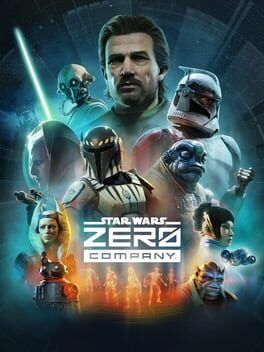
Star Wars Zero Company has landed as an XCOM style Star Wars tactics game, but its staying power may depend on squad identity, repeatable missions, and Gordy Haab's Clone Wars-era score.
Image: IGDB
Store links: Star Wars Zero Company on Steam
A strong tactics launch with a technical catch
Star Wars Zero Company is already available, and the clearest signal around its launch is that a turn-based tactics pitch can still cut through the noise when the identity is sharp enough. StarWars.com posted its “Available Now” guide on August 27, 2026, while public reference listings for the game state that Bit Reactor and Electronic Arts released it for PlayStation 5, Windows PC, and Xbox Series X/S on that date.
The immediate tension is on PC. GamingBolt reports that Star Wars Zero Company peaked at nearly 78,000 concurrent players on Steam shortly after launch, which the outlet says made it the franchise’s second-biggest Steam launch behind LEGO Star Wars: The Skywalker Saga. In the same report, GamingBolt also points to performance problems, crashes, and high GPU temperatures. EA has not announced sales figures in the provided source material, so the Steam concurrency claim is a popularity signal rather than a confirmed unit-sales milestone.
For strategy players, that combination matters in practical terms. A tactics game does not live on launch curiosity alone. It needs a campaign structure that encourages re-runs, a squad players care about preserving, and enough audiovisual identity that repeated maps, ability rotations, and risk calculations keep feeling dramatic. Star Wars Zero Company’s pitch is strongest when those three parts line up: XCOM-style decision pressure, a Clone Wars-era band of misfits, and Gordy Haab writing the score as a continuation of his own Star Wars game music lineage.
The XCOM comparison is useful, but it is not the whole design
The shorthand around Star Wars Zero Company gameplay is obvious: this is an XCOM style Star Wars game from Bit Reactor, a studio that GamingBolt describes as being composed of former Firaxis developers, with Greg Foertsch, an art director on XCOM, directing the project. The Guardian’s review frames the concept as a natural fit, combining complementary class abilities, difficult dice-roll outcomes, and permanent character deaths with a setting built around blaster duels, last stands, and sacrifice.
Public gameplay descriptions fill in the structure. Players control Tesh Hawks, the leader of Zero Company, during the Clone Wars. The player can customize Hawks’ gender, appearance, and voice at the start. Combat is turn-based and played from a top-down perspective, with squad members spending limited action points on movement and abilities. Those action points can be replenished within a turn through certain abilities, according to the public listing, which is important because it suggests the game is not purely about inching from cover to cover. The tactical ceiling comes from sequencing, class interaction, and timing.
The squad can include custom mercenaries and story-based characters. Story characters have unique skills and abilities, while custom units can be sorted into classes. Players can also create astromech droids focused on support and explosives. That mix gives Zero Company two different kinds of investment: authored characters with bespoke identities, and player-built pieces that can serve a specific tactical role. The game also supports lasting injuries and permanent death, with the narrative continuing regardless of who is lost.
That last point is the hinge. Permadeath in XCOM is powerful because it turns a bad flank, a missed shot, or a greedy objective grab into campaign history. In Star Wars Zero Company, the same system has to coexist with a more scripted squad drama. The game is trying to make players care about both the build and the person holding the blaster.
The campaign loop is built around repeatable pressure, not pure randomness
The clearest long-term hook sits between missions. Public listings describe the Den as Zero Company’s base of operations, where players conduct research, upgrade gear, launch strategic investigations, and choose tactical strikes. Campaign time advances in cycles as missions are completed. Some objectives are time-limited and expire if ignored. Non-combat operations can gather intel, and those operations involve narrative decisions that may create consequences several cycles later.
That is where the Star Wars tactics game starts to separate itself from a simple sequence of authored battles. The player is not only selecting the next mission on a list. They are managing tempo. A time-limited objective can force a suboptimal squad choice. A research path can delay a gear upgrade. An intel operation can pay off later, but only if the player can absorb the opportunity cost now. These are the kinds of strategy-layer decisions that make a campaign memorable after the tactical novelty wears off.
The combat missions also appear designed for controlled replayability rather than full procedural generation. Public gameplay descriptions say each level is designed by the developer, while enemy placement is procedurally generated. That choice has consequences. Handcrafted spaces can support readable sightlines, recognizable Star Wars set dressing, and scenario pacing. Procedural enemy placement can keep replays from collapsing into memorized openers. The tradeoff is that players should not expect the same kind of endlessly elastic mission ecosystem associated with heavily modded XCOM 2.
GamingBolt makes that comparison directly, arguing that Zero Company lacks some of XCOM 2’s sheer depth, including the extensive base-building that helped Firaxis’ 2016 game become a long-tail strategy benchmark. That is a fair caution for players who measure value in campaign systems, mod ecosystems, and optimization layers. Zero Company’s staying power, based on the available reporting, seems less dependent on out-simulating XCOM and more dependent on making each operation feel like a squad episode with mechanical consequences.
Squad identity is doing the emotional heavy lifting
The most interesting tension in the reception so far is that Zero Company’s squad identity may be stronger than its death pressure. The Guardian praised the game’s tight-knit team dynamic but argued that, despite the tutorial presenting permadeath as a serious threat, the game rarely becomes dangerous enough to put companions at risk, even on its toughest difficulty. The review says this blunts some of the game’s potential for unscripted drama.
That criticism cuts to the center of the design. If deaths are rare, the campaign cannot lean as heavily on loss as XCOM does. It has to create attachment through other means: banter, ability synergies, class roles, and the small tactical saves that players remember. The Guardian points to exactly that kind of emergent camaraderie, including moments such as a Mandalorian medic arriving in time to heal a Jedi or a clone trooper giving begrudging credit to a former enemy sniper.
For a tactics audience, this is a different retention model. XCOM veterans often talk about the soldier who panicked, the rookie who landed the impossible shot, or the colonel who died because the extraction timer got greedy. Zero Company appears to be aiming for a softer but more authored version of that attachment. You are still managing risk, injuries, classes, and permadeath, but the script is also working to sell the squad as a dysfunctional family.
That could help the game reach players who bounce off harsher tactics campaigns. StarWars.com’s guide frames Zero Company as approachable even for people who have never played a tactics game before. The provided source text does not include detailed accessibility or difficulty options, so that should be treated as official positioning rather than a full mechanical breakdown. Still, it lines up with the Guardian’s observation that the game may be less punishing than its XCOM inspiration.
Gordy Haab is treating the score as a Clone Wars continuation
The other piece of the identity puzzle is music, and IGN’s interview with Gordy Haab gives the clearest look at how deliberate that layer is. Haab has written music for multiple Star Wars games, including The Old Republic, Battlefront I and II, Squadrons, Jedi: Fallen Order, and Jedi: Survivor. For Star Wars Zero Company, he told IGN that he thought of the score as a “sequel” to other Clone Wars-era stories.
Haab specifically pointed to 2017’s Battlefront II as a springboard. He told IGN that after Battlefront I, where he described the assignment as writing “the B-sides for the original scores,” he began branching into his own approach. For Zero Company, his parameter was, in his words, “What would be the sequel to that?” He said he wanted the music to have “that sparkle that the Prequel era music has” while still carrying his own personal aesthetic stamp.
That is important for a tactics campaign because music has a different job here than it does in a linear action set piece. In a turn-based game, players may sit inside the same combat state for a long time, cycling through percentages, cooldowns, ability ranges, and worst-case outcomes. The score has to support deliberation without flattening tension. It also has to make repeatable missions feel connected to a larger era rather than like isolated board-game encounters.
IGN’s interview also shows how far Lucasfilm’s musical boundaries have shifted across projects. Haab said Lucasfilm’s early direction was to be original while treating the original films as the north star. Over time, he said, different shows and games created different walls for each project. He contrasted Star Wars: Hunters, which he scored with orchestra and heavy metal band, with projects where that approach would not fit. For Gordy Haab Star Wars Zero Company is therefore not a blank Star Wars pastiche. It is positioned as a Clone Wars-era score informed by Battlefront II, the prequel sound, and Haab’s accumulated game-specific language.
The real test is support, performance, and depth after launch
The confirmed picture is strong but incomplete. Star Wars Zero Company is out now on PS5, Windows PC, and Xbox Series X/S according to StarWars.com and public release listings. It is a turn-based tactics game from Bit Reactor and EA set during the Clone Wars, with squad customization, story characters, custom mercenaries, astromech support units, action-point combat, lasting injuries, permadeath, a base called the Den, cycle-based campaign time, research, gear upgrades, strategic investigations, tactical strikes, and missions that pair designed levels with procedural enemy placement.
The unconfirmed side is equally relevant for buyers. EA has not announced sales in the provided sources. The source material does not include a price, a detailed patch roadmap, PC requirements, or platform-by-platform performance data. GamingBolt reports serious PC technical issues around launch, including crashes and high GPU temperatures, but the provided material does not document a specific fix. If you are sensitive to PC performance problems, waiting for confirmed patches and updated player reports is the safer route.
If your main question is whether Zero Company is a full replacement for XCOM 2, the available reporting points to caution. GamingBolt says it does not have XCOM 2’s sheer depth, and The Guardian suggests its permadeath pressure may be softer than the premise implies. If your question is whether there is a durable Star Wars tactics game here, the case is stronger. The structure gives players campaign tempo decisions, repeatable mission variation, and squad-level identity. The score, according to Haab’s IGN interview, is built to make that loop feel rooted in the Clone Wars rather than merely borrowing its costumes.
That is the strategic bet. Zero Company may endure if players keep returning to preserve relationships, refine squad roles, and hear each operation as part of the same wartime arc. The launch numbers reported by GamingBolt show curiosity. The next phase will show whether Bit Reactor can turn that curiosity into the kind of campaign habit strategy games need.