
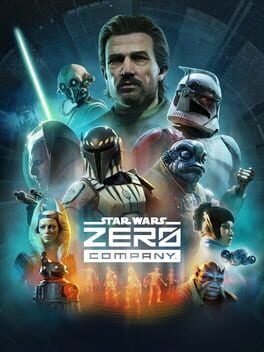

Bit Reactor’s latest Star Wars Zero Company details point to a focused turn-based strategy game: Clone Wars voice talent, a 30 to 40 hour linear campaign, permadeath stakes, and a tightly bounded squad structure.
Image: IGDB
Store links: Star Wars Zero Company on Steam
A Clone Wars tactics game with hard limits is now a much clearer pitch
The clearest new detail around Star Wars Zero Company is also the one most likely to divide Star Wars players by taste: EA and Bit Reactor now estimate a 30 to 40 hour main story campaign for the average player, depending on difficulty and strategy experience, and the game is being described through the developer Q&A as a linear RPG experience rather than a branching galaxy sandbox.
That framing matters because Zero Company is arriving with a lot of familiar Star Wars wish-list ingredients. It is set at the height of the Clone Wars, it stars a customizable leader named Hawks, it includes clones, droids, Mandalorians and a Jedi Padawan, and Lucasfilm Games and Bit Reactor have now revealed a cast that directly reconnects the game with The Clone Wars animated era. Polygon reports that Matt Lanter is returning as Anakin Skywalker and Dee Bradley Baker is returning as clone trooper Trick, with Baker’s wider history as the voice of clone troopers across Star Wars animation giving the announcement obvious weight for Clone Wars fans.
The tension is that Star Wars Zero Company is not being sold, at least in these latest details, as a sprawling open-ended Star Wars life simulator. The confirmed structure points the other way. Rock Paper Shotgun, summarizing Bit Reactor’s developer Q&A, reports no plot branching, no formal character romances, no planned mod support, and no New Game+. Prima Games, also covering the Q&A, describes New Game Plus as unavailable at launch, which leaves a small wording gap between “no New Game+” and “not at launch.” Either way, buyers should treat Zero Company’s first release as a contained tactical campaign, not a platform built around endless campaign cycling.
For strategy players, that is a cleaner sales pitch. A 30 to 40 hour Star Wars Zero Company campaign length gives Bit Reactor room for squad development, loss, mission pressure and authored pacing without asking the design to support every fantasy a Star Wars RPG could possibly imply.
The Star Wars Zero Company cast leans into continuity without making continuity the whole game
The Star Wars Zero Company cast announcement is the strongest signal that Bit Reactor and Lucasfilm Games want Clone Wars authenticity without turning the tactics game into a cameo parade. Polygon reports the main cast includes Jonathan Freeman or Erica Luttrell as Captain Hawks, depending on player choice, Dee Bradley Baker as Trick, JB Blanc as Kabb Uppercut, Judy Alice Lee as Jae Mordant, Nicole Rainteau as Tel-Rea “Tel” Vokoss, Alex McKenna as Cly Kullervo, and Jason Spisak as Luco Bronc.
The supporting cast and cameos reported by Polygon include Leo Howard as Bennic Halloren, Vic Michaelis as Runa Blask, Jim Pirri as Neesh Renark, DC Douglas as M-3VO, Matt Lanter as Anakin Skywalker, Kevin Michael Richardson as Gorga, Rekha Sharma as Fathom, Hunter Smith as Typhon, and Dylan Kenin as Visser. Polygon attributes the full reveal to Bit Reactor and Lucasfilm Games, and notes the San Diego Comic-Con panel titled “Bringing Star Wars Zero Company to Life.”
There is a clear practical benefit here. In a tactics game, players spend a lot of time hearing short command barks, injury reactions, mission chatter and relationship beats between deployments. Baker returning as Trick is especially meaningful because clones are not interchangeable in good Clone Wars storytelling, even when the fiction is built around armies of identical soldiers. Matt Lanter’s Anakin gives the setting a recognizable anchor, but the main playable unit is still Zero Company, a hired, unconventional team led by Hawks.
DualShockers adds useful context by noting other returning Star Wars game and animation veterans in new roles, including Erica Luttrell as the female version of Hawks and DC Douglas as the pilot and medical droid M-3VO. That kind of casting does not prove writing quality, but it does reduce one common risk in licensed tactics games: the feeling that the strategic layer is wearing the franchise as a costume. The Clone Wars cast connection is doing real positioning work for Star Wars Zero Company, especially for players who care about tone as much as rules.
The permadeath Jedi Padawan is a balance decision hiding inside a character reveal
The most interesting design choice in the Q&A is not simply that Star Wars Zero Company includes a Jedi. It is that the Jedi is limited. Rock Paper Shotgun reports that Tel-Rea, the Jedi Padawan in Zero Company, can dual-wield lightsabers and use Force Push to send enemies into overwatch zones. The same report says players only get one Tel-Rea, she is permakillable, and there is no option to train a replacement Jedi Padawan as a custom operator.
That is an unusually important constraint for a Star Wars tactics game. Jedi are a balance nightmare in squad tactics because their fantasy pushes toward dominance: mobility, melee lethality, deflection, crowd control and narrative importance all compete with the value of blaster troops, droids and specialists. If every late-game squad simply becomes “as many Jedi as the roster allows,” the class economy collapses. By making Tel-Rea singular, authored and vulnerable, Bit Reactor can make her powerful without letting the player solve the roster puzzle by stacking Force users.
Prima Games reports that permadeath is enabled by default but can be disabled, and says Bit Reactor framed the mode as a way to reflect loss and consequences. Rock Paper Shotgun likewise notes that players can turn permadeath off. That toggle is the right kind of compromise. Strategy veterans who want the ironman-style emotional spike of a dead specialist can keep the system on. Star Wars players who mainly want the story and squad fantasy can protect themselves from a campaign-defining mistake.
The phrase “permadeath Jedi Padawan” will sound brutal to some players, but the design is less punishing than it first appears if the option is configurable. The sharper point is that Bit Reactor appears willing to protect the tactical ecosystem from the license’s most powerful archetype. If Zero Company lands, Tel-Rea’s value should come from when and how you commit her, not from treating the rest of the roster as backup singers with blasters.
A linear campaign can make mission pressure matter
The developer Q&A details suggest Star Wars Zero Company is built around authored forward motion rather than open-ended wandering. Rock Paper Shotgun reports that the campaign mixes Operations, described as optional, quicker activities that may include choose-your-own-adventure style storytelling, with actual missions. Missions can be delayed and may eventually expire, while story-critical missions become mandatory after a certain point.
That is a familiar strategy structure, but it fits the Clone Wars setting well. A tactical campaign gains teeth when the player cannot do everything, cannot rescue everyone, and cannot grind forever before touching the next story node. Expiring missions create opportunity cost. Optional Operations can feed resources, bonds or advantages, while mandatory missions keep narrative tempo from dissolving into checklist cleanup.
Prima Games reports that the Galaxy Map includes more than 150 planets where strategic Operations can occur, while Tactical Missions take place across more than a dozen handcrafted planets. That distinction is important. A number like 150 sounds massive, but the reported structure suggests many planets support strategic events rather than bespoke battlefield campaigns. That is healthier than pretending every planet will be a fully authored tactical environment. Strategy fans have learned to ask whether map count means variety, repetition, or a mix of war-table abstractions and handmade combat spaces.
Rock Paper Shotgun also reports that players can scout maps before entering battles, and that the squad uses a shared Advantage resource pool for special abilities. Prima adds that some story missions include third-person exploration before combat, letting players gather intel and Advantage Points before the turn-based fight begins. Taken together, these details point to a campaign rhythm where preparation matters before the first shot, rather than a pure sequence of combat arenas.
For players burned out on giant licensed games that confuse scale with strategy, this is encouraging. A linear campaign does not automatically mean a shallow campaign. It can mean Bit Reactor knows where pressure should come from: expiring choices, limited specialists, pre-combat scouting, and battlefield objectives that punish autopilot play.
Bit Reactor is targeting the Overwatch crawl problem directly
One of the more promising mechanical comments from the Q&A concerns pace. Rock Paper Shotgun reports that Bit Reactor is adding mission types such as sabotage and VIP rescue, with the stated hope of avoiding the traditionally safe Overwatch crawl strategy often found in tactics games. That is the right enemy to name.
In squad tactics, Overwatch creep is the gravitational pull that turns dramatic operations into slow corner-checking. Move one soldier, set everyone else to reaction fire, repeat. It is efficient, understandable and often boring. Designers usually fight it with timers, reinforcements, civilian threats, extraction objectives or enemies that punish static formations. Zero Company’s reported sabotage and VIP rescue missions suggest Bit Reactor wants objectives to force tempo rather than letting the player sand every encounter down into perfect information.
The shared Advantage resource pool could become another lever in that tempo game. If Advantage is gained through exploration, intel or aggressive positioning, then the system may reward players who take calculated risks before and during combat. If it is too generous, it could flatten difficulty. If it is too stingy, players may hoard it until the final turns. That balance curve will matter as much as any Star Wars flavor.
The class system also looks broader than the Jedi headline implies. Rock Paper Shotgun reports 12 classes, including four exotic classes, and notes that the Jedi Padawan is one of those exotic options. The same report says players will have both developer-written characters and custom operators. It also says a full squad of astromechs is possible, while EA’s Q&A confirms players will be able to unlock Clone Troopers after a certain story point and field a full team of Clone Troopers. EA also says operators have clone armor cosmetics from the start, and clone helmets provide voice modulation.
That is where Zero Company’s tactics pitch becomes clearer than a sandbox pitch. The fantasy is not “be anyone, do anything.” The fantasy is “build a strange, specialized warband inside a ruleset that cares about composition.” A clone squad, a droid-heavy team, a Jedi-led strike force and a mixed mercenary lineup should create different tactical economies if Bit Reactor’s classes and mission types hold up.
Who should be paying attention before August 27
EA’s official Q&A says Star Wars Zero Company is scheduled for August 27 and points readers toward pre-ordering, but the provided details do not include price, PC requirements, performance targets, editions, or a full platform breakdown. That leaves practical buying questions unanswered for now. Players who care about technical performance, difficulty tuning, save rules and post-launch support should wait for those specifics or for reviews closer to release.
The confirmed and reported design direction is much clearer. Star Wars Zero Company is a single-player, turn-based tactics game set during the Clone Wars, with a customizable Hawks leading Zero Company against the Separatist-aligned Infinite Coil cult and its leader, Kundri Fathom, as Polygon describes the premise. It has a substantial Clone Wars cast connection through Matt Lanter and Dee Bradley Baker. It has a 30 to 40 hour average main story estimate from EA’s Q&A. It has default permadeath that can be disabled, including real stakes for Tel-Rea, the one reported Jedi Padawan operator. It has no reported romance system or branching plot, and New Game Plus support is either absent or, per Prima’s wording, absent at launch.
That package will disappoint anyone hoping for a huge Star Wars RPG where faction allegiance, romance, modding and alternate endings drive replay. It should interest players who want a bounded campaign with tactical pressure, authored squad identities and enough Clone Wars continuity to make the setting feel specific.
From a strategy perspective, the most encouraging sign is restraint. Bit Reactor is not currently describing an infinite Star Wars playground. It is describing a tactics campaign with limits: one Jedi, finite mission windows, a linear story, a defined runtime, and mission types meant to break safe habits. Those limits are where good strategy often starts. The remaining question is whether the final game turns those constraints into difficult decisions for 30 to 40 hours, or whether the Star Wars license ends up carrying systems that do not evolve past the opening act.