
Fuse Games is mashing up Burnout’s brutal takedowns with Star Wars podracing and a runs-based campaign in Star Wars: Galactic Racer. After a wave of previews, here’s why it might be the arcade racer to watch heading into launch – and where it still has something to prove.
Star Wars has dabbled in racing before, but Star Wars: Galactic Racer feels like a pitch that never should have been approved on paper. Take Burnout’s metal-twisting takedowns, mix in the memory of Star Wars Episode I: Racer, wrap it all in a runs-based roguelike structure, and drop it into an underground, post-Empire league of illegal speed freaks.
Somehow, it works.
Across recent hands-on sessions, Galactic Racer has emerged as one of the most confident arcade racers in years. The big question is whether this blend of Burnout chaos, Star Wars fan service, and roguelite structure can do more than just thrill for a weekend. Can it actually help pull arcade racing back into the spotlight when it launches later this year?
Burnout in a galaxy far, far away
The Burnout DNA in Galactic Racer is impossible to miss. Fuse Games is stacked with veterans from the classic EA series, and you feel it as soon as you push a speeder beyond its comfort zone.
Boost is the lifeblood of every race. Instead of sim-style racing lines, you are encouraged to drive like a menace. Drafting behind rivals, threading through traffic, scraping past obstacles, and brushing crash barriers all feed your boost meter. It feels aggressively familiar if you spent any time with Burnout 3 or Revenge, right down to the way the camera leans into your sense of speed as the environment blurs into streaks of color.
The real hook, though, is takedowns. You can shunt rivals sideways into canyon walls, clip their tail just as they line up a jump, or outright spear them head-on. Solid hits trigger slow-motion kill cams that linger on shattered engines, shearing fins, and tumbling debris, a clear homage to Burnout’s greatest hits. It is gleefully nasty in motion, and it suits the fiction of an unsanctioned, Outer Rim death sport where syndicates treat racers as expendable brand assets.
Where Episode I: Racer was about barely contained speed and course memorization, Galactic Racer asks you to weaponize that speed. The best runs juggle both mentalities, flicking between scraping by with millimeters to spare and deliberately body-checking a rival into oblivion just to refill your boost and clear a line.
Podracing heritage without being a remake
Despite all the Burnout talk, Galactic Racer still feels like a Star Wars racer rather than a generic future-sports game with a license slapped on top.
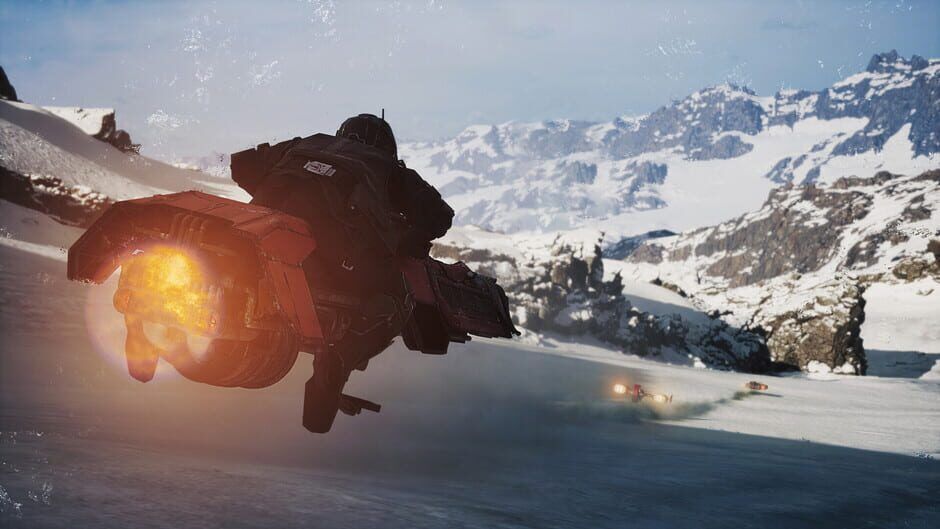
Vehicles sit somewhere between classic podracers and speeder bikes. You are not in a cockpit snug inside a chassis so much as strapped to a shrieking chunk of repulsor tech. Different classes, from Landspeeders to Skimspeeders, emphasize either top speed, agility, or bulk, and the way they skim over terrain evokes the clattery, precarious feel of The Phantom Menace’s podrace.
Track design leans hard into Star Wars geography. Early previews have shown ice canyons, volcanic fissures, forest industrial routes, and dusty Outer Rim settlements crammed with scenery and short-cuts. Environmental hazards sell the fantasy just as much as the speed. Collapsing walkways, crashing starships, shifting machinery and sudden gaps demand quick reactions. You are less learning sterile ideal lines and more memorizing where the galaxy itself might decide to kill you.
Sound and presentation are working overtime to hit that Star Wars itch. Engines wail with a familiar, screen-rattling timbre, blaster fire crackles in the distance, and crowds roar over a score that nods to the films without simply replaying John Williams’ hits. Overlay graphics for your syndicate sponsor, in-universe ads around the circuits, and color-coded HUD elements all make this feel like a piece of the galaxy rather than something bolted on after the fact.
A roguelike racing league
Where Galactic Racer really breaks from both Burnout and Episode I: Racer is its campaign structure. Instead of a menu of fixed championships, you are thrown into The Galactic League, an underground competition that plays out as a series of runs.
Each run is a climb through a branching ladder of events. You start at the bottom of the league, pick from a small handful of race types and locations, and then respond to what the game throws at you. Win a high-risk contract race for one syndicate, and you might be offered better-paying, more dangerous gigs from their rivals. Scrape through a nail-biter with your vehicle hanging together by a thread, and the next “safe” route might be to divert into a repair-focused event that slows your momentum but keeps your run alive.
Between events, you pick upgrades, modifiers, and perks that persist for the duration of that run. Stronger hulls that let you trade paint more aggressively, cooling tweaks that let you run boost for longer, handling mods that help you survive those razor-thin canyon passes: all of these feed back into the basic decision of how recklessly you want to race. Take more risk, get more rewards, but also accept that a single messy collision can end a promising climb.
Lose a critical race or wreck too many times and the run ends. You do not lose everything, though. Roguelite-style meta progression carries over in the form of permanent unlocks: new vehicles, new sponsors and their associated perks, improved access to routes, and cosmetic trinkets that reinforce the fantasy of being a rising star in a very illegal sport.
On paper, the structure solves one of arcade racing’s long-standing problems. Instead of grinding the same cups and time trials for marginal gains, every campaign attempt creates its own little story. Maybe you had a run where you played it safe, settling for lower-risk events but securing a stable bankroll of upgrades. Maybe another time you pushed too hard for syndicate favor, racked up spectacular takedowns, and then watched your season crumble on a single mistimed jump on Mustafar.
Tension, stakes, and the joy of destruction
The biggest impact of the roguelike structure is how it reframes traditional Burnout-style aggression. In classic Burnout, the worst consequence of a bad crash was a lost few seconds and a wounded ego. In Galactic Racer’s league runs, a catastrophic wipeout can mean the end of a multi-event arc, the loss of a promising build, and a trip back to square one with only a few meta unlocks to show for it.
That gives every shunt and brush with a canyon wall a welcome sense of weight. Lining up a risky takedown near a course hazard becomes a real decision. Do you slam this rival into the rock face for the boost and satisfaction, knowing that misjudging it will send you tumbling into the abyss and force a restart? Or do you hold back, accept second place, and play the long game for the sake of the run?
Because so much of your power comes from mid-run upgrades, there is a growing sense of momentum across a good session. Early races can feel a little fragile, with underpowered machines that cannot soak up much punishment. By the middle of a strong run, your speeder has evolved into a custom monster tuned around your preferred style, whether that is a nimble dodger that never stops boosting or a bruiser built to bully the pack.
This escalating tension is crucial to why Galactic Racer already feels more than just a nostalgia hit. It is not only about recapturing the vibes of Burnout and Episode I: Racer but about giving their shared love of risk and speed a new structural backbone.
Variety beyond simple races
Previews have highlighted more than just vanilla “first to the finish” events. The Galactic League format supports a range of race types that all twist the takedown-heavy handling in slightly different directions.
There are standard sprint races that emphasize route choice and split-second drifting through traffic, but also elimination-style events where the last place racer is knocked out every lap. Those naturally amplify the psychological warfare of nudging rivals toward hazards, since every takedown directly shapes the field.
Contract races for specific syndicates enforce modifiers like stricter damage limits, heavier traffic, or more aggressive AI, paying out better rewards if you meet their conditions. There are even mode variants that focus more on survival than finishing position, pushing you through gauntlets of hazards where maintaining your machine is more important than anything else.
It is an approach tailored to the runs-based campaign. You are rarely doing the same thing twice in a row, and the stakes attached to each event type feel different enough that you change your risk profile accordingly.
Can it actually revive interest in arcade racing?
Racing as a genre has spent the last decade leaning either into hardcore simulation or into collectathon-style open world driving. Pure, track-focused arcade racers have been rarer, and those that do arrive often struggle to keep attention beyond a short nostalgic burst.
Galactic Racer’s best shot at breaking that pattern lies in how thoroughly committed it is to its identity. It is not trying to be Forza Horizon with lightsabers, nor a sim with Star Wars decals. It knows it is an aggressive, short-run, spectacle-heavy racer, and everything from the campaign structure to the visual language supports that.
The Burnout-style takedowns give it an immediate hook for lapsed fans of EA’s series. The Star Wars wrapper broadens its reach to people who might not normally pick up a racing game but will show up for podracers and speeder bikes. The roguelite league format, finally, offers a modern retention gimmick that fits the moment to moment action rather than fighting it.
If Fuse Games can deliver enough track variety and vehicle depth, Galactic Racer could hit the sweet spot that eluded so many spiritual successors. A run-based campaign makes it inherently friendly to short sessions, streaming, and “one more race” loops, which are exactly the kinds of habits that help a smaller racing game punch above its weight.
The remaining question marks
For all the confident first impressions, there are a few areas that will only be answered at launch.
The first is long-term progression. Early previews make the roguelite structure sound appealing, but its success hinges on how smartly it doles out unlocks and fresh challenges. If new vehicles, sponsors, and perks keep meaningfully changing your approach ten or twenty hours in, the league could have real legs. If the meta layer runs dry too quickly, the format might start to feel like repetition in disguise.
AI behavior is another potential swing factor. Burnout-style racing lives and dies on how rivals respond to your aggression. They need to be just unpredictable enough to feel alive without ever seeming unfair or rubber-band heavy. The snippets shown so far suggest a healthy willingness to trade paint, but the true test will be whether that holds up over full-length campaigns and higher difficulty tiers.
Multiplayer and social hooks also remain partially obscured. Spectacular slow-motion wrecks and high-risk runs are tailor-made for clips and highlight reels, and the game seems aware of that. But whether shared leaderboards, competitive seasons, or bespoke modes can keep a community engaged past the honeymoon period is still up in the air.
Finally, the Star Wars factor can cut both ways. Lean too hard on familiar planets and sound cues and the game risks feeling like a safe nostalgia play. Push too far into original locations and designs, and some fans might miss a tighter link to the films they love. So far, Galactic Racer appears to be threading that needle, but the breadth of the final track list will be telling.
Where Galactic Racer sits before launch
Taken together, the Burnout-style takedown racing, podracing lineage, and roguelike league structure are giving Star Wars: Galactic Racer a sharper identity than most licensed games manage before release.
On a purely sensory level, it already looks poised to deliver the kind of high-speed, high-impact thrills that arcade fans have been missing. Every boost, every brush with another speeder, every slow-motion takedown feels tuned to make you lean toward the screen.
Structurally, the Galactic League could be the missing ingredient that lets those thrills stay fresh for more than a weekend. By turning each campaign attempt into its own story of risk, reward, and eventual disaster, Fuse Games is giving itself room to keep players coming back in a way traditional cup ladders often fail to do.
Whether that all adds up to a genuine revival for arcade racing or just a very stylish one-off will depend on the depth that sits beyond these early previews. But right now, in a landscape dominated by sims and open worlds, a hard-hitting, takedown-heavy Star Wars racer with roguelike ambitions feels like exactly the kind of shot of adrenaline the genre needs.