
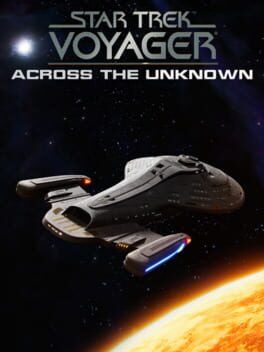

Early expectations for Star Trek: Voyager – Across the Unknown, a rogue-lite survival strategy take on Voyager’s journey home, and how it fits into the long, strange history of Star Trek games.
Star Trek games have been through almost as many anomalies as the shows themselves, from the bridge sims of the 90s to the action-heavy shooters of the 2000s and the MMO era that followed. Star Trek: Voyager – Across the Unknown, due February 18, 2026, from Gamexcite and Daedalic Entertainment, is trying something different again. It turns Voyager’s long way home into a rogue-lite survival strategy game that you can replay over and over, each time recharting the Delta Quadrant.
A Rogue-lite Take On Voyager’s Seven-Year Journey
Across the Unknown is set squarely during the events of Star Trek: Voyager. You assume command of the USS Voyager after it has been flung into the Delta Quadrant, decades away from Federation space. The goal is simple on paper and impossible in practice: get your crew home.
The campaign is structured as a journey across 12 sectors of the Delta Quadrant. Each sector is made up of nodes and events that can play out in different ways on each run. You are not playing through a fixed retelling of the TV episodes. Instead, you get a shifting route where familiar threats, unknown phenomena, and story events remix from one attempt to the next.
This is where the rogue-lite structure comes in. You make hard calls about routes, engagements, and away missions, you manage finite resources, and when things go wrong, you start again with new knowledge, new upgrades, and a different configuration of challenges. Voyager’s central dramatic question “Can this crew hold together long enough to get home?” maps naturally onto rogue-lite repetition and escalation.
Survival Strategy On The Bridge
Across the Unknown’s Steam page pitches it as a survival strategy and interactive fiction hybrid. In practice that means you are juggling three main layers: ship management, tactical encounters, and narrative choices.
On the ship management side, Voyager is your central character. You oversee its systems, allocate power, and decide how to spend scarce resources harvested from encounters and anomalies. Keeping hull integrity, energy reserves, and crew morale in balance looks to be the core of the loop. The more you push the ship, the more likely your next surprise contact will be the one that cripples you.
Tactical encounters range from ship-to-ship combat to environmental hazards. Battle sequences are set up as strategic engagements where positioning, system use, and pre-mission preparation matter more than twitch reflexes. This fits the license: Starfleet captains are supposed to think before they fire. The goal is usually to survive or secure a specific objective rather than simply wipe out the enemy.
Then there are the away missions and narrative events. Here you choose which officers to send, weigh the risks against potential rewards, and live with the consequences. The game leans into interactive fiction elements, presenting you with branching story choices that can cost you resources, crew, or reputation with factions, or unlock new advantages later in the run. Voyager’s episodic DNA is echoed in this format, where each incident feels like a self-contained story that still feeds into the larger journey.
Fitting Into Star Trek’s Long History In Games
Star Trek video games have historically gravitated toward a few familiar templates. There are the bridge crew simulators like Star Trek: Bridge Commander, the point-and-click adventures and narrative games like 25th Anniversary and Judgment Rites, the ship combat and strategy titles such as Starfleet Command and Armada, and more recently the MMO always-on approach of Star Trek Online.
Voyager itself has not had as many dedicated games as The Next Generation or the original series. Elite Force focused on first person away team action, turning the show into a tactical shooter. Across the Unknown moves to the opposite end of the spectrum by putting you back in the captain’s chair and framing the ship as the central unit of play.
In that sense, it feels like a spiritual cousin to modern strategy roguelites such as FTL and more narrative-focused space sims, but filtered through Trek’s ideals. The decision to emphasize survival strategy and repeatable runs aligns it with contemporary tastes while still calling back to Star Trek’s older PC roots where planning, problem solving, and negotiation mattered as much as phasers.
What Stands Out From The Steam Page
The Steam listing for Across the Unknown stresses a few pillars that define the game’s identity. First is the officially licensed use of Voyager as a setting. Gamexcite and Daedalic are working under Paramount’s umbrella, and that should mean visual and narrative fidelity to the show, from the ship design to recognizable locations and species in the Delta Quadrant.
Second is the explicit mix of genres. The description talks about survival gameplay, strategy-level decision making, and interactive fiction. That trio suggests a structure where you are not simply watching cutscenes between battles. Instead, text-driven events and conversations with your crew and encountered aliens are central to the experience, with mechanical weight behind their outcomes.
Third is the promise of high replay value. The campaign’s 12-sector trek is designed to change on subsequent plays, presenting different paths, encounters, and story beats. Steam’s page hints that choices made in one run may affect options in later ones through persistent unlocks and meta progression. That has the potential to support long-term play if the variety of events, ship upgrades, and crew situations is broad enough.
Finally, the single player focus means all the balancing is aimed at a solitary captain on the bridge. There is no co-op bridge crew to coordinate with, no MMO grind. That clarity of focus should allow the developers to tune difficulty curves, resource scarcity, and narrative pacing purely around one person’s command experience.
What Makes A Good Trek Adaptation In 2026?
Adapting Star Trek for games has always been tricky, because the franchise is about exploration, ethics, and science as much as it is about combat. In 2026, expectations have sharpened. Fans have decades of previous Trek games to compare against, and modern players expect mechanical depth along with faithful theming.
A successful Trek game today needs to deliver three things. The first is meaningful choice. Star Trek’s best episodes are about impossible decisions, where any option has a cost. A rogue-lite like Across the Unknown is well positioned to explore this, because failure is part of the structure. The most interesting runs will be the ones where you are forced into no-win scenarios and have to decide which value to compromise: Starfleet protocol, crew safety, or the long-term mission.
The second is an authentic sense of exploration and wonder. The Delta Quadrant is ideal territory for this, full of strange new worlds and cultures that Voyager only glimpsed during its run. If the event design is rich enough, each sector could feel like opening a new episode, complete with unexpected twists and moral dilemmas. The interactive fiction layer is where that spirit of discovery will either come alive or feel thin.
The third is respecting the crew and the ship as characters. Voyager works as a show because of the people aboard and their evolving relationships. Even in a strategy framework, the crew need to matter as more than expendable stats. Away missions that hinge on the particular strengths and histories of certain officers, events that reference past choices, and persistent consequences for losing or injuring key personnel will all help the game feel like Voyager rather than a generic sci-fi roguelite with a license.
Across the Unknown’s pitch aligns well with these pillars. It is structured around decisions, centered on a dangerous journey through unknown space, and built on managing a ship full of people who want to get home. The question now is whether Gamexcite can deliver enough narrative depth and systemic variety to sustain the rogue-lite loop beyond the first few crossings of the Delta Quadrant.
Expectations Heading Toward Release
As it stands, Star Trek: Voyager – Across the Unknown looks like one of the more promising Trek adaptations in years. The survival strategy approach makes mechanical sense for Voyager’s premise, and the choice-driven, semi-randomized campaign has the potential to turn every playthrough into its own canon-light timeline of the ship’s journey.
There are open questions around production values, the breadth of event writing, and how strongly the game will lean into the ethical and diplomatic storytelling that defines Trek. If it leans too hard on combat, it risks feeling like just another space roguelite with familiar costumes. If it gives equal mechanical weight to negotiation, science, and problem solving, it could finally capture the full spectrum of what makes Star Trek tick.
For now, Across the Unknown occupies an intriguing space in the broader history of Star Trek games. It looks back to the more thoughtful PC strategy titles of the past, borrows structural ideas from modern roguelites, and wraps it all around one of the franchise’s most inherently game-friendly premises. As 2026 approaches, it will be one to watch for anyone who has ever wanted to sit in Janeway’s chair and chart their own improbable path home from the far side of the galaxy.