
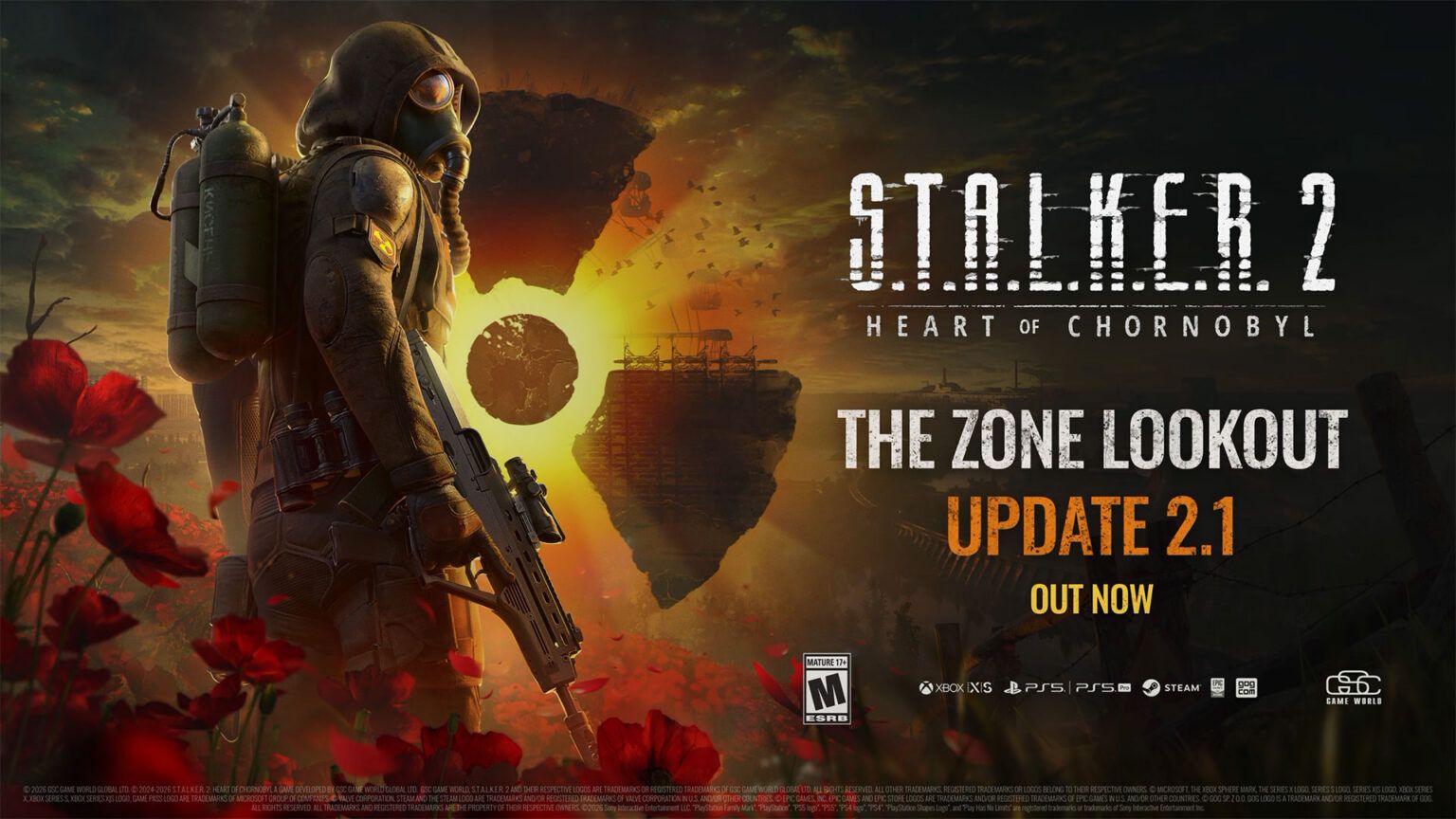
GSC Game World’s Heart of Chornobyl update gives players control over A-Life NPC visualization distance, adds squad-leader fast travel, and raises new performance questions for the Zone.
Image: fullcleared.com
The Zone can now look alive farther out, if your hardware can take it
GSC Game World’s STALKER 2 update 2.1, titled The Zone Lookout, adds a new setting for A-Life NPC visualization distance, giving players direct control over how far away simulated NPC activity appears in S.T.A.L.K.E.R. 2: Heart of Chornobyl. That is the headline change because it cuts straight into one of the game’s most sensitive survival promises: the feeling that the Zone is moving around you, not waiting politely inside a small bubble until you walk close enough.
GamingBolt reports that the update is now available on PC, PlayStation 5, and Xbox Series X|S. GamingOnLinux also describes it as a free update from GSC Game World. The new visualization option is paired with changes to long-range gunfights, binocular support for the increased distance, and a new fast-travel system tied to friendly or neutral squad leaders in the world.
There is one date discrepancy worth separating from the confirmed feature set. Multiple reports tied to GSC’s official showcase and Steam patch notes place the update’s publication on October 26, 2026, with AccountShark citing Steam patch notes at roughly 7:01 AM CT that day. Inven Global, citing a release, says the update went live on October 19. The provided sources do not resolve that conflict, so players should treat the platform client itself as the authority and check whether their installed version is 2.1 before hunting for the new menu options.
The immediate tension is practical. A-Life distance is an immersion feature, but it is also a workload feature. The farther the game asks the Zone to show its teeth, the more it risks dragging frame rate, streaming, and stability into the swamp with it.
A-Life gets a player-facing distance control after a rough reputation at launch
A-Life has always carried unusual weight in S.T.A.L.K.E.R. discussion because it is the series’ name for the simulated life of the Zone, the roaming stalkers, mutants, fights, and encounters that make the world feel hostile even when the player is not the center of the scene. Inven Global describes A-Life as the series’ simulated population of stalkers and mutants that roam, fight, and move on whether the player is nearby. GamingOnLinux notes that the system was one of the more interesting ideas in the series, while also saying STALKER 2’s version was “far less interesting than expected” at release and did not appear to function properly for many players.
Update 2.1 does not claim to solve every long-standing A-Life criticism. What it does, according to GamingBolt, is let players decide how far A-Life NPCs appear. Red Reactions, citing GSC’s showcase, gives the menu path as Settings, then Game, then Visualisation options. That same report stresses an important boundary: the range mainly applies to A-Life NPCs, while quest and scripted characters are handled separately.
That distinction matters for expectations. This is not presented as a universal draw-distance slider for every body in the Zone. If a mission NPC fails to appear, or a scripted character is governed by separate quest logic, the A-Life visualization setting may not touch that case. GamingBolt similarly warns that the setting will not necessarily apply to quest NPCs.
For survival players, though, the feature targets a different problem: the empty horizon. When hostile patrols, neutral stalkers, or distant firefights only become visible close to the player, the world can feel staged. When they appear and act farther out, the journey between two safe places can start to feel like a moving risk assessment again. You are not simply watching fog and treelines. You are reading motion.
The new presets draw a line between atmosphere and STALKER 2 performance
The STALKER 2 patch notes coverage points to several presets rather than one single fixed distance. GamingBolt says the Recommended setting is intended for stability, while Dynamic adjusts the range based on the player’s hardware configuration. It also says Extended and Highly Extended are available for players who want to push the range higher, with the warning that performance could suffer. Red Reactions reports that preset availability can differ between PC and consoles, and that GSC does not provide a universal distance value or guaranteed frame-rate result.
That lack of a universal number is sensible given the feature. A-Life visualization is not the same kind of option as a texture-quality toggle that only changes how sharp a nearby surface looks. It can change how much living activity is being displayed, heard, and supported at range. In a game built around traversal, sightlines, weather, cover, and sudden violence, that can touch CPU work, streaming behavior, AI visibility, and combat readability.
GSC’s stated recommendation, as relayed by Inven Global and Red Reactions, is to use the default or recommended preset for the best balance of performance and stability. Dynamic is the safer experiment for players who want the Zone to stretch farther without manually overcommitting. Extended and Highly Extended sound tempting, especially on a strong PC, but they are the settings most likely to expose stutter, dips, or odd behavior if your system is already close to the edge.
This is the part survival fans should approach like inventory management. Do not change everything at once. Load into a save near a busy route, a settlement edge, or a known conflict corridor. Watch frame pacing while looking across open terrain, then move through the same area at a higher preset. The right setting is the one that lets the world breathe without turning every distant firefight into a hitching contest.
Long-range combat and binoculars are being pulled into the same system
The Heart of Chornobyl update is not limited to making faraway NPCs visible. GamingOnLinux reports that GSC made tweaks to improve long-range gunfights. Inven Global says gunfights can now be heard breaking out much farther away depending on the preset, with weapon ballistics adjusted to match. Red Reactions also notes GSC’s showcase describes distant gunfire audio and weapon ballistics changes, while cautioning that these are developer-reported changes rather than independent benchmark results.
That is a meaningful combination. Visibility alone can make the Zone prettier, but sound is what turns distance into pressure. Hearing a fight before you see it gives you time to choose whether to skirt the ridge, get the binoculars out, prepare an ambush, or keep your head down because the last bandage in your pack is already spoken for. STALKER tension lives in those half-decisions, the ones made with incomplete information and a bad feeling in the dark.
AccountShark’s patch-note summary also says binoculars were adjusted to work with the longer distances. That fits the design direction. If the player can render life farther out, the tools for scouting need to keep up. Otherwise the setting would mostly benefit screenshots and accidental sightings. With binocular support, the feature becomes part of route planning.
The open question is consistency. Long-range combat needs believable audio falloff, visible targets, and ballistics that do not collapse into theater. If the update succeeds, distant gunfire should become information. If it fails, it could become noise, with fights starting beyond practical player response or dipping performance exactly when the player needs a clean read. That is the first thing I would test after updating: find a high vantage point, listen, scan, and see whether the game gives you actionable danger rather than atmosphere alone.
Squad-leader fast travel shortens journeys without erasing the march
Update 2.1 also adds a new form of fast travel through squad leaders. GamingBolt reports that friendly or neutral squad leaders in the world can be paid for travel, similar to guides. Inven Global adds that squad leaders now appear on the compass, and that players can talk to them to travel to a nearby destination along that squad’s route.
This system has firm limits. Inven Global says only nearby locations the player has already explored are available, weight limits still apply, and a squad leader will not carry the player’s backpack. The same report notes GSC’s example that a stalker from Zalissya will not take players all the way to Prypiat. GamingBolt also reports that the service costs “good cash,” even when the squad is neutral or friendly.
Those restrictions are important because STALKER’s survival rhythm depends on the return trip being dangerous. A fully open fast-travel grid can drain the dread out of a route once the player knows it. This version, as described by the patch coverage, sounds more like opportunistic movement than teleportation. If a squad is heading your way and you can afford the fare, you can shave off some repetition. If you are overburdened, broke, or trying to cross half the map, the Zone still gets a vote.
For players returning after a break, this may be the most convenient change in day-to-day play. The A-Life distance setting affects how alive the wilderness feels. Squad-leader travel affects how much friction sits between repairs, stash runs, quest turn-ins, and the next ugly detour. Used sparingly, it should ease backtracking without turning the map into a menu.
Patch fixes target missions, anomalies, AI, and PS5 missing NPC problems
Beyond the headline features, the broader STALKER 2 patch notes coverage points to a maintenance-heavy update. AccountShark’s summary says The Zone Lookout includes dozens of AI, combat, and mission fixes, a long list of PlayStation 5 missing-NPC bugs, fixes for Cost of Hope starting missions that would not begin, and reworked anomalies including the CNPP arch-anomaly. Red Reactions similarly says the complete Steam notes list binocular adjustments, anomaly changes, and mission fixes.
Those fixes sit in the shadow of Update 2.0. AccountShark describes 2.0 as the earlier Back to the Zone update that arrived alongside Cost of Hope, bringing an engine upgrade, updated foliage and lighting, new weapons and attachments, binoculars, and custom difficulty. It also says follow-up patches addressed crashes, especially on AMD hardware. Update 2.1, by that account, is GSC’s answer to ongoing feedback around A-Life behavior, missing characters, and the feeling that the Zone was too empty at distance.
GSC’s own framing, as relayed by Inven Global, is that the patch was “almost entirely community-driven,” shaped by feedback from social media, forums, and reviews. That does not automatically mean every player complaint is fixed. It does mean the update is aimed at the places where STALKER 2’s survival fantasy most often broke down: NPC presence, combat behavior, quest reliability, and travel friction.
Players using mods should be cautious. AccountShark reports that GSC recommends disabling mods if players see performance or stability problems after 2.1. Red Reactions also points players toward GSC’s support center for further help. Given that this patch touches visualization range, AI-adjacent behavior, travel systems, anomalies, and missions, mods that alter the world, NPCs, difficulty, or performance settings are obvious candidates for conflict.
What to test before trusting the new Zone
After installing STALKER 2 update 2.1, the first check is simple: confirm the game is actually on version 2.1, since the reports do not give one universal storefront download time and AccountShark says consoles list the download as update 1.025 while bringing the game to 2.1. Then go to Settings, Game, and Visualisation options, as reported by Red Reactions, and note the available presets on your platform.
Start with Recommended or Dynamic before trying Extended or Highly Extended. Watch the game in the places where STALKER 2 is most likely to strain: open views across ruined ground, approaches to settlements, roads where patrols cross, and areas where gunfire can carry. Do not judge performance only while standing still. Move, turn quickly, use binoculars, and listen for distant combat. If the Zone feels richer but your aim turns syrupy when a fight begins, the setting is too expensive for your machine.
Next, test whether the added distance changes survival decisions. Can you spot a squad early enough to avoid them? Does a far-off exchange tell you where danger is moving? Do binoculars now help you plan a route rather than simply confirm that something is already too close? These are the practical gains the A-Life NPC visualization option needs to deliver.
Finally, try squad-leader fast travel as a tool rather than a habit. Look for friendly or neutral squad leaders on the compass, check the destinations, compare the fare against your repair and ammunition needs, and remember that explored-location and route limits still apply. In a good STALKER run, saving time can cost safety later if it empties your wallet before the next bad night.
The Zone Lookout update sounds strongest when treated as a tuning pass for pressure. It gives players more control over how far the world reaches, but it also asks them to decide how much performance they are willing to feed into that illusion. For a survival game, that trade is fitting. The farther you stare into the Zone, the more it may demand back.