
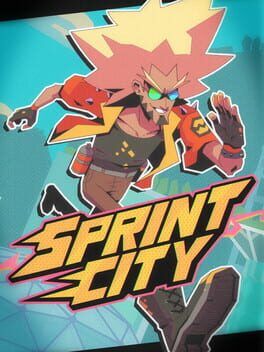
From the creators of SpeedRunners, Sprint City’s new Steam demo turns competitive platforming into a high‑speed multiplayer parkour playground, with layered map design and user‑generated challenges hinting at a deeper formula ahead of its Q1 2026 launch.
Sprint City does not waste time explaining itself. The new Steam demo drops you into a sun‑drenched solarpunk skyline, points you at the nearest glowing objective, and lets the movement system do the talking. Within a few minutes the lineage is obvious: this is from the original creators of SpeedRunners, and it is very clearly their attempt to scale that razor‑sharp competitive platforming into something bigger, more social, and more expressive.
The demo is only a slice of what is planned for the full Q1 2026 release, but it already shows how the team is evolving its formula through high‑speed multiplayer parkour, layered map design, and user‑generated challenges.
From tight arenas to a shared city
SpeedRunners lived and died on tiny loops of track where every pixel of momentum mattered. Sprint City keeps that obsession with speed but moves it into an open, shared‑world structure. Instead of four runners looping around a single circuit, the demo lays out a dense vertical neighborhood where you are constantly choosing routes, chaining wall‑runs and grapples, and eyeing every ledge as potential tech.
The shift to a city that multiple players occupy together changes the competitive tone. Races and challenges still exist as clearly framed events, yet they are reached by free‑roaming across rooftops with other runners visible in the distance. You feel like part of a living pick‑up‑and‑race community rather than a matchmaking queue that only exists between load screens.
This structure also lets the movement system breathe. Traversing to a race start becomes its own mini‑puzzle. You can follow the obvious ramps and billboards, or you can start experimenting, looking for wall angles that preserve momentum, pipes that chain into grapples, and low‑friction surfaces that let you maintain a sprint for longer than the designers probably intended.
Parkour as a competitive language
The core of Sprint City is still a side‑on competitive platformer, but the demo leans into parkour as a language you learn over time. Basic sprinting feels snappy and instantly readable if you have SpeedRunners muscle memory, yet the expanded move set turns every run into a negotiation between speed and control.
Wall‑running is the most immediate upgrade to the old formula. Surfaces that would be simple jumps in a traditional platformer become opportunities to maintain momentum where others might stall. You are not just clearing gaps, you are painting lines up and along structures, always trying to stay in a state of flow.
The grappling hook and swinging kit layer verticality on top. A well‑timed grapple cancels a bad jump, saves a misread corner, or slings you into a completely different path. When several players share the same stretch of skyline, you start to see wildly different interpretations of the same space. One runner threads tight ground‑level slides, another commits to long arcs through the air, and a third uses wall‑runs to bounce between the two.
That variety is what keeps Sprint City from feeling like a simple SpeedRunners successor. Where the previous game asked you to solve a track once and then execute perfectly, this one invites you to keep rewriting your solution as you learn the physics and the geometry of the city.
Map design that invites obsession
The playable district in the Steam demo is deliberately limited, but it is clearly designed to be run hundreds of times. Routes overlap and fold back on themselves. Short, readable streets hide side paths that only become obvious once you are comfortable enough to look away from the main racing line.
Each rooftop has at least two ways up and usually several ways across. Fire escapes, air vents, glass walkways and decorative facades all double as parkour lines. Even within a single time trial route, there is a constant tension between following the signposted path and trusting that there is a faster line hidden just out of sight.
It is here that the SpeedRunners DNA is loudest. The camera framing and 2D perspective keep everything clean and readable. Visual language does a lot of work: bright rails, hanging signs and color‑blocked platforms hint at possible shortcuts without outright spoiling them. Failures are rarely confusing, which is vital in a game that wants you to iterate instantly.
The city’s solarpunk aesthetic supports this design focus. Clean horizons, saturated colors and sparse background clutter make silhouettes easy to parse at high speed. You know at a glance what is solid, what can be wall‑run, and which hanging fixtures are safe grappling targets. It is stylish and practical in equal measure.
User‑generated challenges as the glue
Where Sprint City truly starts to differentiate itself is in how it treats user‑generated challenges as a first‑class feature. Even in this early demo you are encouraged to create runs and race variants that other players can tackle. Instead of only consuming developer‑crafted time trials, you become a route designer.
This system works because the city is built like a toolkit. Choke points, multi‑tiered avenues and open plazas can all anchor different flavors of challenge. You might set up a tight, technical sprint that snakes through alleyways and demands perfect wall‑runs, or a looser race that rewards risky grapples off distant cranes.
Competing on these user‑authored tracks feels less like memorizing content and more like deciphering another player’s idea of flow. The map design supports it by keeping the density of options high. Even when you accept a challenge made by someone else, you still have room to put your own spin on the route, and leaderboards capture those tiny optimizations.
If SpeedRunners was about mastering a handful of official circuits, Sprint City looks ready to turn its entire shared city into a canvas that the community can keep redrawing.
Multiplayer that starts at the city level
The online layer is built around the idea that you and your friends are inhabiting the same place, not jumping between isolated lobbies. The demo’s shared world means that moving from free‑roam to a formal race is often just a matter of converging on a marker together and voting into a mode.
Steam integration in the demo makes inviting friends simple, but the feature that stands out is browser play. A Steam player can fire off an invite link that drops friends into the game through a web browser without a full download. For a skill‑based platformer that thrives on quick rematches and casual dares, this lowers the barrier to entry significantly.
Combined with user‑generated challenges, this makes Sprint City feel more like a multiplayer playground than a traditional match‑based game. You can be exploring, spot another runner hammering away at a time trial, and within seconds you are racing their ghost or trying to shave a second off their record.
A promising path to Q1 2026
The demo is honest about its scope. Content is limited, progression is mostly placeholder, and you will see the same skyline slices often if you fall in love with a particular challenge. But the fundamentals are strong, and that is what counts in a high‑speed competitive platformer.
Movement already feels tuned to that delicate balance where tiny skill improvements translate into meaningful time saves. The map design invites experimentation instead of forcing rote memorization. User‑generated challenges and the shared world structure hint at a community that could keep the game vibrant long after the initial launch window.
With a full release targeted for Q1 2026, Sprint City has time to layer in more districts, more toys and deeper progression. If the team can maintain this clarity of movement and expand the city without diluting its density, Sprint City has every chance to become the next fixture in competitive platforming, not just a spiritual successor to SpeedRunners.
For now, the Steam demo makes a strong case. If you ever wondered what SpeedRunners would look like stretched across an entire city, populated by a constant flow of friends, rivals and community‑made challenges, Sprint City is starting to sketch out that future at a very fast pace.