
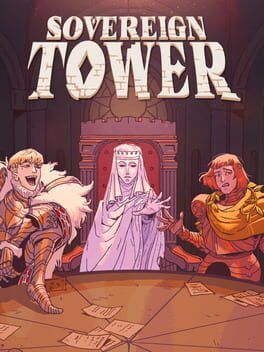

Sovereign Tower blends Round Table management, fantasy RPG choices, romance, faction pressure, and a demon-powered time loop. Early impressions suggest a darker game than its cozy presentation implies.
Image: IGDB
Store links: Sovereign Tower on Steam
A kingdom sim with a demon in the basement
Sovereign Tower is being framed by early critics as a management RPG that looks welcoming at first glance, then starts asking how much damage a ruler is willing to erase. CGMagazine identifies it as the new management RPG from WILD WITS GAMES, published by Curve Games, with a listed PC release date of 06/08/2026. Its review listing categorizes the game as a role-playing game, indie title, and visual novel, which is a useful starting point because Sovereign Tower sits between several familiar shapes without cleanly belonging to only one of them.
The concrete hook is simple and dangerous: as the Sovereign, you manage a broken fantasy kingdom, recruit knights to your Round Table, settle petitions, send companions on quests, and eventually face the temptation to rewind time through a demon relic. Rock Paper Shotgun describes that relic as capable of rolling back the seasons while leaving the player character’s knowledge and stats intact. COGconnected similarly reports that a demon in the bowels of the castle offers a magic crystal that can turn back time, while warning that the demon is not presented as an ally and that the consequences are not immediately laid bare.
That is the tension behind the current Sovereign Tower preview conversation. On the surface, this is a paper-map kingdom manager full of strange knights, faction petitions, flirtation, gossip, and oddball medieval humor. Underneath, according to multiple outlets that have played it, it is a game about irreversible social harm, dead timelines, compromised ideals, and the uneasy power fantasy of being the only person who remembers how badly things went.
The daily loop is small, but the pressure is systemic
The structure reported so far sounds approachable. Rock Paper Shotgun says days follow a cycle in which the player goes to the throneroom, hears petitions from the realm, then assigns knights to quests. COGconnected describes a similar rhythm: holding an audience, listening to citizens grovel, flatter, complain, or make demands, assigning knights, buying weapons, leveling attributes, hearing gossip, and consulting advisors.
That could read like a cozy Sovereign Tower management game if the consequences were light. The reported systems suggest the opposite. Rock Paper Shotgun says players must watch gold reserves and reputation among scholars, merchants, peasants, and nobles. CGMagazine emphasizes that choices can raise standing with one group while lowering it with another, and that improved faction ranks can unlock potential choices and upgrades. The important distinction is that the faction layer is not only a meter to optimize. It intersects with role-playing intent. CGMagazine’s reviewer described playing a ruler focused on commonfolk, which angered the nobles enough to trigger an uprising unless a specific recruited noble knight and marriage route could calm the crisis.
That example is the clearest sign that Sovereign Tower RPG progression is less about finding universally correct answers than building a political toolset before the kingdom punishes your blind spots. If you recruit for moral comfort, class solidarity, romance, or raw competence, you may be leaving yourself exposed somewhere else. A knight can be a stat block, a diplomatic bridge, a liability in the castle, or the missing piece that prevents civil war. For RPG players who care about party composition, that makes the Round Table function like a build, except the build is social, political, and narrative rather than only combat-oriented.
Knights are companions, resources, and problems
The most distinctive character writing in the available previews comes through the knights themselves. Rock Paper Shotgun spends time with Ursula, a recruit described as shrewd and arcane-minded, useful for quests involving stolen grimoires and talking wheels of cheese, but also irresponsible, resistant to diplomatic work, and fond of grinding up spiders for a local beverage. The same preview notes that the writer kept returning to Ursula’s scenes because they were trying to romance her, with repeated rewinds dulling the impact of the same flirtatious exchanges.
COGconnected reports a wider range of companion complications. A knight sent on a goose chase may have a phobia of waterfowl. A quest failure might cost coin, cause embarrassment, lead to a knight’s breakdown, or end in death. CGMagazine adds that building the Round Table brings the same instability as governing the kingdom. A roster full of nobles and wealthy knights may object to sheltering refugees in the castle, while a table filled with criminals and miscreants can unsettle castle staff.
Those details make Sovereign Tower’s party management feel closer to a courtly RPG than a simple dispatch board. The player is not merely matching high arcane stats to an arcane mission. Personal taste, ideology, social origin, emotional stability, and factional connection all appear to feed the outcome web. Rock Paper Shotgun notes that Ursula’s stats make her attractive for certain eldritch tasks, but her preferences make her difficult to use cleanly. That friction is where the darker reading of the game begins: every character relationship can be optimized, but every optimization risks turning people into tools for a timeline you may later discard.
Time travel changes failure into temptation
Sovereign Tower time travel is the system early impressions keep circling because it reframes failure without making it harmless. In Rock Paper Shotgun’s account, the player initially swore not to use the demon relic, then sent all available knights away shortly before a bearded Dragon Knight arrived to challenge the Sovereign to a duel. With no gallants available, the player was beheaded and entered a spiral of rewinds. The comedy of that situation sits beside a grim design question: if the game gives you a way to undo disaster, how long before restraint feels foolish?
CGMagazine calls Sovereign Tower a constant wrestling with temptation. Its review opens with the loss of a knight, a failed journey, and the collapse of a crucial alliance while a fearsome opponent’s return approaches. The choice presented there is not between success and failure in the abstract. It is whether to continue into an impaired future and hope for a last-minute correction, or return to the demon, rerun the clock, and accept unknown consequences.
COGconnected highlights the philosophical cost of this system. Because the Sovereign remembers what happened after a rewind, you can use prior knowledge to choose differently, but doing so kills off the previous timeline, including positive bonds or events that existed there. That is a sharper design than a standard save reload because the fiction appears to acknowledge the moral weight of repetition. PC Gamer’s headline, based on its preview, goes so far as to call the system one of the best time travel systems the writer had encountered, while also describing the game as ruthless, full of murder and impossible choices. The provided PC Gamer source excerpt does not include the full argument behind that claim, so the exact basis for that praise is not available here, but it aligns with the other reports that time travel is central rather than decorative.
The darkness is hiding inside the presentation
Several accounts stress the contrast between Sovereign Tower’s outward charm and its harsher consequences. Rock Paper Shotgun calls the early hours a lush Celtic creation and compares its feel to Reigns expanded into a fuller RPG, with a paper map resembling medieval Brittany. The same preview notes WILD WITS GAMES hails from that region and speculates, playfully and explicitly as speculation, about whether an evil encroaching empire could be read through Breton historical context. That historical reading is not confirmed by the developer in the provided material, but the regional texture appears to be part of what makes the game’s courtly world feel specific.
COGconnected describes the art as charming and a little rough, comparing it to a medieval manuscript crossed with a graphic novel. It also reports that there is no voice acting, while praising the writing and its use of anachronistic humor and modern sensibilities over a medieval frame. That matters for expectation-setting. A player coming to Sovereign Tower for cozy oddness may find that tone, but the sources consistently say the jokes coexist with murder, class resentment, death, faction collapse, and manipulation through time.
CGMagazine’s noble uprising anecdote is especially useful because it shows how comedy can turn into systemic threat. The nobles are petty enough to be funny, but if neglected, they can declare war on their own ruler. A marriage can defuse the situation if the right knight is present. Without that person, CGMagazine says events would have taken a darker turn. This is where Sovereign Tower’s cozy look becomes deceptive. The presentation may soften the first impression, but the underlying quest logic seems interested in causality, leverage, and the cost of ruling by hindsight.
The risk is repetition, not lack of ideas
The biggest caveat in the available Sovereign Tower preview material is also tied to its most interesting system. Rock Paper Shotgun says the time rewinding introduces repetition and that, after three to four hours, the writer worried it could be the reason they might not finish the game. They describe the early experience as delightful, but note that repeated flirtatious banter and revisited scenes can begin to feel dulled by the loop.
That concern should not be dismissed. Time-loop RPGs live or die by how well they distinguish productive repetition from busywork. If rerunning a season reveals new quest paths, exposes hidden faction dependencies, and changes how the player understands a knight, repetition can become progression. If it requires too much repeated dialogue or routine management before reaching the altered decision point, the cost of experimentation rises. The provided sources do not give enough information to say how Sovereign Tower handles long-term skip tools, scene acceleration, or late-game loop fatigue, so that remains one of the practical unanswered questions.
Still, the critical spread suggests the game’s structure has teeth. CGMagazine awarded Sovereign Tower a 9 in its PC review and emphasized its choice pressure. COGconnected’s review argues that good and bad choices are rarely obvious, and that the game is denser than its art and writing may initially suggest. Rock Paper Shotgun is more cautious on the time-loop repetition but still praises the opening blend of Celtic atmosphere, court management, and RPG structure. Taken together, the early picture is not of a shallow novelty, but of a systems-heavy court drama whose central mechanic may be brilliant for some players and exhausting for others.
Who should keep Sovereign Tower on their radar
Based on the provided listings and reviews, Sovereign Tower is most clearly positioned for PC players interested in RPG choice architecture, companion management, and narrative systems that punish clean optimization. CGMagazine lists the played platform as PC and names WILD WITS GAMES as developer and Curve Games as publisher. A Steam community listing exists for app 4113940, and a Steam page for the Sovereign Tower Demo exists at app 4422320, but the provided Steam source text does not include pricing, system requirements, supported languages beyond the page language menu, controller information, or a final platform breakdown. Those details should be checked directly on Steam before purchase.
For RPG players, the strongest reason to watch Sovereign Tower is its apparent refusal to separate builds from ethics. Your Round Table composition, faction reputation, romantic choices, quest assignments, and willingness to rewind all feed the role you are playing. For management fans, the appeal is a kingdom sim where the resource graph has names, grudges, and phobias. For visual novel readers, the draw is branching conversation under pressure, with the added twist that a character may remember success only because you erased the path that first taught you how to reach it.
The cautious advice is equally clear. If repeated scenes in time-loop games bother you, Rock Paper Shotgun’s concern about repetition is worth taking seriously. If you want voiced presentation, COGconnected reports there is no voice acting. If you want a cozy monarchy builder where careful play can keep everyone happy, CGMagazine and COGconnected both describe a game built around tradeoffs, failure states, and choices whose consequences may not be obvious when selected.
That is also what makes Sovereign Tower stand out. Its darkest idea is not simply that rulers make cruel decisions. It is that the game lets a ruler learn from cruelty, rewind the evidence, and then benefit from knowledge earned in a dead version of the world. For an RPG about kingship, that may be the sharpest throne in the room.