
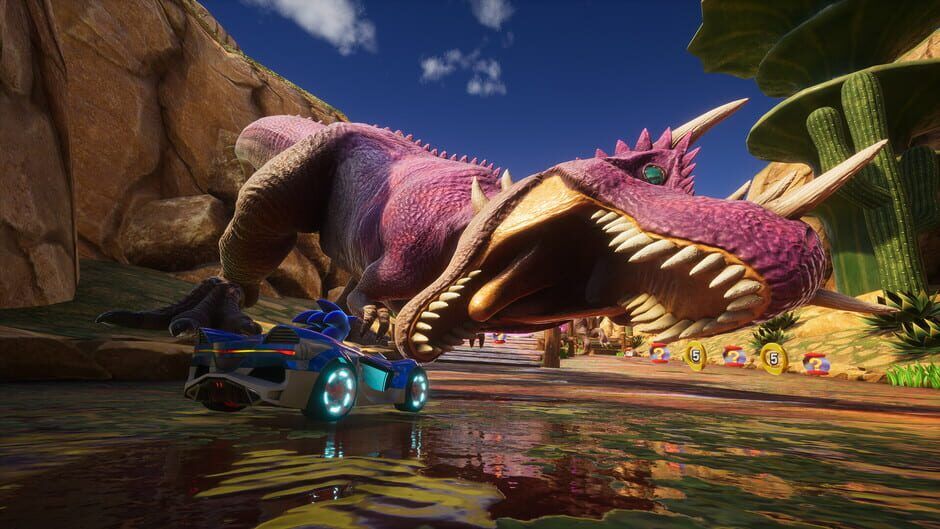

Sega reveals a wave of free post-launch crossover racers for Sonic Racing: CrossWorlds, including Classic Sonic, Crazy Taxi’s Axel, and Amigo, and hints at a broader live-service roadmap built on Sega nostalgia.
Sega is leaning hard into its back catalog with Sonic Racing: CrossWorlds, and the company has now confirmed that some of its most nostalgic additions will arrive as free post-launch content. Classic Sonic, Crazy Taxi’s Axel, and Amigo are all set to join the roster after release, giving players more reasons to keep returning to the track without opening their wallets.
Classic Sonic takes the wheel
Sonic Racing: CrossWorlds already leans into the series’ modern style, but the addition of Classic Sonic is a direct pull from the 16-bit era. Rather than just being a cosmetic swap, Classic Sonic is being treated as a fully fledged racer with his own vehicle and animations, aimed at fans who grew up on the Mega Drive / Genesis games and players who discovered the character again through Sonic Mania.
Where the main Sonic in CrossWorlds channels high-tech aesthetics and sleek lines, Classic Sonic is all about chunky proportions and bold colors. Sega’s pitch is clear: bring the two versions of its mascot together in a single roster so players can mix generations in online lobbies and local multiplayer. For a game that sells itself on warping across dimensions, having timelines collide in the character select screen fits the premise perfectly.
Axel drifts in from Crazy Taxi
Axel’s arrival from Crazy Taxi is arguably the boldest crossover pick in this first wave. He is not a traditional circuit racer, which is exactly what makes him interesting here. Crazy Taxi is all about aggressive driving, traffic-dodging lines, and showboating for style points, and that energy translates naturally into an arcade racing crossover.
In Sonic Racing: CrossWorlds, Axel rolls in with his signature cab adapted to the game’s more exaggerated track design. Expect heavy emphasis on drift handling and high-risk shortcuts, in line with how Crazy Taxi rewarded players for weaving through impossible gaps. Sega clearly understands that nostalgia is strongest when it comes packaged with recognizable vehicles as well as faces, and Axel’s yellow cab is one of the most iconic silhouettes in Sega’s arcade history.
Amigo keeps the party going
Amigo, the maraca-shaking mascot of Samba de Amigo, rounds out this early crossover trio on the lighter side. Where Sonic and Axel push speed and aggression, Amigo exists to reinforce Sonic Racing: CrossWorlds as a party-forward racer. His inclusion taps into Sega’s music-game legacy and lets the art team go wild with bright colors, rhythmic animations, and carnival-style vehicle design.
Post-launch racers like Amigo also hint at how Sega might use themed events and limited-time playlists. It is easy to imagine rhythm-inspired track modifiers or event challenges tied to Amigo, adding short bursts of novelty that fit a live-service cadence without overhauling the core game.
Free DLC and Sega’s live-service plan
The biggest story around Classic Sonic, Axel, and Amigo is that they are confirmed as free additions. In an era where character drops are often used to sell season passes and premium bundles, Sega positioning these crossovers as no-cost updates is a strategic move.
First, it helps keep the online player base unified. When core roster expansions are free, matchmaking is simpler and new players are less likely to feel gated out of content. For a racer that aspires to live on as a platform, that matters more than a short-term bump in cosmetic revenue.
Second, it signals how Sega wants Sonic Racing: CrossWorlds to function as a live-service hub for the entire Sega universe. The publisher has already talked about ongoing support and crossover content, and starting that roadmap with recognizable Sega icons at no extra charge builds early goodwill. Players are more likely to stick around for the long haul if the first impression of post-launch support is generous rather than restrictive.
Third, these free drops give Sega an easy way to build a rhythm of updates. Even if the game later introduces paid cosmetics, premium passes, or external collaborations, anchoring the big headline characters as free additions keeps each season or content beat feeling relevant to everyone, not just spenders.
A Sega multiverse on wheels
Sonic Racing: CrossWorlds is positioned as more than just another mascot kart racer. The travel ring gimmick and dimension-hopping structure create an in-universe excuse to bring in wildly different Sega properties. Crazy Taxi’s arcade streets, Samba de Amigo’s rhythm-infused style, and classic 2D Sonic zones all make thematic sense when the premise is that every world can intersect on the track.
That framing is important for the live-service strategy because it gives Sega room to expand in almost any direction. After Classic Sonic, Axel, and Amigo, the door is wide open for other pillars from Sega’s catalog, from arcade staples to cult console favorites. Each new racer and track can double as a small celebration of a franchise, keeping CrossWorlds relevant both as a game and as a running museum of Sega history.
If Sega can maintain a steady pipeline of free characters and tracks while using optional cosmetics and themed events to fund ongoing development, Sonic Racing: CrossWorlds has a chance to become one of the publisher’s longest-running live titles. This first wave of no-cost crossover icons is a strong indication that Sega understands how important a player-friendly foundation is when building a live-service racer around nostalgia.