
Breaking down the first SOL Shogunate dev diary: its lunar samurai setting, rival clans, narrative hook, and why this slick space‑sengoku action RPG is one of the most intriguing mid‑budget projects on the horizon.
SOL Shogunate has been quietly building a lot of buzz for a game that is still a ways off, and its first dev diary finally gives that interest something solid to latch onto. Rather than leading with combat breakdowns or progression systems, Chaos Manufacturing spends its opening salvo on a different priority: making sure you understand why its take on “samurai on the moon” is more than a cute elevator pitch.
In a space crowded with soulslikes and character action games chasing the same reference points, SOL Shogunate is angling for the mid‑budget sweet spot, where a vivid setting and sharp art direction can do as much work as raw scope. The new video, hosted by game director Leszek Szczepański and narrative director Cindi Knapton, is essentially a worldbuilding manifesto that lays out where this lunar saga takes place, who is fighting over it, and why that matters to your revenge story.
A lunar sengoku: samurai in a glass city on the moon
At the heart of SOL Shogunate is a very specific image: a pseudo‑Edo metropolis built under glass on the surface of the moon, neon signs and holo‑screens cutting through a cold vacuum sky. That city is Shin‑Edo, described in the diary as the Lunar Glass City, and it functions as the hub of this entire setting. Traditional Japanese silhouettes, narrow streets and paper lanterns mingle with climate domes, artificial gravity rigs and humming maglev rails. It looks like the kind of place where the ruling class would absolutely insist on walking around in ornate armor with a plasma‑kissed katana at their hip.
Szczepański and Knapton frame SOL Shogunate as a samurai space opera rather than straight historical fantasy. The moon is not just a backdrop but a pressure cooker, with every inch of habitable space engineered and fiercely controlled by the powers that be. Shin‑Edo is the statement of that control, an engineered vision of culture surviving intact in a place that would otherwise kill you in seconds.
Beyond its gleaming districts lies the harsher side of lunar living. The dev diary touches on more hostile regions outside the safety of the domes, places where life support is fragile and the façade of imperial glamour falls away. That contrast is crucial to the pitch: this is not a free‑roaming space playground but a stratified satellite ruled by whoever owns the air, water and gene tech that keep its inhabitants alive.
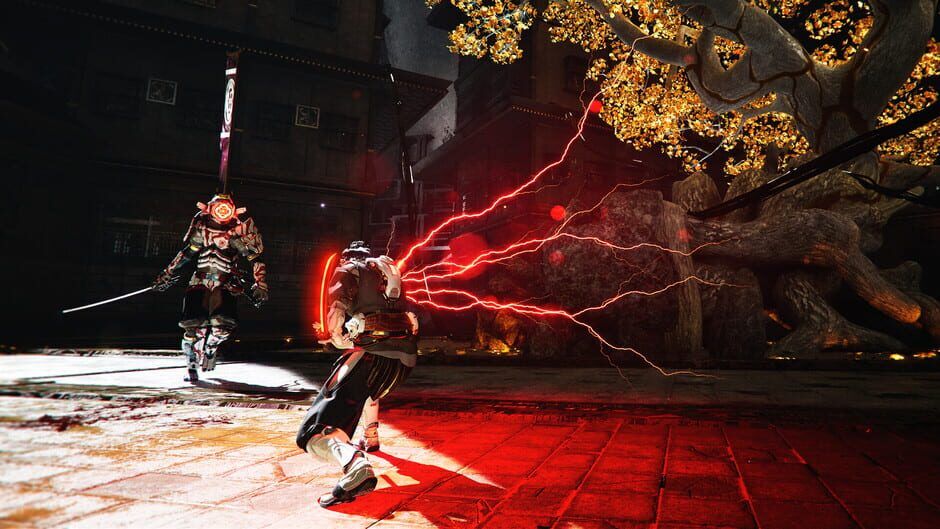
The visual identity sells that divide instantly. In the footage so far, SOL Shogunate leans into dense, strongly lit compositions instead of sheer environmental scale. You get crowded streets bursting with signage, reflective glass surfaces throwing back the glow of lunar night, and battlefields where traditional banners flutter in artificial wind while Earth looms, silent, in the skybox. It is a smart approach for a mid‑budget game, giving the world a premium look through strong art direction rather than endless content sprawl.
Factions on the moon: Tennoji, Karasuma, and a war of bloodlines
If the setting is about control of a fragile habitat, the factions are about who gets to claim the right to rule it. The first dev diary introduces two of the key samurai clans, Tennoji and Karasuma, and uses them to sketch out the social order that has turned the moon into a new feudal frontier.
The Tennoji clan embodies the establishment. They are positioned as one of the great power blocs propping up the shogunate’s rule over the lunar colonies, custodians of the genetic and scientific advances that keep the rich alive and comfortable. If the air feels fresher in Shin‑Edo’s upper districts and the cybernetics shine a little brighter, Tennoji money and research are probably involved. They present as dignified and refined, high‑tech armor plated with ornate detail and immaculate masks that hide their faces and insulate them from the reality outside their polished walkways.
Karasuma, introduced alongside them, reads much more like a clan built on ruthlessness and opportunism. While the diary does not dive into a full lore encyclopedia, the framing suggests a power base that sits closer to the edge of the law, leaning into military strength and aggressive expansion to carve territory out of the lunar surface. If Tennoji are the scholars and stewards of life support, Karasuma are the razors that enforce a status quo when diplomacy fails.
Both clans are tied to the same crucial resource: the biotech and advanced science that make surviving on the moon viable in the first place. That linkage is a neat twist on classic samurai fiction. Instead of feuding over rice harvests or distant provinces, these factions are effectively at war over who gets to own the means of survival itself. The dev diary hints at gene treatments and augmentations that not only keep the elite breathing but enhance their status into something approaching post‑human nobility.
For a player‑driven narrative, that setup gives SOL Shogunate plenty of angles to explore. Aligning with or cutting through these clans can be framed as more than picking a color on a war map. Every political choice is an implicit decision about who continues to enjoy engineered longevity under glass and who is left to scrape by in lunar wastelands outside the domes.
The Shattered Heir and a revenge tale under glass
All of this worldbuilding would risk feeling like a lore bible if it were not anchored to a sharper character hook, and that is where protagonist Yuzuki comes in. Billed as the Shattered Heir, Yuzuki is the last survivor of a massacred clan, set on a path of revenge that turns her into an outlaw ronin cutting across the lines that keep Shin‑Edo’s society compartmentalized.
The dev diary uses Yuzuki as the lens through which we experience the moon. She is not a detached observer from outside the system but someone whose birthright was violently stripped away by the same clan politics that keep the shogunate afloat. That origin gives SOL Shogunate a strong personal engine: you are not simply exploring a cool setting, you are actively dismantling or manipulating the hierarchies that define it.
It also pairs well with the game’s pulpier space opera elements. A clan heir with a broken legacy stalking neon‑lit alleys and gliding across low‑gravity battlefields is exactly the kind of protagonist that can carry a story that mixes honor codes with retro‑futurist tech. When the diary talks about the moon as a closed system of privileges and bloodlines, you can almost see the paths branching in front of Yuzuki: align with a new master, burn the whole structure down, or carve out an outlaw existence in the margins between domes.
While the early materials are cagey about specific narrative beats, the tone feels closer to stylized revenge cinema than solemn historical drama. Expect duels framed against huge vistas of lunar regolith, clan banners catching Earthlight, and quiet character moments in back‑alley teahouses that sit one bad seal away from being exposed to vacuum.
Why the visual pitch matters so much for a mid‑budget action RPG
The dev diary does not spend long on the nuts and bolts of combat, but even from brief snippets you can feel the push toward responsive, gravity‑aware action. Yuzuki dashes in low arcs, slashes that send enemies tumbling in slow spins against the black, then snaps back to the ground in showers of neon sparks. It is closer to character action than strict soulslike, which already helps SOL Shogunate carve out its own lane.
Where the game really separates itself, though, is in how hard it leans on its visual pitch to carry mid‑budget ambition. You can see it in the way combat arenas are framed as stage‑like slices of the wider world. Fights break out on glass walkways with a view down into bustling undercity layers, or in stark maintenance tunnels where flickering signage is the only color against grey plating. This is not about simulating a massive open world so much as handcrafting a series of striking spaces that reinforce the mood of each encounter.
That approach is exactly what has allowed other mid‑budget standouts to punch above their weight. By keeping scope contained and focusing resources on a distinct aesthetic, a game can look and feel premium without chasing the open‑world checklist. SOL Shogunate seems to understand this deeply. Every shot we have seen so far is working to sell the same fantasy: wandering samurai caught between duty and survival, except the daimyo wear pressure suits and the castle walls are made of irradiated glass.
There is also a clear confidence in mixing cultural reference points. The dev diary does not treat sci‑fi trappings as a mere skin over historical Japan. Lunar infrastructure, artificial biospheres and biotech caste systems are treated as core to the fiction, reshaping age‑old samurai archetypes instead of just decorating them. That gives SOL Shogunate the potential to feel fresher than yet another grim medieval kingdom haunted by familiar monsters.
One to watch on the road to release
We still need to see more before calling SOL Shogunate a lock, particularly deeper dives into enemy variety, progression and how the clan system actually touches moment‑to‑moment play. But as a first attempt to plant a flag in players’ minds, this dev diary does its job. It argues, with clarity, that the game’s lunar samurai world is worth inhabiting on its own, and that its factions and protagonist are pointed at the kind of operatic drama that suits a focused, self‑contained action RPG.
In a market where many mid‑budget projects struggle to stand out next to bigger franchises, SOL Shogunate already has a memorable image: a lone ronin streaking across the surface of the moon, katana drawn, Earth hanging over her shoulder like a distant, uncaring god. If Chaos Manufacturing can match that visual promise with responsive combat and meaningful choices in how you navigate its rival clans, this could be one of the most interesting action RPGs to watch as it moves closer to launch.