
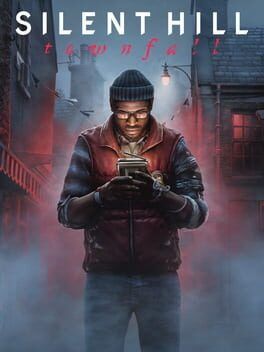

Recent Silent Hill Townfall hands-on previews point to a first-person horror game built around stealth, unreliable analog tools, and the dread of ordinary abandoned homes rather than constant combat.
Image: IGDB
Store links: Silent Hill: Townfall on Steam
Townfall’s newest previews point to a slower, weaker kind of Silent Hill
The clearest development from the latest Silent Hill Townfall hands-on coverage is that Screen Burn Interactive’s entry is leaning hard into vulnerability. Across recent preview sessions, outlets describe a first-person Silent Hill horror game where sneaking, hiding, listening, tuning a handheld CRTV, and reading the rooms around you appear as central to survival as any weapon Simon can swing or fire.
That is a meaningful tonal turn after recent Silent Hill attention has often circled around combat. Rock Paper Shotgun’s Gamescom 2026 demo account directly contrasts Simon with Silent Hill f protagonist Hinako, noting that where Hinako could rely on spear work and dodge timing, Simon felt like a far more conventional survival-horror character, barely able to beat back a knife-faced creature with panicked swings of a rotting plank. PlayStation Blog’s hands-on report also frames sneaking and hiding as important to survival alongside combat, while IGN describes stealth as the first resort and combat as a last-ditch answer.
The result, based on those impressions, is not a powerless walking simulator. Kotaku’s breakdown of Konami’s 19-minute gameplay trailer notes that if stealth fails, Townfall still has a familiar Silent Hill fallback in the form of a gun. Polygon’s preview says a later, mid-game demo section ramps up intensity and combat challenge. But the center of gravity appears different. Silent Hill Townfall gameplay, as described by multiple previews, is about trying to stay unseen long enough to understand the place that is swallowing Simon.
The CRTV turns guidance into a source of pressure
Townfall’s defining tool is the CRTV, a handheld television-like device that fits the game’s 1990s setting and replaces the series’ familiar radio with something more tactile and less dependable. Kotaku says Simon tunes the CRTV until he gets a solid signal, then uses its screen to identify buildings tied to objectives. PlayStation Blog reports that it provides puzzle hints and becomes necessary to access an elevator after Simon finds it in an impossible apartment inside a red-lit Otherworld space.
The horror comes from the way that help curdles into pressure. Rock Paper Shotgun’s demo account describes Simon trapped in a nearly pitch-black room, tuning the CRTV to detected frequencies. Each frequency points to a humanoid silhouette. Then another appears. Then another. The device shifts from reassuring detector to a small glowing warning that Simon is surrounded.
Director and writer Jon McKellen told Rock Paper Shotgun that the 1990s setting supports this design because Townfall sits at the cusp of technology, before smartphones and the internet, and because the team wanted tech that does not fully empower the player. McKellen said the CRTV is deliberately slow, sluggish, limited, and able to show only one enemy at a time, forcing players to tune between threats when several are nearby. His summary was blunt: “It feels like it’s not the perfect tool to save you.”
That limitation is the practical core of the Silent Hill Townfall hands-on reports. A monster tracker sounds like a safety net until the act of using it steals your attention. Rock Paper Shotgun notes that staring at the CRTV too long is a good way to get slashed. IGN similarly positions the device as the main crux of Townfall’s gameplay, a visual guide that draws the player deeper into the environment rather than handing over clean, modern information.
St. Amelia’s horror is built from ordinary rooms and local texture
The previews are also strikingly specific about place. Silent Hill Townfall is set in the fictional Scottish settlement of St. Amelia, though the source material describes it with slightly different terms: Rock Paper Shotgun calls it a forsaken Scottish village, Polygon describes an abandoned coastal village, Kotaku refers to a fictional Scottish island, and IGN frames it around seaside towns of Scotland. The consistent point is that this is not the familiar American Silent Hill, and the relocation appears to be central rather than cosmetic.
IGN reports that Townfall is developed by Screen Burn Interactive, the Glasgow studio previously known as NoCode, and says the setting closely reflects foggy Scottish seaside towns. Rock Paper Shotgun emphasizes the specifically 1990s British texture: 20mph signs, yellow kitchen cabinets, grey phone boxes, and other details it argues a homegrown studio could capture with unusual consistency. Kotaku’s reaction to the gameplay trailer lingers on a prepaid electricity card and meter used to restore power to a house, a mundane UK detail that became one of the trailer’s strangest shocks for an American viewer.
Those details matter because Townfall’s abandoned homes seem to be doing much of the storytelling work. Polygon’s preview describes shuttered shops, homes with for-sale signs, and a central square marked by protest signs, including one reading “CEG Widows.” Kotaku also notes hand-painted protest signs with slogans such as “This town is ours” and “We need justice.” None of the provided sources confirm exactly what happened in St. Amelia, but the environmental trail points toward a community that fractured before Simon arrived.
The atmosphere suggested here is domestic dread rather than spectacle first. A locked organ container in a house, a power meter, a missing nurse’s apartment, a pharmacy, a clinic, a broken stethoscope, a portrait of Simon in Zoe’s upstairs hallway: the horror comes from finding intimate objects in places where ordinary life has been interrupted and left to rot.
Zoe’s trail makes puzzles part of the narrative, not a pause from it
PlayStation Blog’s four-hour hands-on report provides the clearest look at how Townfall’s puzzle structure connects to its story. Simon appears to arrive in St. Amelia after responding to a letter asking him to return, though the preview says his arrival is intentionally ambiguous: one moment he seems to be on a boat approaching the dock, the next he bursts from the water and pulls himself ashore. He hears signs of a protest or riot in the town square, only to find it empty, then answers a pay phone and is pushed by a cryptic voice to find a woman named Zoe.
According to PlayStation Blog, writer and director Jon McKellen said Townfall’s puzzles are direct hints about the story. The CRTV signals are tied to St. Amelia’s past and Zoe’s past, providing clues about who she was and where she might have gone. Zoe is identified as a nurse, which leads Simon toward the clinic where she worked. In her office, three scales await objects important to her, objects she associated with failures that preceded her disappearance from work.
The examples given are small but pointed. Simon can find Zoe’s ID badge in her apartment, a prescription in a nearby pharmacy tied to a wrong dosage she called in, and a medical bag in a coworker’s apartment containing a broken stethoscope, described as a symbol of her inability to truly hear her patients. PlayStation Blog says Zoe’s story is linked to the town, which seems to have suffered some kind of medical outbreak, and to Simon, even though he does not know who she is.
IGN adds another troubling layer: Simon is an American outsider in St. Amelia, has an IV hooked up to his hand, carries or is connected to a blood bag, and is searching for Zoe Ellis while she reaches him through the CRTV with vague, desperate voice lines. IGN also says Simon finds a portrait of himself in Zoe’s upstairs hallway. The previews do not resolve whether Simon is hallucinating, trapped in a supernatural manipulation, or confronting buried memory. They do suggest the game is using puzzles as pressure points in character history rather than as detached locks and keys.
Stealth changes how players will read enemies and resources
For horror players, the crucial question is how Townfall balances threat, tools, and agency. Based on the previews, the answer seems deliberately uncomfortable. Simon can fight, but several outlets describe him as poorly suited to it. Rock Paper Shotgun’s demo account makes his melee weakness explicit, while IGN cites Alien: Isolation as a clear inspiration in the way Townfall builds tension through first-person vulnerability and reliance on stealth before combat.
That lineage is not accidental. IGN reports that Screen Burn Interactive has a direct lineage with Alien: Isolation, and that Jon McKellan worked on that game and directed its DLC. In Townfall, that influence appears less about copying a single unstoppable stalker and more about making information costly. If you use the CRTV to check an enemy, you may lose sight of the space around you. If you try to watch the creature directly, you may lose track of another frequency. If you crouch behind a fence or move between houses and shops, you are betting that the environment is hiding you as well as you think it is.
Kotaku’s trailer report says Simon can use objects in the environment to distract enemies and sneak past them. That detail suggests stealth is active rather than purely about waiting behind furniture. It also suggests resource pressure may not come only from ammunition or healing items, but from attention, timing, noise, and whether the player can trust a clunky analog device under stress.
The enemy design glimpsed in the source material is still partly described through impressions rather than named mechanics. Rock Paper Shotgun mentions a cleaver-faced or knife-faced humanoid, while IGN describes monstrous mutants tied to what seems to be a disease and mutation that ravaged St. Amelia’s people. PlayStation Blog says the line between supernatural horror and psychological struggle feels especially hazy in Townfall. Until Konami or Screen Burn lays out the full combat systems, the safest reading is that enemies are built to make stealth messy, not optional wallpaper.
Release timing, scope, and the questions still hanging in the fog
The provided source material leaves several practical details unresolved. Polygon’s preview says Silent Hill: Townfall is planned for this fall, but the excerpts do not include a specific release date, price, platform list, PC requirements, console performance targets, or upgrade details. PlayStation Blog’s report links to a PlayStation page and is hosted on Sony’s official blog, but that alone is not enough in the provided material to map every platform or edition.
There is also a scope claim circulating in community coverage rather than in the publisher-attributed material here. A ResetEra thread summarizing previews cites “via @OneMoreGamePH” that the main game is 10 to 14 hours, completion time varies depending on whether players sneak through the fog or face horrors head-on, and Townfall will have five endings, including three main endings and two secret endings. Because that excerpt is an aggregation post and not a direct Konami or Screen Burn statement in the provided sources, those numbers should be treated as preview chatter unless confirmed elsewhere.
The broader context is that Konami’s revived Silent Hill slate arrives with higher expectations than it had a few years ago. Polygon notes that Bloober Team’s 2024 Silent Hill 2 remake drew widespread critical praise and received five nominations at The Game Awards, while Silent Hill f sold more than a million copies in its first day and earned three nominations. Townfall is entering that revived climate with a smaller, stranger identity: first-person, Scottish, analog, and apparently built around sneaking through abandoned domestic spaces rather than leading with weapon mastery.
For players deciding whether to follow Silent Hill Townfall closely, the early signal is clear. If you wanted the series to push harder into stealth horror, environmental storytelling, and low-confidence survival pressure, these hands-on reports are encouraging. If you prefer Silent Hill when combat systems are dense, expressive, and frequent, the previews suggest Townfall may ask for a different appetite: patience, caution, and a willingness to stare into a tiny screen while something sharp moves in the fog.