
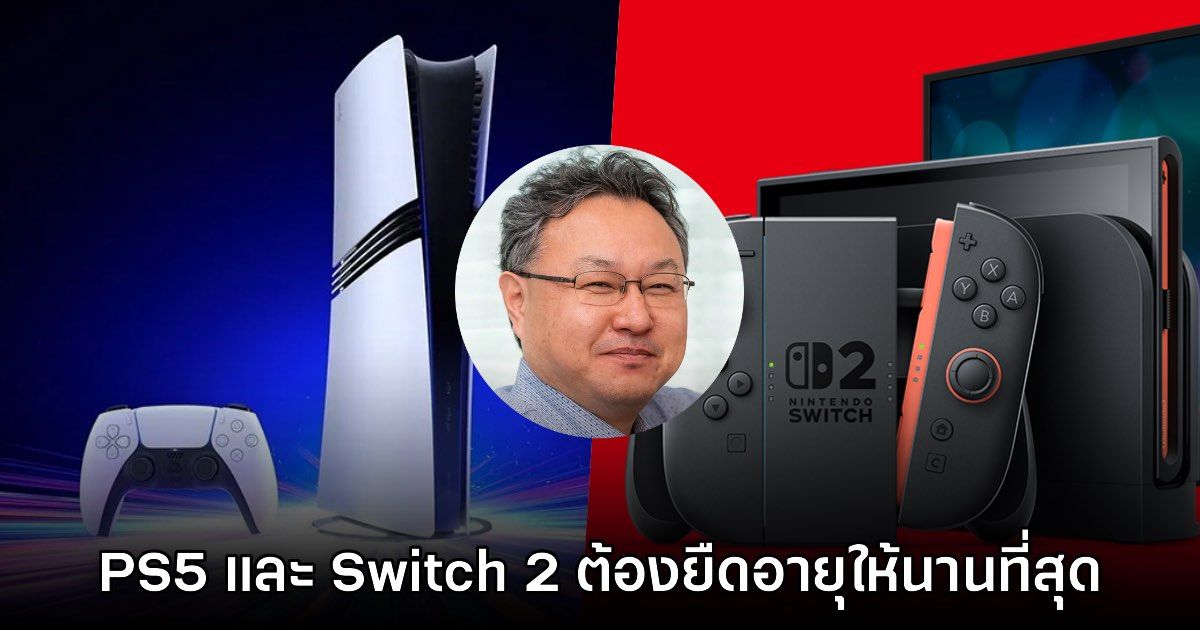

Former PlayStation executive Shuhei Yoshida argues Sony and Nintendo should extend the PS5 and Switch 2 generation while Xbox pushes toward next-gen hardware.
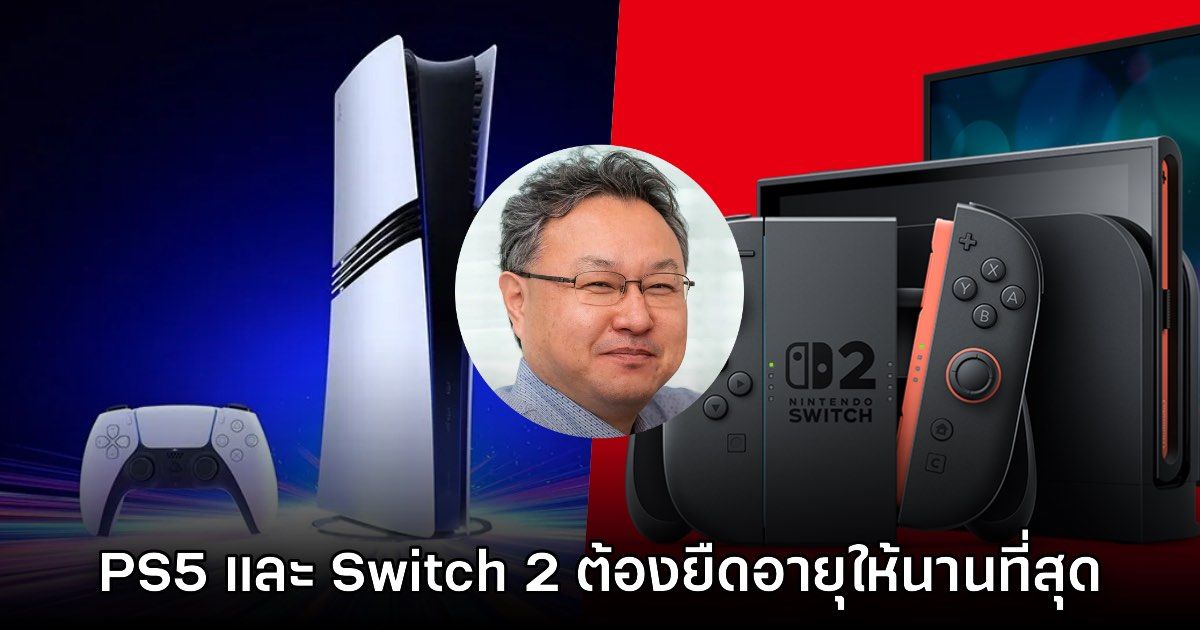
Image: thisisgamethailand.com
Yoshida turns the next-gen question into a timing problem
Former PlayStation executive Shuhei Yoshida has argued that Sony and Nintendo should keep the PS5 and Switch 2 generation running for as long as possible, even as Xbox appears more willing to push into new hardware. Speaking in an interview with The Verge, as reported by VGC, IGN, Push Square, GamingBolt and others, Yoshida said Sony and Nintendo have already sold enough current-generation hardware that the smarter move may be to delay successors rather than ask players to buy into another expensive cycle.
The tension is clear: PlayStation and Nintendo can treat time as an advantage, while Xbox may see time as a problem. Yoshida framed Xbox differently because, in his view, Xbox Series X and S have continued to trail PS5 and Microsoft is trying to reshape its console business around new models. VGC identifies that next-generation Xbox effort as Project Helix, while GamingBolt and VGChartz also describe Xbox as the platform holder more likely to move first.
Yoshida’s central point was not that new consoles are impossible, or that Sony and Nintendo have no future hardware plans. His argument was about incentives. “I think they should try to keep the current generation as long as possible, because I think people are very happy using PS5 and Switch 2,” he told The Verge, according to VGC’s transcript of the interview. For anyone watching the console cycle like a strategy map, that is the key move: extend the board state while your installed base is still active, rather than reset it while costs are hostile.
The cost of hardware is now part of the platform meta
Yoshida tied his argument to the rising cost of components and the pressure that puts on both platform holders and consumers. In the interview, he said people have “finite budget” and that components specific to PCs and consoles have increased in price faster than other forms of entertainment, according to VGC and IGN. His conclusion was simple: players with a PS5, Switch 2 or a “good enough” PC may be content to keep playing rather than replace hardware quickly.
IGN connected Yoshida’s comments to the rising cost of computer memory, describing the current situation as a memory price crunch fueled in part by AI datacenter demand. GamingProMax made the pricing argument more explicit, reporting that the PS5 disc model has risen from $500 at launch in 2020 to $650, the digital model from $400 to $600, and Switch 2 from $450 to $500. Those specific figures come from GamingProMax’s report, while IGN also cited PS5 price increases and the broader component-cost pressure.
That changes the next-gen calculation. A normal generational transition asks players to accept a price premium for new performance, new features and a new software runway. Yoshida is questioning whether that pitch works if the starting price is already painful and if the existing machines are still satisfying players. In strategy terms, Sony and Nintendo do not have to force a risky tech escalation if their current platforms still hold player attention, third-party support and first-party momentum.
PS5 may gain more from runway than from a quick PS6 reset
Push Square noted that the PS5 is approaching six years old, an age where console-cycle speculation naturally turns toward next-generation hardware. It also pointed out that many consoles historically see successors after roughly seven years. That history makes the PS6 question unavoidable, but Yoshida’s comments challenge the assumption that the old cadence still fits today’s market.
IGN reported that Sony has not officially indicated when PS6 will arrive. The outlet also said analysts had previously suggested 2028 as a likely window, while a later IGN analyst piece described a higher likelihood of PS6 launching after 2028 as Sony focuses on extending the PS5 lifecycle. That is analysis and forecasting, not an announced Sony date. The confirmed piece is narrower: Sony has not publicly dated PS6, and Yoshida, speaking as a former executive rather than as Sony’s current spokesperson, believes PS5 can keep going.
There is a practical reason that argument lands. Many major games still target PS5 as the high-volume console baseline, and Yoshida told The Verge he does not think players or developers are broadly demanding stronger hardware yet. “I don’t think lots of people are asking for ‘more power, we need more power,’” he said, according to Push Square and VGC. He added that he does not think developers are asking for better hardware either. That does not mean no developer wants more GPU headroom, CPU budget or memory bandwidth. It means Yoshida sees no industry-wide pressure strong enough to justify rushing a new PlayStation box into an expensive supply environment.
Switch 2 is even earlier in its cycle, but Nintendo faces the same cost wall
Nintendo’s situation is different from Sony’s because Switch 2 is far earlier in its life. IGN explicitly noted there is no suggestion that Nintendo plans to launch a Switch 3 soon, and that Switch 2 only arrived last year. That makes Yoshida’s Nintendo point less about a successor announcement being imminent and more about how long Nintendo should stretch the platform before major replacement pressure builds.
That distinction matters. Nintendo historically benefits when it can keep a successful hardware concept alive with software cadence, hardware revisions and family expansion rather than a fast generational reset. IGN noted that Nintendo always budgets for future hardware research and that upgrades to the launch Switch 2 model will likely be considered at some point, in the way the original Switch family eventually expanded with Switch Lite and Switch OLED. That is not the same thing as evidence of a Switch 3 plan. It is normal platform maintenance.
Yoshida’s comment that people are happy using Switch 2 should be read through that lens. If Nintendo has a young platform, active users and component costs working against a cheap successor, then a longer Switch 2 generation length becomes a rational business path. The strategic risk is different from PlayStation’s. Sony must decide when PS5 becomes technologically stale. Nintendo must decide how long it can scale Switch 2’s audience before changing the platform promise again.
Xbox has a reason to move first, but its pricing model is the open question
Yoshida was more sympathetic to Xbox moving first because he sees Microsoft as trying to change the competitive landscape. Push Square quoted him saying Xbox is a team that wants to change that landscape and that “it’s their time to play.” VGC reported that the discussion came in the context of Xbox messaging around Project Helix and possible new business models for next-generation hardware.
The most striking part of the interview was Yoshida’s response to the idea of a subscription-style console model. Asked about a scenario where players might pay $200 per year for hardware and Xbox Live, Yoshida suggested that might not be enough if the hardware cost is over $1,000. According to VGC and GamingBolt, he floated the possibility of $300 or $400 per year, or even a $50-per-month subscription, as a hypothetical.
Those numbers are not Xbox pricing announcements. They are Yoshida thinking aloud about what a subsidized or service-bundled next-gen box might require if hardware costs are high. That distinction is important because Project Helix itself remains surrounded by unannounced details. VGC describes it as Xbox’s next-gen console and says Xbox may be pursuing a device that can also run PC games. GamingBolt said rumors have indicated both Sony and Microsoft were on track for late-2027 next-gen consoles, while GamingProMax referred to alpha dev kits arriving at studios in 2027 and a consumer launch likely late 2027 or beyond. Those timing claims are rumor or reporting around plans, not confirmed launch dates from Microsoft or Sony.
For players, the safest read is patience unless a platform holder says otherwise
The reader-facing guidance is straightforward because the confirmed information is limited. Sony has not announced a PS6 release date. Nintendo has not announced a Switch 3. Microsoft has not provided final public pricing or release details for its next Xbox hardware in the source material provided here. What is confirmed is that Yoshida, a former senior PlayStation figure, believes the economics favor extending PS5 and Switch 2, while Xbox may have more incentive to reset with new hardware.
That makes “PS6 can wait” a reasonable shorthand for Yoshida’s position, but it should not be mistaken for Sony policy. The same applies to Nintendo. A longer Sony Nintendo current generation would fit his view of consumer budgets, component inflation and current player satisfaction, yet platform holders can still pursue internal R&D, revisions, prototypes and launch planning while publicly supporting existing hardware.
For PS5 owners, Yoshida’s comments support holding steady unless there is a specific game, performance need or hardware failure pushing an upgrade. For Switch 2 owners, the argument is even stronger because the system is earlier in its commercial life and no credible source here points to an imminent successor. For Xbox players, the calculus is less settled. Microsoft may be trying to redefine the console around power, PC compatibility or service bundling, but until Xbox names the hardware, price and release window, Project Helix remains a strategic signal rather than a buying decision.
The larger platform debate is no longer only about who can ship the most powerful box. It is about who can make the next transition feel affordable, necessary and well-timed. Yoshida’s view is that Sony and Nintendo do not need to force that transition yet. If component costs stay high and players remain satisfied, the winning move may be to let PS5 and Switch 2 breathe while Xbox takes the first next-gen gamble.