
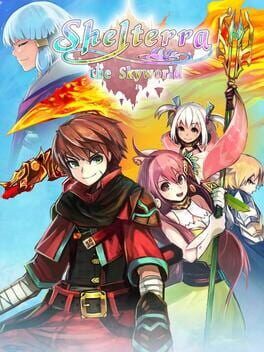
Kemco and Magitec have announced Shelterra The Skyworld for Nintendo Switch 2 and Nintendo Switch, with a November 5, 2026 release date and Switch 2 technical upgrades.

Image: IGDB
Kemco’s next fantasy RPG is coming to both Nintendo generations
Kemco and Magitec have announced Shelterra The Skyworld for Nintendo Switch 2 and Nintendo Switch, according to Nintendo Everything, with the RPG scheduled for November 5, 2026. That date puts the game in the late-2026 window rather than Nintendo’s 2027 slate, but the platform split is the immediate point of interest: this is a new Switch 2 RPG that is also being built for the original Switch audience.
Nintendo Everything reports that the Switch 2 version will feature an improved frame rate and resolution, along with better text readability. Those are practical upgrades for a classic fantasy RPG, especially one built around turn-based battles, dungeon exploration, informant clues, and skill discovery. The announcement does not provide exact resolution targets, frame-rate numbers, pricing, file size, physical release plans, or any upgrade path between the Shelterra Nintendo Switch and Shelterra Switch 2 versions.
That leaves Shelterra The Skyworld in a familiar cross-generation position. The confirmed facts are straightforward: Kemco and Magitec are releasing the game on both systems on November 5, and Switch 2 has technical improvements. The open questions are the ones that matter to buyers who now have access to two Nintendo libraries at once: whether the versions are sold separately, whether saves move across systems, and whether Switch 2 enhancements are tied to a native release, an edition label, or another storefront arrangement.
A floating continent, a corruption threat, and a very useful talking stone
The official overview shared by Nintendo Everything frames Shelterra as a classic JRPG set on a vast floating continent. Shelterra is described as untouched by a mysterious corruption known as Odium, but the story begins to move when Claude, who dreams of becoming a professional adventurer, takes on what sounds like a modest escort mission and discovers a threat that could send his homeland crashing to the surface.
The lore hook is economical but effective. Claude’s talking stone is revealed to be an Artifact, a spirit destined to protect Shelterra. From there, the official description says Claude joins forces with the Orlok regime to uncover the Skyworld’s secrets and prevent the floating continent’s destruction. Based on the announcement text, the central fantasy is less about visiting a single kingdom and more about reading the structure of a world suspended above disaster.
For RPG players, that setup gives Shelterra The Skyworld a clear progression spine. The premise has a home to protect, a corruption to understand, a political faction in the Orlok regime, and a companion system built into the Artifact reveal. The source material does not confirm branching story choices, faction reputation, romance systems, or multiple endings, so those should not be assumed. What is confirmed is a quest built around exploration, dungeon danger, and a party that gains power by learning how the Skyworld works.
The progression pitch is about hunting skills, not only gaining levels
Shelterra’s most interesting mechanical detail is not the standard promise of turn-based battles, but how the official overview describes skill acquisition. Players will learn new skills by fighting specific monsters, and they can gather clues from informants to hunt down the abilities they need. That implies a progression loop built around research and targeted encounters rather than simply watching a level-up screen deliver the next ability on a fixed track.
For a systems-minded RPG player, that small distinction can change the rhythm of an adventure. If certain monsters teach certain skills, then dungeon routes, enemy ecology, and NPC information become part of build planning. A player might push into a dangerous region early to secure a defensive tool, delay a boss until the right ability is found, or revisit earlier areas with a new party goal. Nintendo Everything’s source text does not say how many skills exist, whether skills are permanently learned, or whether every party member can learn every ability, but the announced structure points to a game where knowledge is part of character growth.
Artifacts are the other confirmed layer. The overview says players can summon mystical Artifacts to fight alongside them, unleash powerful abilities, or call on their protection against major attacks. That gives Shelterra two overlapping forms of preparation: the skills the party brings into combat and the spirit-like support available through Artifacts. Until Kemco and Magitec show deeper combat footage or publish a detailed store page, it is too early to judge balance, difficulty, or party customization depth. Still, the announcement gives RPG players enough to see the intended loop: explore freely, listen for clues, seek specific enemies, expand the party’s toolkit, then use Artifacts to swing harder encounters.
Switch 2 upgrades target the details RPG players stare at for hours
The Switch 2 improvements reported for Shelterra are modestly worded, but they address the right pain points for this kind of game. Better frame rate and resolution are expected selling points for many cross-generation releases, but improved text readability is especially relevant for an RPG that asks players to follow lore, consult informants, read ability names, parse battle feedback, and manage a growing skill set.
Nintendo Everything attributes the Switch 2 feature set to the announcement from Kemco and Magitec, but the report does not include measured performance targets. That means players should treat “improved frame rate” as a confirmed direction, not a promise of a specific 60 fps target. The same applies to resolution. The Switch 2 version is confirmed to look and read better than the Switch version in some form, but the announcement does not define handheld versus docked performance, loading times, texture improvements, or UI scaling options.
The original Switch version still matters. By launching on both systems, Shelterra The Skyworld can reach players who have stayed with the original hardware while still giving early Switch 2 owners a cleaner version. That is a sensible fit for a classic fantasy RPG, a genre where audience continuity can be as valuable as technical spectacle. The risk is clarity. Without a price, eShop listing details, or upgrade-path information in the provided announcement, owners of both systems do not yet know whether they should buy at launch, wait for version specifics, or hold out for a listing that spells out entitlements.
A small RPG announcement in a very crowded Switch 2 calendar
Shelterra is not a 2027 game based on the reported date, and it should not be described as one. Its announced Shelterra The Skyworld release is November 5, 2026. The broader context is that Switch 2’s public software calendar is already stretching well beyond that date, and smaller RPGs help fill the connective tissue around the larger releases.
Digital Foundry’s public Switch 2 games database lists major and mid-sized releases across late 2026 and into 2027, including entries such as Metroid Ravenous dated January 28, 2027 and Pokémon Winds & Waves listed for 2027. A separate user-maintained Wikipedia list of Nintendo Switch 2 games states that it currently contains 1001 games and includes multiple 2027-dated or 2027-window titles. Those listings are not Nintendo’s own release calendar, and they should be read as public catalog snapshots rather than platform-holder confirmation for every entry. They do show the shape of the ecosystem players are already tracking: a console library that is being built through first-party names, third-party ports, and smaller genre releases.
That is where Shelterra fits. A Kemco RPG landing in November 2026 will not carry the same visibility as Nintendo’s biggest franchises, but releases like this can keep an RPG audience engaged between tentpole dates. They also matter because Switch 2 is backward compatible with most Switch games according to the provided Wikipedia source, while also supporting enhanced Switch 2 releases and Game-Key Cards. In that environment, every cross-generation RPG creates a practical question for collectors and completionists: which version belongs in the long-term library, and how much do the Switch 2 enhancements improve the experience over the original Switch release?
What to watch before buying Shelterra The Skyworld
Based on the announcement reported by Nintendo Everything, the strongest reason to choose Shelterra Switch 2 over Shelterra Nintendo Switch is readability and performance. If you plan to play mostly handheld, text clarity could be the deciding factor, especially if the game leans heavily on informants, skill descriptions, and dungeon navigation. If you only own an original Switch, the good news is simple: the game is confirmed for that platform on the same date.
The reasons to wait are equally practical. Kemco and Magitec have not provided a price in the supplied materials. There is no confirmed physical edition, no stated upgrade path, no save-transfer explanation, and no detailed breakdown of Switch 2 technical targets. The announcement also does not confirm whether the Nintendo Switch 2 version has exclusive content, quality-of-life features beyond readability, or any changes to encounter design.
For now, Shelterra The Skyworld is best viewed as a late-2026 classic fantasy RPG with a readable hook and a progression system worth watching. Its floating-continent premise gives the story a strong sense of place, while the monster-based skill learning and Artifact summons give build-minded players something to examine once more footage or store-page details appear. The confirmed release date is close, the platform choice is real, and the unanswered version questions are the ones RPG buyers should settle before committing.