
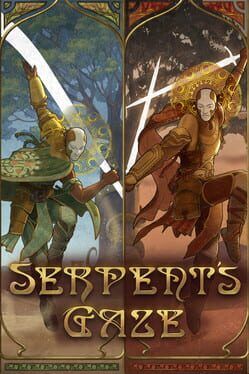

Hands-on-style impressions of Feeble Minds’ debut, Serpent’s Gaze, breaking down its Coffee Stain / Paradox pedigree, co-op-focused Souls-like combat, roguelike build-crafting, and how the new Steam demo sets it apart from other Souls-likes.
Feeble Minds: From Goat Chaos And Grand Strategy To Co-op Souls
Serpent’s Gaze is the first game from Feeble Minds, a new Swedish studio that quietly came together in 2022. If the name doesn’t ring a bell yet, the résumés absolutely do. The team is stacked with developers who previously worked at Coffee Stain (Satisfactory, Goat Simulator, and publishing work on Valheim and Deep Rock Galactic) as well as Paradox, the house of grand strategy.
That mix of backgrounds matters, because Serpent’s Gaze is not just “another Souls-like.” Coffee Stain’s DNA shows up in the focus on seamless co-op and emergent chaos, while Paradox’s influence is clearest in the layered systems and build tinkering that sit on top of the action. Feeble Minds describes the studio as a blend of veterans who wanted to mash together their favorite ideas with new blood that is hungry to experiment, and Serpent’s Gaze is where all of that collides.
What Serpent’s Gaze Actually Is
Serpent’s Gaze is a third-person action RPG about being a Scion, a chosen zealot of a god in a harsh desert world. Your job is to cut through the followers of rival deities, topple their towering champions, and slowly piece together what this war of faiths has done to the land.
Mechanically, it is a four-player co-op Souls-like that borrows heavily from roguelikes. You move through hostile zones, fight methodical melee duels against husk-like enemies, and eventually square off against bosses that demand pattern recognition and tight stamina management. Between your runs, you lean into build-crafting that reshapes how your Scion plays on the next descent.
The newly released Steam demo slices off an early chunk of this loop so you can feel the weight of the combat and the friction of learning, dying, and pushing a little further.
Co-op Souls With A Roguelike Spine
The foundation is immediately familiar if you have touched Dark Souls or Lies of P. You have a dedicated dodge, a guarded block, stamina that punishes panic rolls, and enemies that can delete you for a single greedy swing. What Feeble Minds layers on top is a structure closer to a roguelike run.
Areas and encounters are structured so that your route and pickups change. During a run you find temporary boons, weapon variants, and relic-like modifiers that transform how your build functions. These are not just small percentage buffs. The demo hints at perks that tilt your Scion toward status-heavy dot builds, huge slow swings that trade safety for massive poise damage, or a more mobile duelist build that fishes for counters.
Because each run offers a slightly different set of tools, you are encouraged to lean into what the desert hands you instead of grinding a single perfect build. That keeps the familiar Souls rhythm from going stale, especially in co-op, where your squad can evolve into a proper party composition without rigid classes.
Combat Feel: Weighty, Deliberate, And Punishing
Hands-on, the combat in the demo feels closer to the slower, heavier end of the Souls spectrum. Every strike has a clear wind-up, with a noticeable commitment once you press the button. Light attacks have just enough recovery that you cannot mash out of trouble, and heavy swings will get you killed if you throw them at the wrong time.
Hit feedback is a highlight. There is a chunky impact when steel meets chitin or bone, and enemies convincingly react to stagger thresholds. Land a fully charged blow on an exposed weak spot and you get a sharp audio cue and a lurching stagger that begs for a follow-up. Miss, and you feel the dead air in the animation as your Scion over-extends and eats a spear to the ribs.
Enemy design in the demo leans on a handful of archetypes rather than hordes. You get slow, shielded devotees who punish circling, twitchy dagger carriers with deceptive lunge distance, and larger brutes that telegraph huge swings but soak up damage. On their own they are manageable, but the encounter design is quick to stack them in combinations that test crowd control and target prioritization.
If there is a pain point, it is that early dodge i-frames feel stingy. The intention clearly pushes you toward reading tells and dodging into attacks at the last second instead of panic-rolling away. After a few runs the timing clicks, and when it does, the combat shifts from clumsy to satisfyingly precise, but new players will bounce hard if they expect forgiving invulnerability windows.
Co-op Balance: Shared Brutality, Shared Triumph
Co-op is where Feeble Minds’ Coffee Stain background really shows. The Steam demo supports up to four players and getting a lobby going is fast and simple. Once you are in, Serpent’s Gaze treats the party as a unit rather than a host with disposable phantoms.
Enemy health and aggression scale upward, and you immediately feel that in how often foes swap aggro and how much more resistant elites become. This is not a power fantasy mode where three extra bodies trivialize encounters. In fact, sloppy co-op play can be harder than solo runs, because a mistimed attack from one player can pull a boss’s combo into another teammate or block a clean revive.
The upside is that the game quietly supports role differentiation without formal classes. In the demo it is possible to lean a build into a sturdy frontliner who holds a boss’s attention, while others spec into damage-over-time effects or ranged pressure that slowly chews through health bars. Positioning and communication matter, especially when the procedural layouts funnel you into cramped chokepoints.
Revives are limited and dangerous to pull off. The window to get a fallen ally back up is long enough that a coordinated group can scrape through a disastrous pull, but trying to heroically dive for a revive during a boss’s second phase is usually a death sentence. That risk-reward balance does a lot of work in making co-op feel tense instead of slapstick.
The most impressive thing about the co-op in the demo is how it preserves the high-stakes feeling of a Souls-like while giving you the social highs of shared victory. When a boss finally topples after a string of failed runs, the rush hits just as hard in a full squad as it does alone.
Roguelike Build-Crafting: Iteration Over Grind
Where Serpent’s Gaze most clearly steps away from its inspirations is the roguelike slant in its progression. Each run scatters choices that meaningfully reshape your approach. Some offer raw stat bumps, others bolt new effects onto your core actions, and a few twist how you interact with co-op partners.
In the demo that might look like a relic that refunds stamina when you score a backstab, a modifier that causes your heavy attacks to cleave wider arcs at the cost of additional stamina, or a boon that splashes a debuff onto nearby allies when you are healed, encouraging clustered formations.
Crucially, the game seems more interested in synergy than in linear power growth. Stacking effects that feed into each other feels both more important and more fun than simply watching numbers go up. One run might revolve around bleeding enemies dry over time while kiting them through chokepoints. The next might be a risky glass-cannon setup that leans on perfect dodges and huge ripostes.
Because runs are semiprocedural, you cannot count on finding the same setup again. That forces you to adapt instead of settling into a single solved build, addressing one of the big fatigue points of traditional Souls-likes where your chosen weapon and stat spread can make the back half of a game feel on rails.
How It Stands Out From Other Souls-likes
The Steam demo is early and rough in places, but it already hints at several ways Serpent’s Gaze could carve out a distinct space in a crowded genre.
First, the studio’s obsession with cooperative play is not an optional garnish. Serpent’s Gaze is built from the ground up for 1 to 4 players, with scaling and encounter design that assume friends in the mix. It feels closer to a co-op dungeon crawler with Souls combat than a strictly solitary gauntlet that merely tolerates summons.
Second, the roguelike structure shifts the emotional arc of play. Instead of a single marathon campaign where every death pushes you back to a fixed checkpoint, Serpent’s Gaze breaks progress into contained runs packed with experimentation. It borrows that “one more try” compulsion from games like Hades or Dead Cells and stitches it to the slower, more deliberate action of Souls-likes.
Finally, the build-crafting systems, even in embryonic demo form, show a clear interest in emergent playstyle discovery. The focus on stacking weird synergies and adapting to what each run offers makes it feel more like tuning a deck of tools than locking into a class. In a genre where many games live or die by how good their one or two viable builds feel, that flexibility is refreshing.
Early Verdict From The Demo
As a vertical slice, the Serpent’s Gaze Steam demo does exactly what it needs to. Combat is punishing but fair once you internalize the i-frame timing, and every swing feels like a decision. Co-op meaningfully changes the feel of encounters without trivializing them, and the roguelike scaffolding already adds replay value beyond simply mastering one route.
It is still early. Animation polish, onboarding, and clearer feedback for some enemy attacks would all help smooth the rougher edges. But Feeble Minds’ pedigree is visible in how confident the core loop already feels. There is a clear throughline from Coffee Stain’s co-op-first mentality and Paradox’s love of intertwined systems to this moody desert pilgrimage where each run is a chance to rewrite your god-killer.
If the full game can build on this foundation with more enemy variety, deeper build permutations, and a compelling payoff to its war of gods, Serpent’s Gaze has a real shot at being more than a curiosity in the Souls-like pile. For now, the demo is well worth downloading if you are curious how a bunch of ex Satisfactory, Goat Simulator, and Paradox devs tackle the brutal dance of dodges, parries, and last-hit revives.