

Early SCUF Omega coverage praises its customization, paddles, TMR sticks, and app support, but the $219.99-plus price puts the PS5 pro controller in a tougher fight than its plain pitch suggests.
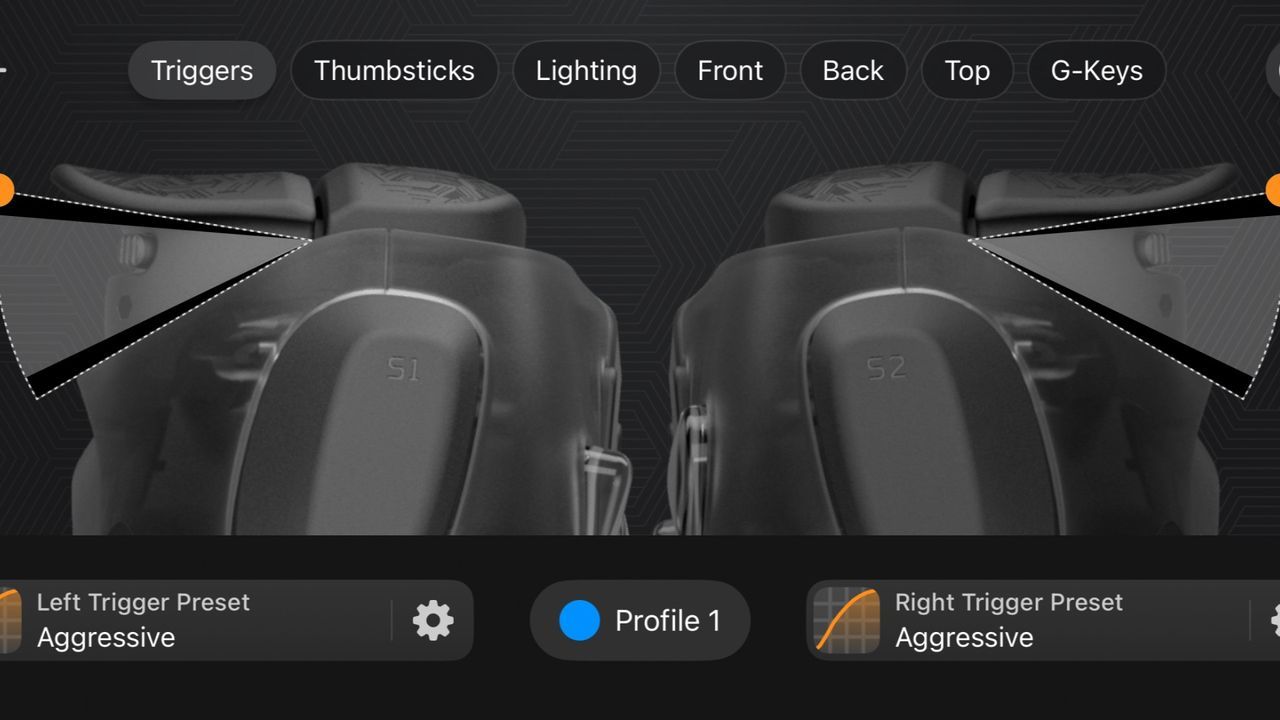
Image: gamesradar.com
The SCUF Omega arrives in a crowded premium pad fight
The clearest early read on the SCUF Omega PS5 controller is not that it lacks pro features. It is that its strongest features are arriving at a price where players can reasonably expect a controller to make a sharper case for itself.
SCUF’s own PS5 controller listing positions the Omega as an officially licensed PlayStation 5 controller built for competitive play, with four rear paddles, two side action buttons, five G-Keys, a mobile app, Endurance TMR thumbsticks, Omron mechanical switches, and a 1K polling rate in wired and wireless modes on PC. SCUF lists standard Omega models such as Black, White, Smoke, Steel Gray, Light Gray, Forest Green, Red, and Orange at $219.99, while themed designs shown on the same page rise to $229.99 or $239.99.
That price is the pressure point running through the first hands-on coverage. Push Square, which says it tested the controller for the last few weeks, describes the Omega as an officially licensed pro controller for PS5 and PC that connects to PS5 either wired or through a wireless dongle, with Bluetooth support on PC. The outlet lists the price at £209.99/$219.99, increasing to £229.99/$229.99 depending on customization options. Its framing is reserved: this is a “no-frills” pro controller with many inputs and a high price, rather than an obvious new front-runner among the best PS5 controller alternatives.
For a competitive shooter player, the Omega’s pitch is easy to understand. Keep thumbs on the sticks, move key actions to rear paddles or side buttons, shorten trigger travel, and tune profiles through an app. For everyone else, especially players coming from Sony’s regular DualSense or weighing pricier pads against the DualSense Edge and other premium options, early coverage suggests the Omega needs to do more than list competitive features. It has to feel special in the hand, and that seems to be where the enthusiasm cools.
A pro feature set with a deliberately plain first impression
The Omega’s most convincing confirmed advantage is input density. SCUF advertises four rear paddles, two side buttons, and five G-Keys, which gives it a busier control surface than a standard DualSense. Push Square also highlights those extra inputs, identifying the rear paddles, side buttons, and a row of five lower buttons used for programmable functions plus volume and mic controls.
That kind of layout can be meaningful in games where movement and camera control are inseparable. In a precision platformer, a remapped jump or dodge can change the feel of a difficult route. In a competitive shooter, placing slide, jump, reload, or weapon swap away from the face buttons can keep aim steadier. Luna “Pixel Perfect” Kim note: this is the sort of mechanical utility that often sounds small until a game asks you to jump, track, cancel, and correct at once. Extra inputs only matter, though, if they are positioned well enough that your hands stop thinking about them.
Push Square’s early read is mixed but not dismissive. The outlet says the controller is fairly light without feeling cheap, secure thanks to rubber grips, and comfortable enough in hand. It praises the smooth trigger travel and says the face buttons have a satisfying mouse-click effect. The same clicky feel can be applied to the triggers with a rear switch. SCUF’s official page identifies the switches as Omron mechanical switches, marketed for speed and responsiveness.
Still, the first impression described by Push Square is notably muted. The controller did not, in the outlet’s words, leave a strong initial impression beyond being a controller. That may sound harsh for hardware aimed at competitive players, but it gets to the core of the Omega’s challenge. At $219.99 and up, comfort and competence are expected. A premium pad has to justify the extra spend through either a standout feel, a distinctive technical benefit, unusually strong software, or a price that undercuts rivals. Early coverage suggests the Omega lands closer to practical than exciting.
Customization is the showpiece, but it can raise the bill
The most visibly SCUF part of the Omega is its customization. Push Square calls the style one of the controller’s best features and says buyers can choose from prebuilt designs or adjust details such as face-button colors, thumbsticks, and touchpad design through SCUF’s website. The review unit Push Square received was the Cherry Blossom design, which SCUF’s own store currently lists at $229.99, above the $219.99 base models shown on the PS5 controller page.
SCUF’s store listings reinforce how central design choice is to the product. Alongside standard colors, the page lists themed Omega models including Cherry Blossom, Dark Cherry Blossom, Snake, Gentle Mates, Skyrroz, and Courage at higher prices. That matters because the Omega is being sold as both a performance tool and a personalized object. If you are spending over $200 on a PS5 pro controller, the ability to make it look like your pad rather than a stock accessory is part of the appeal.
The risk is that aesthetic customization can distract from the value question. A player comparing a $219.99 Omega Black to a $229.99 Cherry Blossom Omega is already in premium territory. Add another design charge and the conversation shifts from “is this a sensible pro upgrade?” to “am I paying extra for a pad that early coverage still describes as plain in feel?”
Push Square’s unboxing description adds to that restraint. The outlet says the box includes a rough fabric hard case, the controller, its dongle, and a braided USB-A to USB-C charging cable. It does not present the package as lavish. That lines up with the broader early impression: the Omega seems assembled around functional competitive priorities, with customization as its personality layer rather than a luxury presentation.
The technical pitch is strongest on sticks, inputs, and app control
On paper, the Omega has several serious hardware claims. SCUF advertises Endurance TMR thumbsticks, describing them as magnetic precision sticks engineered to resist stick drift. Push Square also identifies the sticks as TMR, short for Tunnelling Magnetoresistance, and notes SCUF’s claim that they offer higher accuracy than Hall Effect sticks. That is an important distinction in the current controller market, where drift resistance has become a major selling point for premium pads and third-party alternatives.
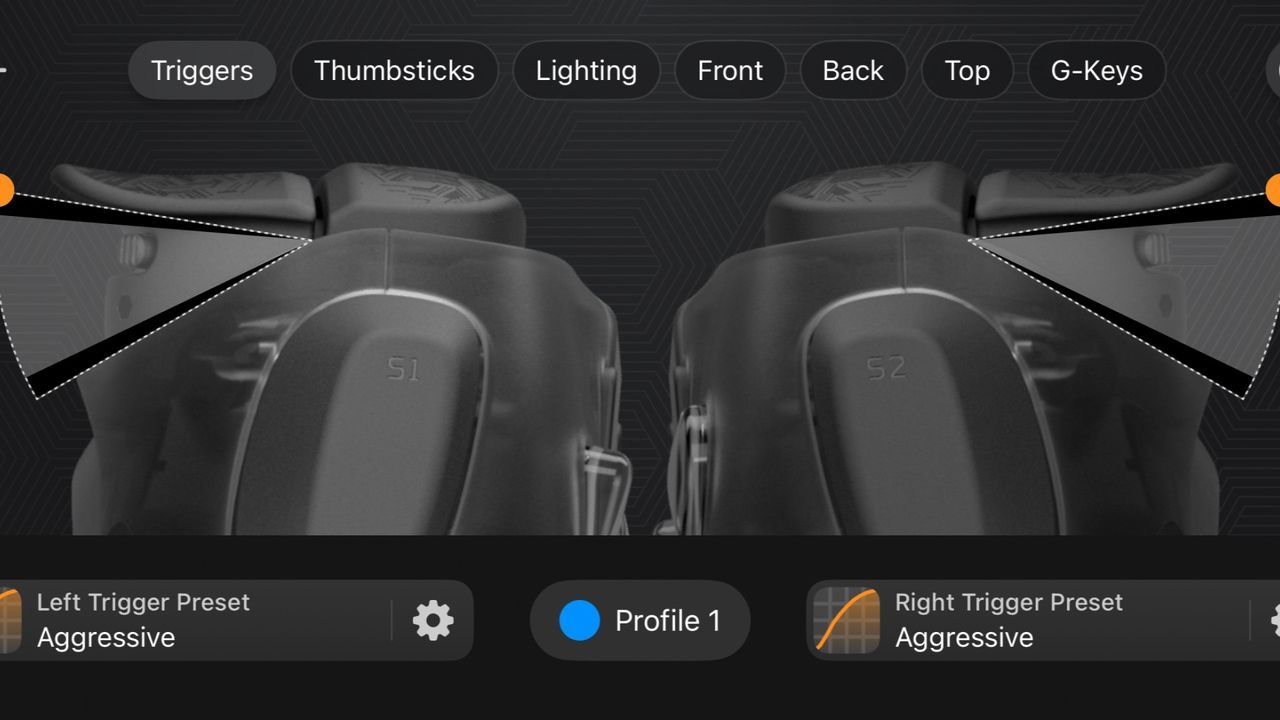
The controller’s app support also appears central. SCUF lists a mobile app for iOS and Android. Push Square says customization is handled through an app on PC or mobile and calls the process fairly straightforward, with the ability to save three profiles mentioned in the supplied review text. The required media for this piece, credited to GamesRadar, shows the SCUF mobile app assigning trigger deadzones on the Omega, which supports the idea that the controller is built around software-side tuning rather than purely on-pad remapping.
Connectivity is more complicated. Push Square reports that PS5 use works through a wired connection or a wireless dongle, while PC supports Bluetooth. The outlet also points out an awkward hardware step: a switch under the faceplate must be changed when moving to dongle connection rather than Bluetooth or wired use, and again when switching between PS5 and PC connectivity. Push Square notes that the magnetic faceplates are easy to remove, but still calls the switch a tedious step.
For some players, that will be a small tradeoff. For others, especially anyone moving between console and PC nightly, it is the sort of friction that wears down the premium sheen. A pro controller can be wonderfully configurable and still feel clumsy if the path between setups interrupts play.
The big omission: no rumble or adaptive triggers
The starkest practical limitation in Push Square’s coverage is the absence of rumble and adaptive triggers. The outlet states that, as is common for controllers of this kind, the Omega does not include any form of rumble or adaptive triggers.
That omission makes sense for part of SCUF’s target audience. Competitive players often turn off vibration, and shorter trigger actuation can be preferable in shooters where speed matters more than resistance. SCUF’s own marketing leans hard into competitive language, saying the Omega is built for those who play to win and emphasizing inputs, precision, durability, and low latency.
The tradeoff is harsher on PS5 than it would be elsewhere. Sony’s DualSense identity is built around haptics and adaptive triggers, and many PlayStation players associate “premium PS5 controller” with preserving those platform-specific sensations. If a player spends much of their time in cinematic action games, racing games, first-party adventures, or atmospheric indies where vibration and trigger feel contribute to texture, the Omega’s competitive focus cuts away part of what makes PS5 games feel native on Sony’s hardware.
That is where the best PS5 controller alternatives question becomes personal. The Omega may be attractive if your priorities are extra inputs, drift-resistant stick technology, mechanical switches, and profile tuning. It is less compelling if your idea of premium includes the tactile language of the DualSense. Early coverage frames that divide clearly: SCUF has built a pad for performance-minded control, but it has not tried to be an all-purpose DualSense upgrade.
Conflicting online claims make buyer caution essential
Readers searching for a SCUF Omega review will find at least one major conflict in publicly available coverage. A PixelBuys article describes a “PS5 Scuf Omega Controller Review 2026” with a very different spec and price profile, claiming the controller is a wired-only $139.99 pad with haptics and adaptive triggers, no Bluetooth, no wireless dongle, and no Hall effect sticks. It also presents the Omega as roughly half the price of a DualSense Edge.
Those claims do not line up with SCUF’s current PS5 controller page or Push Square’s hands-on report. SCUF lists Omega models starting at $219.99, advertises Endurance TMR thumbsticks, highlights a mobile app, and describes PC low-latency support in wired and wireless modes. Push Square reports PS5 wired and dongle connectivity, PC Bluetooth support, TMR sticks, and no rumble or adaptive triggers. A GameBastion aggregation of Push Square’s story repeats the same core Push Square details, including the £209.99/$219.99 price and PS5 wired or dongle support.
Because SCUF’s own store and the current hands-on review material agree on the higher price and core feature set, buyers should treat the lower-price wired-only description as unresolved conflicting information rather than a reliable guide to the Omega currently being sold. If you are comparing the SCUF Omega PS5 controller against a DualSense Edge, Victrix-style modular pads, or other premium options, check the exact model page before buying. The price and feature gap changes the value argument completely.
The available source material does not include our own hands-on testing, long-term durability data, battery life measurements, repair information, or stick calibration results. It also does not establish whether the Omega will receive software updates that improve profile handling or platform switching. Those are the questions that matter after launch week coverage fades.
Who should wait, and who might still want one
Based on the confirmed listings and early coverage, the Omega looks easiest to recommend to a specific player: someone who mainly plays competitive games on PS5 or PC, wants many remappable inputs, cares about drift-resistant stick tech, and does not mind giving up rumble and adaptive triggers. The controller’s four rear paddles, side buttons, G-Keys, TMR sticks, mechanical switches, and app support form a coherent competitive package.
It looks harder to recommend to the player who wants one premium controller for every PS5 game. Push Square’s reaction suggests the Omega is comfortable and capable, but not immediately impressive in a way that makes its $219.99-plus price feel self-explanatory. The loss of DualSense haptics and adaptive triggers also narrows its appeal outside fast, input-heavy play.
For now, the smart buyer move is patience unless the feature set maps exactly to your habits. Wait for more SCUF Omega review coverage that tests profile switching, app stability, wireless behavior on PS5 through the dongle, PC latency, stick accuracy, and durability over months rather than weeks. If your current controller works and you are still exploring PS5 pro controller options, the Omega has enough promise to stay on the list, but early reactions do not make it the obvious default.
SCUF has made a clean, highly configurable competitive controller. The unresolved question is whether clean is enough at this price.