
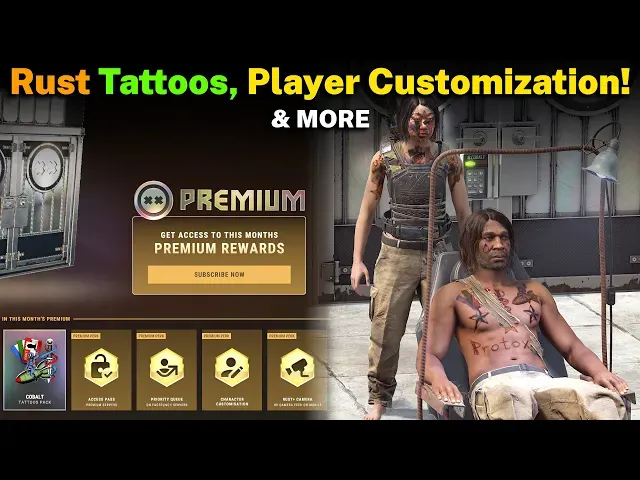

Facepunch has kept Rust character customization out of the live game while tattooing, Premium identity perks, rain wetness, and other staging-branch changes continue to be tested.
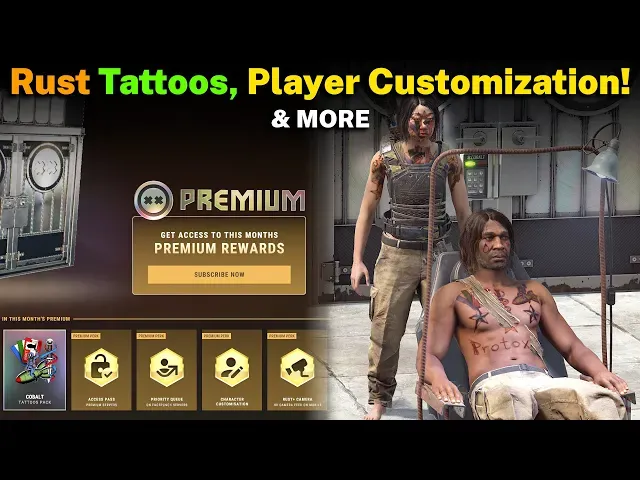
Image: vgtimes.com
Rust’s identity update is still waiting outside the live gate
Facepunch is keeping Rust character customization off the live game for now, according to HappyGamer, which reports that the feature has been held back after community feedback while the staging branch is wiped with tattooing, rain wetness, and a Tech Tree reshuffle. That is the central tension around the next Rust survival game update: the most personal part of the patch, the ability to shape who you are in a world built on suspicion, is visible in testing but still not a confirmed live feature.
The timing is especially sharp because several public reports now point to Rust’s staging branch as the place where identity systems are being assembled. Polygon reports that Rust Premium is available on the staging branch and that its menu lists character customization among Premium perks. Yahoo’s Tech section, citing Polygon, similarly describes player customization as appearing through the Rust Premium test environment. Rustafied, meanwhile, reports that tattoo work continues on its own development branch, with a tattoo chair, interface work, persistence fixes, and audio updates still in progress.
Those details do not add up to a launch promise. RustAddicted warns that Facepunch has not published official December patch notes, and that public commit activity or staging access should not be treated as confirmation for the December 3 force wipe. For players, the practical read is simple: Rust character customization is real enough to be in active testing and Premium-facing menus, but the live game is still waiting on Facepunch to say when, how, and under what access rules it arrives.
The staging branch is doing the dangerous work first
Rust’s staging branch exists to let players test upcoming systems before they reach the live survival sandbox, and this is exactly the kind of feature that benefits from being kept there longer. Character identity in Rust is not decorative in the same way it might be in a lobby shooter. Silhouettes, faces, clothing, scars, tattoos, and recognition all feed into moment-to-moment survival pressure. In a game where a neighbor can become a raider by nightfall, the ability to alter appearance touches trust, deception, and retaliation.
Polygon reports that a staging-branch Premium menu includes character customization, but also notes that the feature could only be applied using code at the time of its report. Polygon frames that as either unfinished or deliberately inaccessible. That distinction matters. If Facepunch is blocking the feature because the interface is not ready, this is a technical delay. If it is deliberately inaccessible, the studio may be controlling when players can test the system in the open, possibly because identity changes need stricter rules than a normal cosmetic toggle.
HappyGamer’s report adds the community-feedback angle, saying Facepunch is holding customization back after player response. The source text does not detail the exact feedback, so it would be premature to claim a specific complaint drove the decision. Still, the result is clear: the live population does not yet have the full system, while staging continues to absorb the risk. That is a familiar survival-game rhythm. The test environment takes the blood loss first so the main servers do not have to.
Tattooing looks further along, but it is still not a live promise
The strongest visible companion to Rust character customization is tattooing. Rustafied reports that the upcoming tattoo system continues to receive work, including a final model for the tattoo chair, updated textures, animations, and new tattoo gun sounds. The chair is now required for tattooing, according to Rustafied, with additional improvements being made to stencil placement, the painting interface, and inventory previews.
That gives the Rust tattooing update a more concrete shape than a vague cosmetic menu. It suggests a physical in-world process, not an abstract account screen. A chair, a tattoo gun, stencil placement, and another player’s body all fit Rust’s existing language of risk. The player is vulnerable, someone else is nearby, and the result may persist after the moment ends. Even a social cosmetic feature becomes a small scene of exposure in a hostile server ecology.
Rustafied also reports technical work on tattoo persistence, including attention to cases where players disconnect while dead. Streamer mode settings are now stored alongside tattoo data so they can apply properly to offline players and corpses, according to the same report. That last detail is easy to skim past, but it points to the ugly edge cases Facepunch has to solve before tattoos belong in live Rust. Bodies can be looted, inspected, hidden, or used as information. If tattoos fail to persist correctly, disappear on death, or leak identity information through streamer mode, the feature creates problems beyond cosmetics.
RustAddicted calls tattoos the strongest feature candidate for the December build based on public development signals, including recent tattoo-branch commits involving stencil artwork, a scrollable stencil menu, tattoo UV support for clothing prefabs, updated body meshes, and filtering intended to make painted designs look less pixelated. But RustAddicted also labels that as a strong development signal rather than confirmation, because Facepunch has not issued the final patch notes.
Premium makes customization feel less settled
The most controversial part of the current picture is not whether Rust can technically support identity options. It is how Facepunch plans to attach those options to Rust Premium. Polygon reports that Rust Premium was introduced after Facepunch removed a controversial Battle Pass entry from the roadmap in August, replacing it with Premium. According to Polygon, Premium began as a status for players with at least $15 worth of items in their inventory that granted access to premium servers, but later patch-note details pointed toward a paid monthly service with exclusive perks and rewards.
Polygon’s staging-branch reporting lists character customization alongside Premium perks such as Access Pass, queue priority for full servers, and HD camera access on mobile. Yahoo’s coverage also says player customization appears to be coming with Rust Premium, while noting that it remains to be seen what will actually be added when the next wipe arrives.
That makes the access model one of the biggest unanswered questions. If Facepunch Rust customization launches as a Premium perk, players who have waited years for control over their appearance may see a long-requested identity feature placed behind a subscription structure. If the staging menu is temporary, incomplete, or not representative of the final live implementation, that concern may change. The current source material does not provide a definitive final pricing page, full subscription terms, or a Facepunch statement separating free customization from paid customization.
The Cobalt Premium pack adds another layer. Polygon reports that the first month of Premium features the Cobalt Premium pack, including launch reward skins for Sheet Metal Doors, Cobalt skins for the Metal Chest Plate and Code Lock, a Cobalt weapon charm, and the Cobalt tattoo pack. Polygon describes the tattoo pack as a customization feature that lets players give characters tattoos via a tattoo artist chair. That suggests tattoos may arrive not only as a survival-world tool, but also as part of Premium’s reward economy.
Locked identity could be a balance rule, not a missing option
One of the more important staging-branch claims concerns how often players can change themselves. Polygon cites user Protox, who dug through staging-branch files and believes that once players customize their character, they will not be able to change it for the rest of the wipe. Yahoo repeats that reported belief, describing it as a possible month-long lock until the next server wipe.
That remains an interpretation from staging files, not an official Facepunch rule. Still, it is a believable solution to a Rust-specific problem. If players can freely change faces mid-wipe, identity becomes a disposable mask. A raider could change their look after an attack, a scammer could shed recognition, and a streamer or clan member could alter appearance to manipulate social memory. Rust already runs on uncertain information, but too much identity fluidity could turn recognition into noise.
Polygon notes that locking customization for a wipe would make sense as a way to prevent players from changing appearances mid-wipe to deceive others. From a survival-design perspective, that restraint may be the difference between customization feeling like ownership and customization becoming camouflage. The player chooses a body, then lives with the consequences until the server world turns over.
Tattooing may follow a different rhythm. Polygon suggests tattoos could likely be added during a wipe but removed the following month, while acknowledging uncertainty. Rustafied’s reporting on persistence work also implies Facepunch is treating tattoos as lasting data rather than throwaway paint. Until Facepunch publishes final rules, players should assume anything seen on staging can change, especially costs, recipes, persistence, and wipe timing.
Rain, movement, and other staging work show a crowded update window
Character customization is not developing in isolation. HappyGamer reports that the staging branch was wiped with tattooing, rain wetness, and a Tech Tree reshuffle. Rustafied provides more detail on the weather side, reporting that rain is receiving improvements to rainfall visuals, surface wetness, terrain variation, and ambient sounds heard while taking shelter under a roof. Advanced weather options have also been exposed in the settings menu, according to Rustafied, while optimizations have reduced redundant shader calculations and removed unused effects to cut shader memory usage.
For a survival player, that is not window dressing. Rain changes visibility, mood, audio cover, and the sense of being hunted through bad conditions. Surface wetness and better shelter audio make the world feel less static, and in Rust that atmosphere can alter how cautious people become around bases, monuments, and night movement. It is also another technical load on an update window already carrying identity systems, tattoo persistence, and Premium-facing menus.
Rustafied also reports work on modern sprint movement in the main branch, introducing the ability to strafe while sprinting with a toggle for players who prefer the existing behavior. Separately, Rustafied says Facepunch continues to work on an experimental extraction game mode and an underground train network overhaul, both without confirmed release dates. RustAddicted’s warning is useful here: even work that looks polished in commits or staging can be disabled, reverted, or held for another update.
That crowded pipeline helps explain caution around customization. A broken skin shader is annoying. A broken identity system can affect corpses, offline bodies, streamer mode, Premium rewards, and social recognition across a month-long wipe. Facepunch has reasons to keep this one in the dark a little longer.
Should players expect it at the December force wipe?
The date circling the whole story is Thursday, December 3, 2026. Polygon says Rust character customization was scheduled for Q4 2026 and is likely coming in the next force wipe, which it identifies as December 3. Yahoo also points to December 3 as the next scheduled server wipe and says it is possible customization appears after the refresh. RustAddicted says the December force wipe is due that day, following the previous wipe on November 5, and notes that community schedule trackers expect an approximately 19:00 UTC update time while warning that Facepunch can shift release timing.
The safest answer is to wait for Facepunch’s official patch notes. The available reporting supports three separate statements. First, Rust character customization and Rust Premium identity perks are visible in staging-branch reporting. Second, tattooing has substantial development activity and staging demonstrations, with Rustafied documenting chair, interface, sound, preview, and persistence work. Third, no provided source includes final Facepunch patch notes confirming the complete December live changelist.
If you play Rust casually, do not buy Premium or plan your wipe around customization until the live notes specify access, pricing, and restrictions. If you run a server or moderate a community, watch for rules around wipe-locked appearances, tattoos on corpses, streamer mode, and whether tattooing requires another player or a specific chair recipe in the final build. If you are waiting for the feature as a long-term identity fix, the staging activity is encouraging, but the holdback after feedback means Facepunch is still shaping the system before letting it loose on live servers.
Rust is at its best when every comfort has a cost. Character customization is heading toward that same pressure point: a long-requested way to claim a face in a game where being recognized can save you, damn you, or mark your door for a raid.