
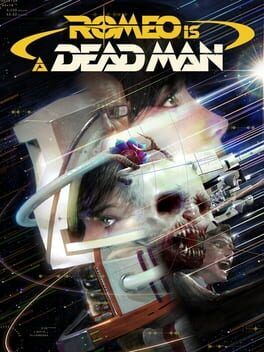

Between its wild new story trailer and early hands-on previews, Romeo Is a Dead Man is shaping up to be Grasshopper Manufacture’s most mechanically dense and confident action game ahead of its February 11 launch.
As Romeo Is a Dead Man barrels toward its February 11 release, the new story trailer and a wave of early previews have crystallized something that once sounded impossible. Grasshopper Manufacture and Suda51 are not just making another loud, stylish, genre-scrambling curiosity. They are building a full-scale, mechanically intricate action game that looks ready to stand alongside the studio’s wildest narratives without collapsing under them.
This is still unmistakably a Suda51 joint. The premise alone gives that away. Romeo, a seemingly ordinary teenager, gets dragged into a catastrophe when his mad scientist grandfather literally shatters space-time. Romeo is killed, then brought back via an eyeball syringe in one of the game’s most queasy visual motifs, and is reborn as Agent Dead Man of the FBI’s Space-Time Division. His crush Juliet vanishes in the chaos, his grandfather dies and somehow becomes his sentient jacket, and the universe fractures into a collage of timelines and realities where Juliet reappears as untrustworthy, often murderous variations of herself.
The new story trailer leans hard into this multiversal heartbreak. There are flashes of domestic warmth and adolescent infatuation, followed by glimpses of Juliet as a threat, a stranger and a victim of something bigger than either of them. Suda’s taste for emotional whiplash is front and center. One line can be about conspiratorial space-time monarchs and AI-controlled presidents, the next about the ache of losing someone who might not even be the same person if you ever find her again. It is melodrama filtered through B-movie sci-fi, and it looks like Grasshopper at its most confident.
What sets Romeo Is a Dead Man apart is how sharply its structure and combat are already coming together according to early hands-on reports. The opening chapters still feel like being bombarded with ideas, cuts and tone shifts, but beneath the chaos sits a focused third-person action game that cares deeply about its systems.
Visually, the game is an aggressive statement of intent. Entire sections swing between grimy 3D dreamscapes, minimalist cube dimensions lit like a conceptual art piece, ink-heavy manga panels and retro comic book spreads where characters move only slightly inside their frames. The story trailer stitches together many of these modes into a single breathless montage that suggests the full game will constantly switch lenses instead of just reskinning the same corridor.
That shifting presentation is not just aesthetic dressing. Previews describe sequences where the comic styling feeds directly into the fights, such as an extended encounter with a Juliet impostor that starts as a dialogue scene printed across bold panels before the gutters literally crack apart and spill you into a boss fight. That sense of scenes disintegrating into combat recalls the best moments of No More Heroes and Killer Is Dead, but there is a new deliberateness to how it flows.
Underneath the noise, Romeo himself is an unusually responsive action protagonist by Grasshopper standards. Early builds already show him chaining dashes, melee strings and gunfire into a rhythm that feels less like a quirky character action pastiche and more like a fully authored combat system designed to hold up across a full-length campaign.
Romeo wields both close-range tools and ranged weapons, and moving between them is key. Reports describe melee as quick, slashy and backed by evasive movement that encourages you to play aggressively rather than circle-strafe at a distance. Ranged attacks are not just a safety valve, they slot into that rhythm, letting you either finish combos stylishly or control space against large boss attacks and mobs.
Layered on top of the fundamentals are the kinds of mechanics that could easily feel like jokes in a lesser action game but here seem intent on supporting a dense combat sandbox. The standout system is the one Grasshopper rather bluntly calls bastards. These are cultivated minions grown in space, almost like grotesque plants, that Romeo can deploy for powerful special attacks. You harvest and plant them, then cash them out mid-fight to add sudden crowd control or burst damage. It is absurd in concept, but functionally it plugs into the loop of assessing the arena, storing resources and choosing when to cash in for momentum.
The tone of the combat is theatrically violent. There is no shortage of gore, dismemberment and molten faces, yet the presentation wraps it all in confetti bursts, sparkling overlays and gaudy sound design. Every kill feels like a miniature fireworks show. That juxtaposition has always been part of Suda’s style, but Romeo Is a Dead Man pushes further, using loud, almost celebratory feedback as a way to make mechanical clarity fun to read in the middle of chaos.
Death even becomes a mechanical beat instead of a pure penalty. When Romeo goes down, the game cuts to a disturbing death screen then flips into a wheel-of-fortune style respawn system. Spin it, and you might come back with boosted attack power or another perk that subtly tips the odds for your next attempt. It is an elegant way to keep the loop punchy, acknowledge player failure and still fold that into the game’s reality-bending tone.
Difficulty selection is just as characterful. Early on, Romeo chooses a chocolate from a small heart-shaped box, each flavor corresponding to a hidden difficulty level. White is the gentlest, milk is standard and orange is effectively hard mode. It is the sort of playful presentation you would expect from Suda, but there is a quietly ruthless design choice under it. Once you bite into your chocolate, you are locked in for the rest of the game.
On standard difficulty, previews describe the first major boss, Every Day is Monday, as an early skill check that demands attention rather than blind aggression. This huge, off-putting mass of flesh and wobbling appendages stomps arenas with fire and shockwaves, and it reportedly took multiple attempts for writers to get through it. Instead of bumping them into frustration, the fight seems constructed to force players to lean into the full toolset, from healing to ultimate attacks, and to treat movement and pattern recognition seriously.
It is here that Romeo Is a Dead Man begins to resemble something more disciplined than Grasshopper’s reputation usually suggests. The structure of these early missions is a deliberate funnel into learning systems. Enemies introduce ideas in small pockets, the first bosses press those ideas until you respond, and the reward is not just progression but a sense that the game expects you to engage with it as a true action title rather than a parade of memes and references.
The non-linear storytelling wraps around this backbone. Scenes jump across timelines and realities, often cutting Romeo off mid-thought to relocate him, and by extension the player, into new scenarios. That could easily feel exhausting, yet early impressions suggest that the pacing works because it treats narrative and combat as part of the same barrage of surprises. One moment you are being told that the current president is just a puppet for a fifth-generation AI implanted by a Space-Time King, the next you are trying to survive a fight in a kaleidoscopic cube realm where the floor might disappear at any second.
It would be easy to read all this as typical Suda51 excess, but the cumulative picture painted by the story trailer and hands-on reports is of a project determined to marry that excess to a more mature sense of game feel and structure. There is still the sentient jacket cracking one-liners and the ever-present sense that you are one line away from the most ridiculous piece of exposition you have ever heard, yet the battles themselves are not being played purely for comedy.
Grasshopper’s past work has often been celebrated more for attitude than mechanical longevity. No More Heroes turned repetition into a joke and a weapon, while games like Lollipop Chainsaw rode their concept art and soundtrack harder than their systems. In Romeo Is a Dead Man, that pattern seems to be shifting. Enemies telegraph attacks clearly without losing personality, boss arenas emphasize spatial awareness and the bastards system offers a light strategic layer about when to spend your precious monsters for maximum payoff.
If Grasshopper can sustain this level of mechanical ambition across the full runtime, Romeo Is a Dead Man has the potential to be more than just 2026’s weirdest sci-fi curiosity. It could be the studio’s most complete action game, where the combat is strong enough to entice players back to challenges and optional encounters even after the novelty of its wildest visual twists wears off.
For now, the signs are encouraging. The new story trailer showcases a studio willing to push visual identity and narrative absurdity further than ever, but the hands-on previews give something more important. They suggest that when you strip away the jokes and the chaos, there is a sharp, demanding and surprisingly coherent action game waiting beneath the jacket.
Romeo Is a Dead Man launches February 11 on PlayStation 5, Xbox Series X|S and PC, and it might be the moment where Suda51’s signature madness finally finds a home inside a fully realized modern action framework instead of just dancing around it.