
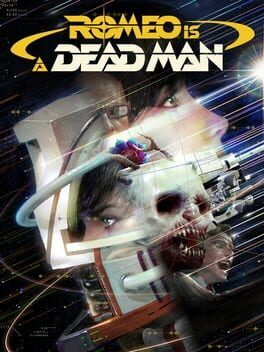
Suda51 and director Ren Yamazaki peel back the mask on Romeo is a Dead Man, from its space-time police premise and Rick and Morty style duo to the ‘controlled chaos’ combat that defines Grasshopper Manufacture’s latest action game.
Romeo Stargazer has a badge, a mask, and a very bad problem with space-time.
On paper, Romeo is a Dead Man sounds almost straightforward. It is a single player sci-fi action game where you play an FBI Space-Time Division agent chasing temporal criminals while trying to find his missing girlfriend. In practice, it is the next strange, swaggering experiment from Grasshopper Manufacture, directed by Goichi Suda and Ren Yamazaki, built on what they happily describe as “controlled chaos.”
The result is a game that feels like a spiritual cousin to No More Heroes and Killer is Dead, yet pitched as a “dead-serious” love story wrapped in ultraviolent slapstick. For players eyeing its launch, understanding how that contradiction holds together means looking at three pillars: the space-time police premise, the way the team weaponized chaos in both story and systems, and the influences that shaped Romeo and his world.
A space-time cop story that only Grasshopper would tell
Romeo is reborn after a time-paradox incident as Agent Dead Man, a masked special investigator for the FBI’s Space-Time Division. His mandate is to hunt down dangerous fugitives who abuse temporal distortions. His personal motivation is simpler and more human. Juliet, the girlfriend who vanished in that same catastrophe, is somewhere out there in the fractured timelines, and every case Romeo takes has the potential to bring him closer.
It is not Shakespeare. Suda and Yamazaki make it clear that Romeo and Juliet is more a playful echo than a structural blueprint. Juliet was originally written as a brief appearance, almost a cameo. As they iterated on the script, she kept demanding more space, growing into a co-equal pillar of the story rather than a tragic footnote. The game borrows the emotional shorthand of doomed lovers, then remixes it into a cosmic search-and-rescue framed by procedural work.
That framing matters. Making Romeo a federal agent gives the team an excuse to hop across wildly different settings and realities. Each case can lean into a different flavor of Grasshopper weirdness, from hard-boiled investigation to gonzo sci-fi. The Space-Time Division is a neat anchor, a way to keep the narrative legible even as it dives into alternate realities and paradoxes.
Yet for all the cosmic talk, Romeo himself is deliberately grounded. Suda describes him as a good-natured, earnest hero in direct contrast to No More Heroes’ Travis Touchdown. Where Travis is selfish and ironic, Romeo is the serious one in a ridiculous universe. That contrast becomes sharper once he puts on the Dead Gear mask, the skull-like device that brands him as “Dead Man.” The mask was a breakthrough in development. Once the team locked in that visual and the Dead Man moniker, they say the whole project’s identity snapped into focus, title and all.
Romeo is rarely alone either. He is paired with his grandfather Ben, an older, crankier partner who turns the space-time road trip into a generational odd couple act. Suda and Yamazaki explicitly cite Back to the Future and Rick and Morty when talking about the duo. The dynamic is familiar. One is more straight-laced, the other chaotic; one wants to do the job by the book, the other wants to tear the book up and use it as a coaster. Grasshopper leans into that archetype but filters it through their own deadpan, late-night-TV sense of comedy.
Rick and Morty, but filtered through Grasshopper’s flavor
The Rick and Morty comparison is most obvious in the Ben and Romeo pairing, but it runs deeper than character banter. Suda often talks about Grasshopper games as their own flavor of ramen. Thick broth, heavy seasoning, loaded with ingredients that might turn off players who prefer something light and clean. Romeo is a Dead Man follows that philosophy, then adds a sci-fi animation sensibility on top.
Episodes of Rick and Morty hurtle from idea to idea, rarely stopping to fully explain themselves. Romeo’s opening hours intentionally have that same breathless energy. The team describes the first chapter as “full speed ahead,” a barrage of concepts, cuts, and tonal shifts that leave players slightly off balance. That is not accident or lack of discipline. It is a choice driven by Suda’s aversion to cutting content and to over-explaining.
During production, the opening segment had to be shortened. Rather than trimming whole scenes out of existence, the team compressed them, layering jokes, exposition, and action so densely that it almost becomes sensory overload. It's a controlled form of confusion. Yamazaki admits that first-time Grasshopper staff were bewildered when they played early cuts of the intro, but long-timers recognized it immediately as the house style.
This is where the “controlled” part of controlled chaos is crucial. Beneath the rapid-fire cuts and non-sequiturs, there is a clear spine. Romeo is a cop. There is a case to solve. There is a girlfriend to find. Like the best Rick and Morty episodes, the emotion is simple even when the plotting spirals through parallel realities. Grasshopper’s trick is to give you just enough to cling to, then let everything around that anchor go off the rails.
Ad-libbed development, refined action
If the story feels chaotic, the process that made it is not much tidier. Grasshopper’s internal meetings sound more like improv workshops than rigid production reviews. Designers, writers, and programmers bring raw ideas to the table. The group chews them over, cherry-picks the most interesting ones, then starts improvising how those pieces might fit into the current build.
That kind of ad-lib development does not map cleanly onto big production diagrams. Yamazaki says that for many newer hires, the actual shape of Romeo is a Dead Man only became clear near the debugging phase, when the last missing systems snapped into place. For veterans who have ridden this roller coaster before on No More Heroes or Killer7, that late coalescing is just how Grasshopper operates.
The important distinction is that the chaos does not extend to how the game feels under your thumbs. Suda is adamant that action games cannot be fully captured in pre-production documents. No matter how detailed the spec sheet, the real work happens hands-on, tweaking movement values, hit pauses, and enemy placement. Romeo is a Dead Man spent a long stretch in this tuning phase, with Suda and the lead programmer gradually sanding down rough edges until the combat reached what they call a “strong-style” rhythm. Attacks hit hard, recoveries and cancels have weight, enemies respond clearly when you land a blow.
Controlled chaos as a combat philosophy
In play, Romeo is a Dead Man is a hybrid of gunplay and sword fighting built around deliberate risk and reward. Romeo can keep his distance and pick off foes with firearms, staying in relative safety outside of enemy attack ranges. The problem is that safety will only get you so far. The game’s signature Bloody Summer finisher system only charges when you wade into close quarters and land melee hits.
That simple rule is the heart of the game’s controlled chaos. Every encounter pushes you to decide how much danger you are willing to court in exchange for spectacular finishing moves. Open fire from afar and the fight stays contained but slower and less explosive. Close the distance and the battlefield turns into a blood-slick carnival of launchers and cinematic executions, at the cost of constantly flirting with death.
Bloody Summer was one of the most tuned pieces of the combat kit. Timing windows, visual cues, the way Romeo’s sword carves through clusters of enemies, all of it went through round after round of iteration. The team wanted each activation to feel like a small climax without completely erasing tension from the rest of the fight.
Enemy layouts went through a similar process. Grasshopper has a reputation for sudden spikes, but here they talk about wanting first-time clears to feel “smooth” without becoming dull. That balance is handled through scenario work more than raw numbers. Enemy types with different behaviors are combined to force interesting decisions. Who do you risk closing in on first to juice your finisher gauge, and who do you keep at a distance with gunfire before they ruin your rhythm?
Bastards, gardening, and tactical chaos
Swords and guns are your baseline tools. The real Grasshopper twist arrives with the Bastard system, a strange hybrid of crafting, pet-raising, and build customization that Suda traces back to experiments in Travis Strikes Again and No More Heroes 3.
Within the world fiction, Bastards are weird entities you cultivate from the soil, each with its own combat ability and growth curve. Mechanically, they function as equippable support skills and companions that slot into Romeo’s loadout. Level them well and they can surpass his standard weaponry in raw impact. On PlayStation 5, the act of harvesting them even pushes through the controller’s adaptive triggers, turning Bastard gathering into a tactile ritual instead of just another menu.
Examples the team calls out range from the elemental to the suicidal. FrostBolt can freeze enemies in place, manipulating the flow of a crowded battlefield. SuicideAttack is a self-destruct option that scales aggressively as you invest in it, a literal embodiment of high risk for high reward. Then there is Mictlantecuhtli, a deity-like Bastard whose raw power makes it a developer favorite. Each new Bastard opens up a different little pocket of tactical chaos to explore.
The design intent is that players constantly experiment with their Bastard lineup instead of locking into a single optimal build. As Romeo’s journey crosses new timelines, fresh Bastards and upgrade paths appear, tempting you to reconfigure your entire play style for the next stretch. Suda has teased that the back half of the game pushes this system even harder, reshaping expectations about what your little soil-grown monsters can do.
In motion, this adds another layer to the risk calculus of combat. Charging your Bloody Summer gauge already encourages aggressive melee. Bastards give you escape valves and accelerants, from freezing a dangerous target to detonating half the room when things get out of hand. The chaos that might otherwise feel overwhelming becomes something you are choosing and directing.
A confusing opening by design
All of that action is wrapped in a structure that frequently dares you to keep up. The early story beats fire past at a sprint. New factions, time anomalies, character asides, gags that whiplash from bleak to absurd, it is delivered in a way that is meant to slightly disorient anyone expecting a straight procedural.
Yamazaki is candid that this approach caused some anxiety internally. Staff who had grown up playing more conventional, heavily storyboarded action games sometimes worried that Romeo’s introduction was too hard to follow. The veterans’ answer was that the confusion is the point, as long as the emotional throughline is clear. Romeo wants Juliet back. The Space-Time Division wants justice. The details can be pieced together as you go.
It is the same philosophy that guides their comparison to mainstream, “perfect” games. Suda uses the Doraemon characters Dekisugi and Nobita as metaphors. Dekisugi is the perfect honor student, the logical embodiment of a polished, orthodox big-budget game where every edge has been rounded off to a mirror shine. Grasshopper wants to be Nobita instead, messy and sometimes clumsy but brimming with surprising personality.
Romeo is a Dead Man tries to be legible enough that newcomers do not bounce off immediately, but it never aims for the frictionless correctness of its bigger-budget peers. The thick ramen broth metaphor shows up again here. Some players will find the density too rich. Others will slurp the bowl dry and hope there is a secret gyoza tucked at the bottom, an extra kick of surprise for those who commit.
Where Romeo sits in Grasshopper’s catalog
Positioning Romeo is a Dead Man inside Grasshopper’s body of work means looking at what it carries forward and what it tries to invert.
From No More Heroes it inherits the love of precise, crunchy action and a protagonist wrapped in pop culture trappings. Romeo’s mask and Dead Man persona feel like cousins to Travis’s beam katana otaku stylings, translated into a pulp sci-fi register. The Bastard system evolves the experimental mechanics from Travis Strikes Again and No More Heroes 3 into something more central and more legibly powerful.
From Killer7 and Killer is Dead it borrows the fascination with government agencies and morally murky assignments. The FBI Space-Time Division has the same air of shadowy bureaucracy that those games’ organizations carried, now blended with the elastic rules of time travel stories.
Where Romeo diverges most sharply is in tone. Grasshopper protagonists are often selfish or detached. Romeo, by design, is neither. He is a sincere agent trying to do his job and rescue someone he loves, a dead-serious emotional anchor surrounded by absurdity. It is closer to a straight love story wrapped in cosmic grime than another exercise in meta irony.
For long-time fans, that makes Romeo is a Dead Man feel like a consolidation. It is a new IP that folds together Grasshopper’s years of combat iteration, their affection for odd-couple duos, and their improvisational writing process, but writes the lead as someone you are meant to believe in rather than laugh at. For newcomers curious ahead of launch, that might be the most important detail.
Yes, it is chaotic. Yes, you will probably be confused at first. The team wants you to embrace that, to treat the chaos as part of the ride rather than a bug to be smoothed out. Beneath the mask and the temporal nonsense is a simple throughline: a man out of time, a partner at his side, and a love he refuses to leave behind, all expressed through action that has been honed well beyond the studio’s off-the-cuff reputation.
If Grasshopper’s thick-broth flavor has tempted you before, Romeo is a Dead Man looks like the next bowl to order. If it has not, this might be the one that finally convinces you to taste the chaos for yourself.