
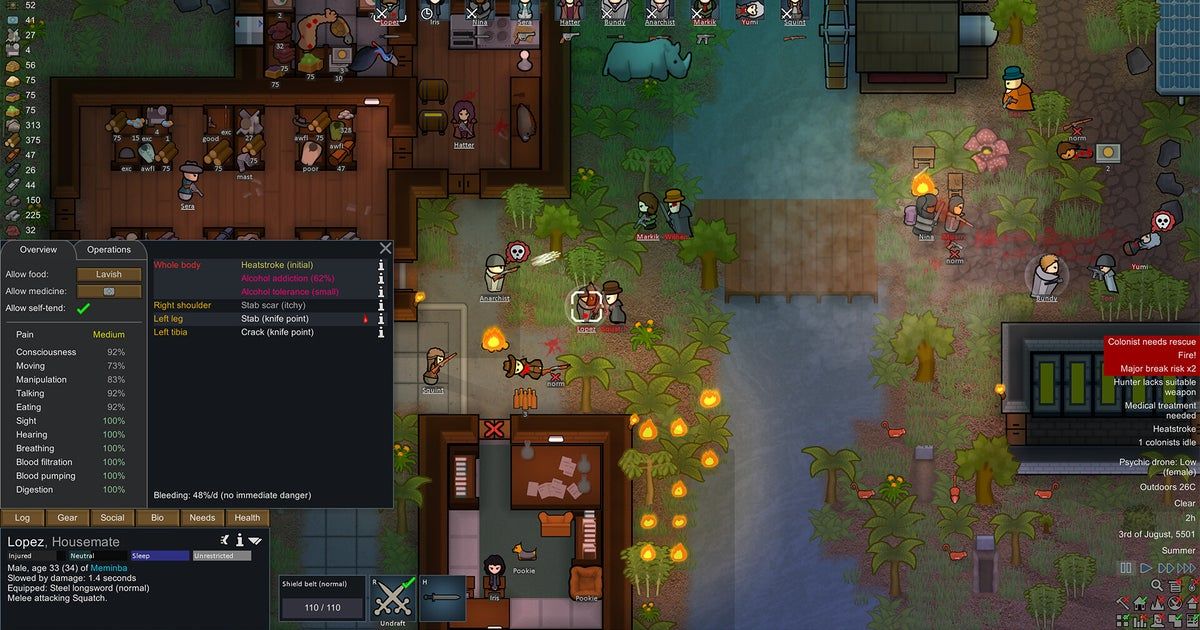

Ludeon is moving RimWorld from Unity to its own Waylith Engine in update 1.7, promising faster colonies, working saves, and mostly intact mods, with some hardware and beta-branch caveats.
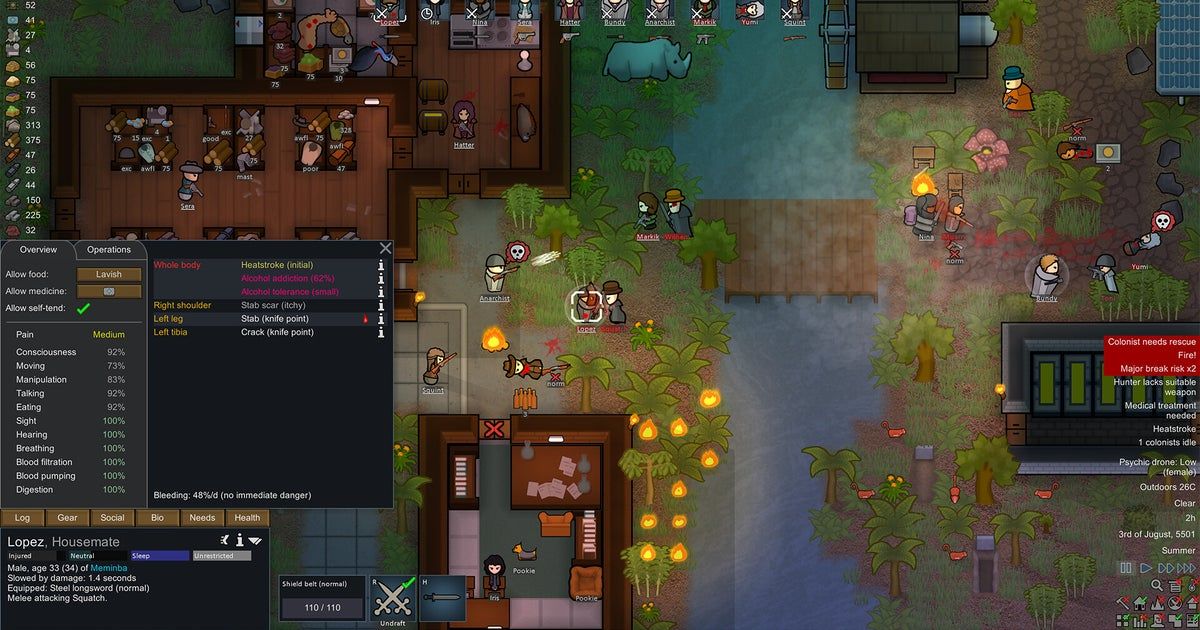
Image: eng.pressbee.net
RimWorld is leaving Unity, but Ludeon says the colony sim should feel unchanged
Ludeon Studios has announced that RimWorld update 1.7 moves the long-running sci-fi colony sim from Unity to the studio’s own in-house Waylith Engine. The concrete promise is unusually bold for an engine migration: according to Ludeon’s October 12 announcement, RimWorld should “look and play exactly the same,” while performance in the studio’s tests improves by 2-4x.
That is the tension at the center of the RimWorld Waylith engine switch. Engine changes are usually the kind of foundational work players only hear about when something breaks. RimWorld is also one of PC gaming’s more mod-dependent strategy ecosystems, where a colony can be shaped by years of workshop additions, custom rules, UI tools, species mods, storyteller changes, and late-game automation. Ludeon is saying update 1.7 changes the technical floor underneath all of that without asking players to abandon their saves or mod lists.
The update is available now for public testing through Steam’s unstable beta branch, according to Ludeon and SteamDB’s record of the October 12 RimWorld update post. The main branch remains on 1.6 for now, and the source material does not include a final release date for 1.7. That makes this a live test rather than a finished transition, which is the right way to read every performance claim and compatibility promise attached to it.
The performance target is late-game RimWorld, not prettier RimWorld
Ludeon’s announcement frames Waylith around speed rather than a visual overhaul. The studio says update 1.7 improves startup time, load time with large mod lists, map generation, world generation, general ticks-per-second, and “just about everything else” compared with 1.6. In one stress test cited by Ludeon, a late-game colony ran 2.2x faster on 1.7 than on 1.6. In another example, a 1,500-mod pack loaded in 6 minutes instead of 14 minutes.
Those numbers matter because RimWorld’s practical endgame is often limited by simulation throughput. A colony with dozens of colonists, a large animal population, heavy pathing, work bills, raids, ideology roles, biotech systems, and modded logic is a balance puzzle running on a timer. Once ticks-per-second drops, the player is no longer only managing food, labor, mood, and defense. They are managing patience.
Ludeon gives a useful example in its own terms: a colony of 40 colonists, 200 ducks, and 100-plus mods should run smoother on Waylith. That kind of scenario is not an edge case for RimWorld’s committed players. It is the natural result of a colony sim that encourages compounding systems. Every added pawn is a worker, a consumer, a combat unit, a pathfinding object, and a story generator. Every mod can add calculations to that stack.
There is still a limit to what can be concluded today. Ludeon explicitly says its test results may vary depending on a player’s PC and mods. Rock Paper Shotgun also points to early Reddit comments saying the update mostly behaves as advertised, with users reporting improved performance and mods continuing to work, while some players noted higher RAM usage on the new update. That community feedback is useful as an early signal, but it is not the same thing as a broad benchmark pass across hundreds of hardware setups and mod combinations.
The mod claim is the real stress test for Waylith
The most surprising part of the RimWorld Unity engine switch is not the headline performance number. It is Ludeon’s claim that the vast majority of existing mods work on 1.7 without changes from authors. The studio says some mods may appear in yellow as “potentially unsupported,” but that warning can simply be caused by the version number changing rather than a functional problem.
For a strategy game with RimWorld’s mod culture, compatibility is a design feature. A raw 2x speed gain loses value fast if players must wait months for their preferred UI tools, race mods, medical systems, storytellers, faction packs, and balance changes to return. Ludeon appears to understand that the update’s acceptance depends on continuity as much as speed.
For modders, Ludeon says Waylith allows use of the latest C# language features, makes it easier to write complex mods without hurting performance, and makes large visual changes and custom effects more accessible. That is a long-term support angle rather than a day-one player feature. If the engine gives mod authors more modern tools while keeping old work mostly functional, update 1.7 could shift the modding ceiling over time.
There is a practical cleanup step, however. Ludeon asks mod authors to test their work and publish versions marked as 1.7-compatible so players no longer see yellow warnings. HowToVideoGame’s write-up of Ludeon’s announcement also says more than two dozen modders tested RimWorld on Waylith before the public announcement. That kind of preflight work helps explain how a migration of this scale could land without an immediate workshop collapse, but the broader Steam ecosystem will be the real test.
Saves can move both ways, but the unstable branch still deserves caution
Ludeon says players do not need to do anything special when switching to 1.7. According to the studio, 1.6 savegames load on 1.7, and 1.7 saves also work if players go back to 1.6. That two-way save compatibility is important because it lowers the cost of trying the beta, especially for players whose current colonies are already straining under heavy simulation load.
The public testing path currently highlighted in the source material is Steam’s unstable beta branch. HowToVideoGame summarizes the Steam process as right-clicking RimWorld in the library, opening Properties, going to Betas, choosing the unstable branch, and selecting “Play 1.7 Unstable” if Steam asks. The sources do not give a date for when 1.7 leaves testing and reaches the main branch.
There is also a hardware caveat. Ludeon warns that if a PC is more than 10 years old, update 1.7 may not run on it. The studio asks affected players to report the issue on the official RimWorld development Discord, saying it may be able to make changes to help. That does not read like a new published minimum spec in the source material, but it is still a meaningful warning for a game with a long tail on older PCs.
From a player-planning perspective, this creates a split. If you run a huge mod list, have long load times, or are deep into a late-game colony where ticks-per-second has become the bottleneck, the unstable branch may be worth testing with backups. If your current 1.6 setup is stable and your colony is mid-crisis, there is no confirmed need to move immediately before 1.7 reaches the main branch.
Waylith gives Ludeon control over RimWorld’s long tail
Ludeon’s announcement does not say the RimWorld Waylith engine move was caused by Unity’s business decisions. That distinction matters. Rock Paper Shotgun draws a comparison to Mega Crit’s move from Unity to Godot for Slay the Spire 2 after Unity’s attempted per-installation fee, a plan that was later reversed. That comparison is useful industry context, but it should not be treated as Ludeon’s stated motive unless the studio says so.
What can be said from the announcement is narrower and more strategically interesting. Ludeon now has an in-house engine built for its own needs, and it is deploying that engine first to a mature live game with a massive modding footprint. If Waylith works as advertised, Ludeon gains more direct control over performance work, compatibility priorities, modder-facing features, and future technical changes.
For RimWorld, that matters because colony sims age differently than campaign-driven games. The player base does not only ask for new content. It asks the simulation to survive increasingly absurd scale: bigger settlements, longer timelines, larger mod stacks, and more overlapping DLC systems. A custom engine does not automatically solve those pressures, but it suggests Ludeon is investing in the game’s foundation rather than only layering content on top of old constraints.
The forward-looking question is whether Waylith becomes invisible in the best possible way. Players should not have to think about it during a raid, a crop blight, a prison break, or a 200-duck performance spiral. If Ludeon can keep the feel of RimWorld intact while buying headroom for heavier colonies and more ambitious mods, update 1.7 becomes a platform move disguised as a performance patch.
The engine is also tied to Ludeon’s next project, but details remain unannounced
GamingOnLinux reports that Ludeon ended its Waylith announcement by noting that the studio is working on something new using the engine, while details may take some time. HowToVideoGame likewise says RimWorld is not the only game on Waylith and that Ludeon teased a new project.
That is the most speculative part of the story, because the available source material does not name the game, announce platforms, give a genre, list a price, or provide a release window. The confirmed fact is that Ludeon has built an in-house engine, is moving RimWorld to it in update 1.7, and has indicated that Waylith will also support something new.
For now, the practical story remains RimWorld itself. Update 1.7 is in unstable testing. Ludeon claims major performance gains, save compatibility in both directions, and broad mod compatibility. Early community reports highlighted by Rock Paper Shotgun appear broadly positive but include RAM-use concerns. Very old PCs may run into trouble. Mod authors are being asked to test and update compatibility tags.
For a game built on cascading systems, the strategic read is simple: performance headroom is design headroom. If Waylith delivers across real player colonies, RimWorld’s next phase will be less constrained by the familiar late-game bargain between ambition and simulation speed. If it stumbles, the pain will show first where RimWorld is most alive: in overloaded saves, giant mod lists, and colonies that have been running long enough to become their own little economies.