
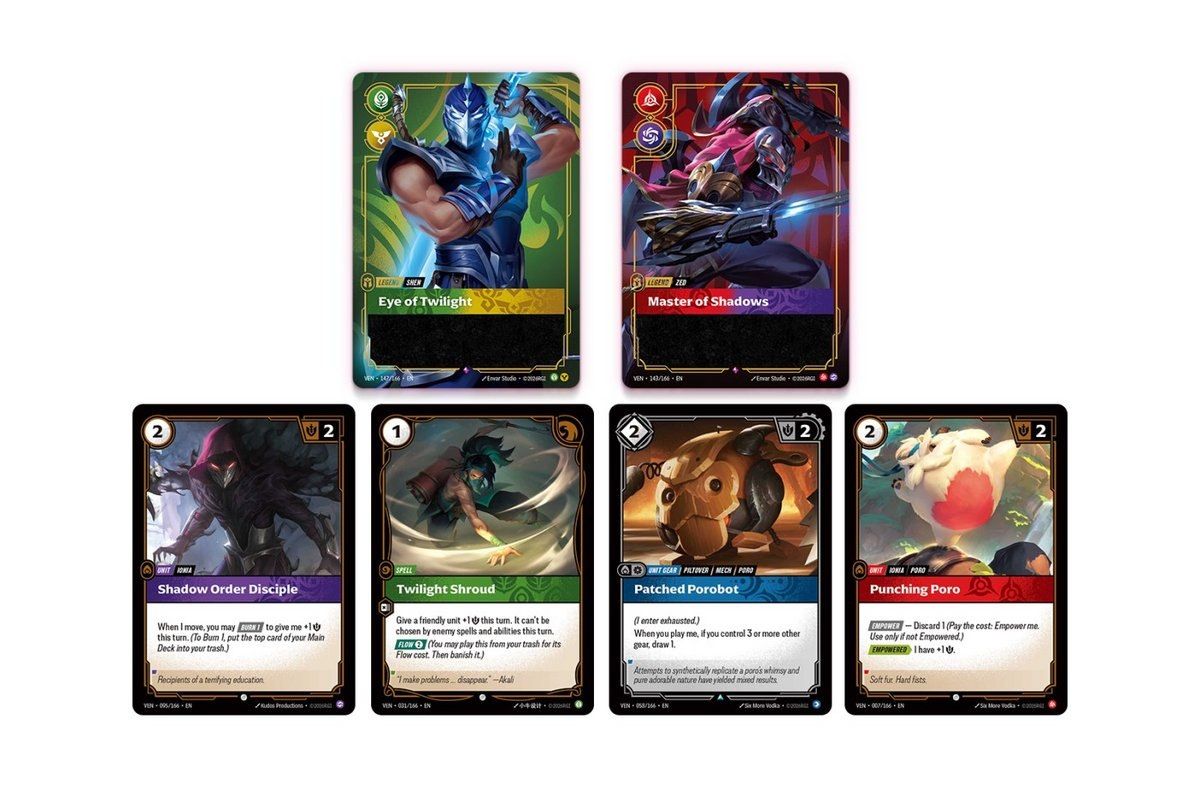

A practical Riftbound Vendetta showdown deck preview focused on Zed, Shen, Empower, Burn, Flow, tempo, deck identity, pricing, and availability.
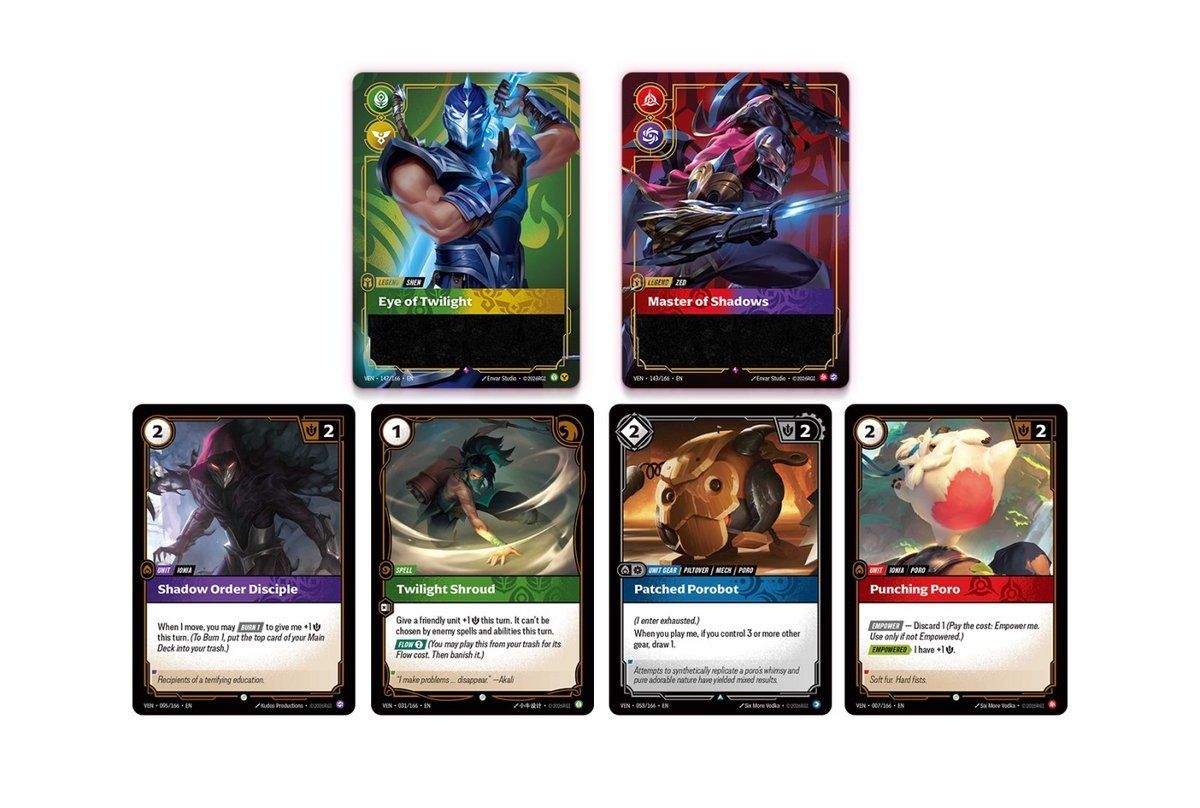
Image: techraptor.net
Vendetta’s first Showdown Deck puts tempo under pressure
Riftbound: Vendetta is introducing a new two-player Showdown Deck product with Shen and Zed as its first pairing, and the key tension is immediately practical: this is being sold as an easy entry point, but its headline mechanics ask players to think several turns ahead. Riftbound.gg lists the Shen vs. Zed box as containing two 56-card preconstructed champion decks, two paper playmats, a rulebook, a deck-building guide, two custom paper deckboxes, and two Vendetta booster packs at $34.99 / €36.99. The same listing says access to purchase through the official Riftbound store uses a 48-hour drawing window, with selected players receiving a purchase link and 24 hours to complete the order.
That makes Riftbound Vendetta’s first Showdown Deck a strange but interesting product. It is positioned as a beginner-friendly package, yet the Zed side, according to IGN’s hands-on preview at Riot’s HQ, uses all three new Vendetta mechanics: Empower, Burn, and Flow. Those keywords are not cosmetic additions. They alter how resources, graveyard access, and late-turn decisions work. For a preconstructed duel box, that is a strong design statement. Riot appears to be using the Shen and Zed rivalry to teach two different speeds of play rather than simply placing two symmetrical starter decks in a box.
The full decklists are still a missing piece. Riftbound.gg’s product page currently marks both the Showdown Deck Shen and Showdown Deck Zed lists as “coming soon.” That limits any card-by-card evaluation. Still, between IGN’s hands-on details, public set information, and the posted product structure, there is enough to preview the decks in the way buyers actually need: what each side is likely trying to do, how the new keywords change tempo, and which players should be paying attention when the July 31, 2026 release window arrives.
Zed’s deck is the obvious test case for Vendetta’s new engine
IGN reports that the Zed deck in the two-player Showdown Deck uses Empower, Burn, and Flow. That is the most important gameplay detail so far because it frames Zed as Vendetta’s mechanical sampler and likely its higher-variance deck. IGN also identifies Zed’s Legend as red Fury and purple Chaos, while Skillshotz Gaming’s Vendetta guide describes Zed as a Fury/Chaos champion tied to fast attacking play, disruption, and unpredictable situations. Skillshotz is a retail and guide source rather than Riot, so its archetype language should be treated as interpretation, but it aligns with what IGN says about Zed carrying the set’s new mechanics.
Burn is the tempo accelerant and the risk. IGN defines Burn as putting a number of cards from the top of your deck into your trash, with some cards able to inflict that effect on the opponent. In a vacuum, milling your own deck looks like a cost. In a Zed shell that also uses Flow, it becomes setup. IGN quotes Riftbound senior designer Jon Moormann saying Flow works well with Burn or Discard because it is “basically just free cards.” Flow lets a card be played from the trash for its Flow cost, then requires that card to be banished.
The tempo consequence is clear, even without the full list. Zed can convert cards that would normally be inaccessible into additional play lines from the trash. That can punish opponents who spend their turn answering the visible board while Zed’s real resource pool is split between hand and trash. The balancing pressure is equally clear. If a player Burns without enough Flow payoff, they are spending deck resources for little return. If the deck is built with the right density of Flow cards, Burn becomes a form of velocity. Zed’s identity, at least in this product, appears to sit on that edge.
Empower gives slower hands a way to spend turns without falling behind
Empower is the keyword most likely to change how Vendetta decks use awkward turns. IGN describes Empower as a state players can activate on their turn, usually for a cost such as runes or a trigger like banishing a card. Once Empowered, a card gains an extra ability or effect. IGN’s example is Akali: her normal Action can move a friendly unit in a showdown to base if it is your turn, while her Empowered version, paid by exhausting three runes and recycling one, also readies that unit.
Moormann’s explanation to IGN is the strategic core. He said Empower can be viewed “as a different way to draw cards in some ways,” because it gives colors with less access to card flow another method to develop the board over the course of a game. In resource terms, Empower is a mana-sink style mechanic. If the player has runes available but no clean card to deploy, the turn does not have to be empty. Existing cards on board can be upgraded into stronger actions.
That matters for Zed because aggressive and disruptive decks often suffer when the first wave of pressure is answered. If Zed’s Legend and supporting cards can Empower, as IGN says many Vendetta Legends can and specifically notes for Zed, the deck may have a second stage rather than a single burst window. Moormann described this structure as a “two-stage Legend,” where the Legend is weaker early but can be upgraded through investment. For players evaluating the Riftbound Zed Shen decks, that suggests Zed may reward sequencing discipline more than raw aggression. The best Zed turns may involve choosing when to hold resources for an Empower upgrade, when to Burn for future Flow value, and when to commit damage immediately.
Shen looks built to teach the opposite lesson
The available public details say less about Shen’s exact card text than Zed’s, but the contrast is still visible. The Shen vs. Zed Showdown Deck is the first release in the new product type, according to Riftbound.gg, and Skillshotz Gaming lists Shen as Calm/Order, or green/yellow, opposite Zed’s Fury/Chaos identity. Skillshotz describes Shen as a player choice for outlasting the opponent rather than racing them. Again, that is guide interpretation rather than a Riot rules document, but it fits the rivalry structure Riot and third-party coverage are presenting around Vendetta.
For a practical showdown preview, the important question is not whether Shen is “control” in a generic card-game sense. It is how Shen can keep pace in a format where Zed gets to convert the trash into extra cards through Flow. If one side is using Burn plus Flow to create extra action density, the other side needs either better stability, better defensive repositioning, or cleaner answers. The source material provided does not reveal Shen’s decklist, so any exact answer package is unconfirmed. What can be said is that Calm/Order points toward a slower identity than Zed’s Fury/Chaos, and the set’s structure appears to frame Shen as the steadier deck in the pair.
That creates a useful teaching duel if the lists are tuned well. Zed should ask, “Can I turn my trash into tempo before I run out of structure?” Shen should ask, “Can I deny the payoff turns and make Zed’s setup costs matter?” The matchup therefore becomes a lesson in timing. New players learn what it feels like to pressure with flexible resources, while the opposing player learns how to recognize when the flashy Burn and Flow turn is actually dangerous.
Flow and Burn could define Vendetta beyond the precon box
The larger Vendetta set context makes the Showdown Deck more than a sealed teaching tool. Riftbound.gg’s Vendetta set page says the fourth set contains 166 total cards, with a booster card pool of 160-plus cards and more than 50 Showcase cards. It also says Vendetta reduces the number of Legends from 12 in Origins and Spiritforged to 9, while introducing new domain combinations for the first time. The Outerhaven reports that Riot revealed the set around iconic rivalries, including Shen and Zed, Mel and Ambessa, and other Champion pairings, with Flow, Burn, and Empower as the new mechanics.
For constructed-minded players, the key implication is that Flow and Burn are unlikely to remain confined to Zed’s preconstructed list. IGN notes that spoilers had already shown multiple Legends making use of the new mechanics, and Moormann specifically called out orange Body cards as having strong Empower options. He also mentioned Ambessa, a red Fury and yellow Order Legend, as having “cool Empowered stuff” in her kit. Those examples matter because they suggest Empower is a broad set tool, while Burn and Flow may create deckbuilding packages across several color pairs.
The risk is balance volatility. Flow effectively changes the value of the trash from a discard pile into a temporary extension of the hand. Burn changes how quickly that extension fills. If the Flow costs are efficient enough, decks built around self-Burn can create turns that feel card-positive without drawing in the traditional sense. If the costs are too conservative, Burn becomes a trap for players who copy the shell without enough payoff. Zed’s Showdown Deck will probably be many players’ first controlled environment for learning that difference.
Availability and product timing still need careful reading
Riftbound.gg lists Vendetta for a July 31, 2026 worldwide release, with the Showdown Deck launching in July. The same Vendetta page says Riot aims to unify the global release date for Riftbound sets so they can be enjoyed at the same time, while its table lists English and Chinese for July 31, 2026 and French for October 23, 2026. That is a small but relevant tension in the public information: the stated goal is global alignment, but language availability in the listing is not fully simultaneous.
For buyers, the cleanest confirmed product details are the box contents, the $34.99 / €36.99 MSRP, and the official-store drawing process described by Riftbound.gg. The booster display is separately listed at $119.99 / €127.99 with 24 packs of 14 cards each. A Skillshotz Gaming guide says its Deerfield Beach store has Vendetta booster packs, displays, and the Shen vs. Zed Showdown Deck in stock now, but that conflicts with the broader July 31 release timing presented by Riftbound.gg and other coverage. Treat individual retailer availability language cautiously unless you can verify local sale timing directly with the store.
There is also a decklist gap. Players deciding whether to buy for competitive upgrades should wait for the full Shen and Zed lists if singles value, exact reprints, or constructed staples are the main concern. Players buying for teaching, casual play, or to sample the Riftbound new keywords have a clearer case. The box is explicitly designed as a two-deck entry product, and IGN’s hands-on reporting confirms that at least the Zed side exposes players to Vendetta’s central mechanical package.
The matchup should reward planning, not autopilot aggression
The best preview read on Riftbound Vendetta’s Shen vs. Zed product is that it uses rivalry as a tempo lesson. Zed appears to be the proactive deck with the broader mechanical spread, using Burn to fill the trash, Flow to turn that trash into playable resources, and Empower to upgrade key cards when the turn would otherwise stall. Shen, based on the public Calm/Order framing from Skillshotz Gaming and the product’s direct opposition to Zed, looks positioned as the steadier answer deck, although the lack of a published list prevents firmer conclusions.
That should make the Showdown Deck more interesting than a simple beginner duel if the tuning holds. Zed players will need to learn when self-Burn is fuel and when it is waste. Shen players will need to identify which Zed cards are setup pieces and which are true payoff threats. Empower adds another layer by letting cards already on board change value later, which means both sides may have to account for dormant power rather than only visible hand size.
For now, the practical advice is split by audience. If you want a ready-to-play Riftbound showdown deck preview experience and are comfortable with a randomized purchase window, the Shen vs. Zed box is the clearest on-ramp into Vendetta’s new systems. If you are buying for tournament efficiency, wait for the full decklists and early card evaluations. The mechanics have enough strategic depth to reshape tempo, but the strength of the preconstructed decks will come down to card density, Flow costs, and how many Empower payoffs survive contact with real play.