
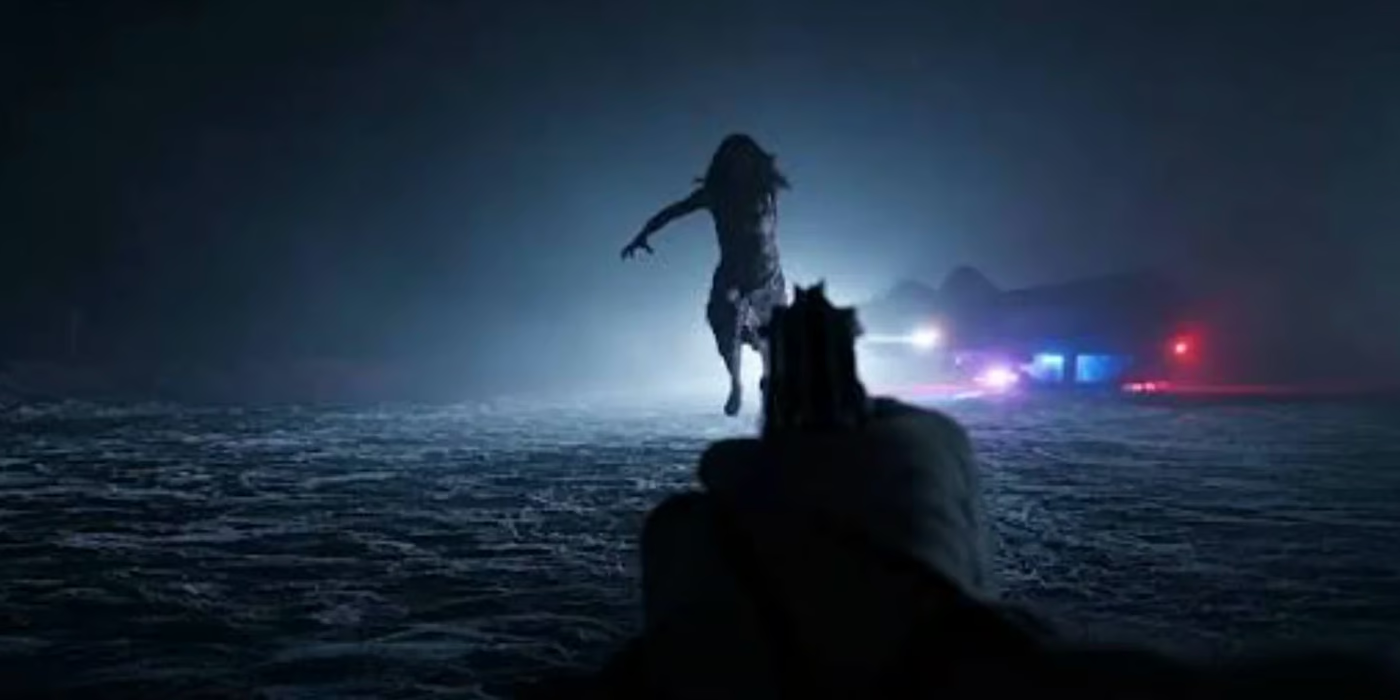

The Resident Evil 2026 film is drawing horror-fan attention for the Merged Monster’s acrobatic choreography, a movie-specific creature process tied to Capcom’s game franchise.
Image: guides.justwatch.com
The creature clip giving Resident Evil fans something physical to study
The sharpest new conversation around the Resident Evil 2026 film is not about a new game, a DLC tease, or a Capcom roadmap. It is about bodies in motion. Kotaku reports that choreographer and movement coordinator Jakub Hudlický shared behind-the-scenes footage showing how performers explored the acrobatics behind the film’s strangest creature, the Merged Monster, after Zach Cregger’s adaptation opened in cinemas.
According to Kotaku, Hudlický wrote that the team’s early question was simple and difficult: how could the Merged Monster move? The footage has drawn attention because it shows the horror idea before the polish: performers strapped together, rolling, bouncing, lurching, and testing how several human bodies could become one impossible threat. That is the kind of production detail horror audiences tend to seize on, because monster design lives or dies in the gap between silhouette and behavior. A creature can look disgusting in a still image, but the fear only takes hold when viewers understand how it crosses a room.
This is film coverage tied to the Resident Evil franchise, not a Resident Evil game update. The 2026 movie is listed by Wikipedia as a horror film directed by Zach Cregger and based on Capcom’s video game franchise. Rotten Tomatoes lists it as an R-rated, 1 hour 34 minute horror/action release now playing in theaters. None of the provided sources describe a new game announcement, a remake, or a playable tie-in. The current attention is on Resident Evil choreography, creature performance, and how a movie adaptation borrows the pressure of survival horror without being interactive.
The Merged Monster works because its movement reads like a resource problem
Kotaku describes the Merged Monster as a mass of jumbled human parts. Cregger called it “the human tumbleweed,” while Kotaku notes that fans have compared it to “that Katamari Damacy thing.” The joke lands because the creature’s shape is readable even before the horror does. It is a rolling collection of limbs, weight, and bad angles, which gives the audience a question survival horror players know well: if this thing comes at you, where do you stand, and how much time do you have?
That is where the acrobatics matter. In games, enemy design is practical by necessity. A zombie shambles, a Hunter leaps, a Licker crawls across ceilings, and the player learns the difference under stress. The Resident Evil 2026 film cannot hand the viewer a controller, so the creature’s body language has to communicate danger immediately. A monster that rolls and folds through space changes the usual hallway math. It suggests unpredictable momentum, blocked exits, and an attack profile that does not reduce cleanly to claws, teeth, or a grab animation.
Hudlický’s rehearsal footage, as reported by Kotaku, is drawing attention because it shows that this effect began with performers solving a physical puzzle. The team was not only building a grotesque image. It was exploring balance, weight transfer, and the uncanny rhythm of several bodies trying to behave as one. For horror fans, that process is often as interesting as the finished shot, because it reveals how much fear depends on motion that feels wrong but still obeys enough physical logic to be believed.
The finished monster was CGI, but the rehearsal still matters
The tension in the story is that the viral movement work did not become the finished creature in a purely practical form. Kotaku reports that the performers served as a framework for the screen version, but the production ultimately used CGI to bring the Merged Monster to life. That distinction is important, especially in a franchise whose audience often argues over practical effects, digital creatures, and whether screen monsters feel tangible.
Cregger had already explained the limit of the human approach in comments to Collider that Kotaku cites. He said he tried to get Cirque du Soleil performers and strapped five people together to work out what he described as a five-person continuous infinite cartwheel, with some people upside down and “legs over legs over legs.” His conclusion was blunt: the experiment looked cool, but the performers had no agility, their heads were visible, and it was not what the movie needed.
That explanation gives the Resident Evil film monster a clearer production logic. The rehearsal was not wasted because the final shot used CGI. It gave the effects team a behavioral reference, a sense of mass and articulation, and a way to avoid a creature that moved like an abstract digital smear. At the same time, Cregger’s comments underline the technical risk. The more impossible the body becomes, the easier it is for viewers to stop reading it as a creature and start reading it as an effect. Horror loses pressure when the audience can see the seam.
Cregger’s reboot is being judged as a survival horror film, not franchise homework
The broader Resident Evil 2026 film is positioned as a reboot rather than a continuation of the older live-action cycle. Wikipedia lists it as the eighth live-action Resident Evil film and says it stars Austin Abrams as Bryan Hodukavich, a medical courier fighting through an outbreak of infected monsters in Raccoon City. IMDb’s listing similarly describes a hapless courier delivering a package to a remote hospital before being caught in an outbreak and forced to survive mutated creatures.
That setup matters because it places the film closer to survival pressure than ensemble lore management. Rotten Tomatoes’ official synopsis says Bryan finds himself in an “action-packed, non-stop race for survival” as one horrifying night collapses into chaos. Letterboxd’s synopsis uses a similar frame, describing a medical courier fighting for survival across a disastrous night. The common thread across public listings is not a promise of playable continuity, but a contained nightmare built around one vulnerable person moving through danger.
That framing also explains why the Merged Monster has become a focal point. If the protagonist is a courier rather than a heavily armed super-soldier, monster behavior carries more weight. A creature’s speed, angle of approach, and sound in the room become part of the survival equation. Good Resident Evil horror, on screen or in a game, depends on the audience believing that every wrong turn spends something: ammo, distance, noise discipline, nerve, or time.
Reception is strong, though faithfulness remains the fault line
Public review signals suggest Cregger’s approach is landing with many critics and viewers, even as adaptation purists remain a live part of the conversation. Rotten Tomatoes lists Resident Evil at 96% on the Tomatometer from 266 reviews and 91% on the Popcornmeter from more than 5,000 verified ratings. The site’s critics consensus says the film packs “unforgettable scares” into a sleek runtime, with Austin Abrams’ comedic timing providing levity, and calls it a tribute to the pleasure and terror of playing a spooky video game.
TheXboxHub’s Resident Evil 2026 review is categorized as a 4/5 movie review, and its shared description says a Resident Evil fan’s enjoyment of Cregger’s adaptation rests on expectations of a gaming movie. AndersonVision’s review is more pointed about the franchise’s screen history, calling a good Resident Evil movie an unexpected thing to be scared by in 2026 and arguing that earlier live-action entries flattened a frightening game series into glossy action. Those are review perspectives, not studio claims, but they show the same pressure point: this film is being measured against both horror craft and decades of uneven adaptation baggage.
Kotaku also reports that die-hard fans were put off by Cregger looking away from source material, while noting that his version of Raccoon City still delivered bizarre mutants inspired by the type seen in Capcom’s series. That conflict is worth keeping intact. A Resident Evil horror movie can satisfy audiences looking for dread, creature work, and survival momentum while still frustrating viewers who want closer adherence to specific game plots, characters, or Umbrella iconography.
The practical guide for game fans deciding whether to see it
For players arriving from the games, the cleanest expectation is this: the Resident Evil 2026 film is a theatrical horror/action reboot based on Capcom’s franchise, not a new chapter you need to play or a direct update on the games. Wikipedia lists Sony Pictures Releasing as distributor, with Columbia Pictures, Subconscious, and PlayStation Productions among the production companies. It also lists a September 15, 2026 Los Angeles release and a September 18, 2026 United States release, with a 94 minute running time. Rotten Tomatoes currently marks the film as now playing and points viewers to ticketing through Fandango.
If your main interest is creature design, the Merged Monster is the reason to pay attention. The behind-the-scenes choreography shows a production trying to solve monster behavior from the floor up before handing the final form to visual effects. If your main interest is fidelity to the games, the sources point to a looser adaptation centered on Bryan’s survival through an outbreak rather than a direct retelling of a specific campaign.
That split makes the film easier to place. Search interest around “Resident Evil movie review” and “Resident Evil film monster” is really circling the same question: does Cregger’s movie understand the physical stress that makes Resident Evil work? Based on the reported movement process, the Merged Monster is built from that question. It turns body horror into navigation horror, and for a franchise obsessed with what waits around the next corner, that is the right place for a movie monster to start.