
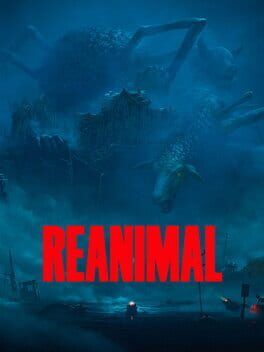

Hands-on impressions of the Reanimal demo on Nintendo Switch 2, covering how it evolves Tarsier’s Little Nightmares-style horror into a more open, co-op-driven structure, how the UE5-powered game runs on Nintendo’s new hardware, and what the slice suggests about puzzles, AI companions, and solo vs co-op tension ahead of launch.
Tarsier Studios built its reputation on Little Nightmares’ suffocating corridors and wordless, tightly scripted scares. Reanimal, their new co-op horror adventure, feels like the point where that formula finally breaks free of the dollhouse. After playing through the freshly released Nintendo Switch 2 demo, it is clear this is still unmistakably a Tarsier game, but it is now stretching into broader spaces, shared terror, and a structure built for replayable co-op runs.
The Switch 2 demo drops you into a slice of the opening, with orphaned siblings picking their way across a stormy shoreline before descending into something far worse. It feels familiar at first glance: side-on platforming, tiny kids framed against giant, hostile architecture, and grotesque adults who move with a queasy, exaggerated weight. Where it diverges from Little Nightmares is how often the camera pulls back to reveal wide, multi-path arenas rather than single, golden routes.
In co-op, that change lands immediately. The siblings move within a shared, directed camera that Tarsier uses not just for mood but for mechanics. The camera refuses to split, keeping both characters locked into the same frame. That simple choice drives most of the tension. When my co-op partner crept ahead to bait a lumbering attendant away from a crank puzzle, the camera stretched as far as it could go, then hit its limit, threatening to tug one of us out of cover. Pushing forward as a pair felt safer, but spacing out opened more tactical options, so we were constantly testing exactly how far we could push the camera without snapping our fragile line of sight.
Even in this short slice, Reanimal’s level design circles around that push and pull. The rundown jetty that opens the demo seems like a linear walk at first, but it quickly splinters into side alleys and broken piers that reward curiosity with optional scares and collectible fragments. One detour led us to a boarded shack, where one sibling had to shimmy along planks while the other stayed on the ground level operating a pulley. The objective was simple, but the layout encouraged improvisation: we traded roles mid-scenario, testing whether the smaller hitbox of the sister made it easier to dodge a patrolling creature on a higher ledge while the brother soaked up risk on the floor.
The core interaction vocabulary will be familiar to Little Nightmares fans. You push and drag objects, clamber up drawers, squeeze through vents, and use light and shadow as tools. What is new is how often puzzles are built for two bodies. Several obstacles in the demo are explicitly cooperative: pressure plates placed just far enough apart to prevent one character from covering both, see-saw planks that demand synchronized weight, and multi-part stealth routes where one child distracts a monster while the other sneaks through a secondary path. These are not complex brainteasers, but they are constructed to force communication.
Importantly, the demo suggests Tarsier is serious about solo players too. When you play alone, the unused sibling becomes an AI companion rather than vanishing from the narrative. The AI in this build is more capable than early marketing might have suggested. They are generally responsive, snapping to context-sensitive prompts, hopping onto platforms when you do, and taking their place on levers and plates with minimal delay. During a stealth segment in a barn littered with dangling carcasses and swinging hooks, the AI buddy mirrored my crouches and dashes closely enough that I stopped worrying about them betraying my position.
They are not perfect, but their imperfections cut in interesting ways. Once, my AI partner hesitated a beat too long before crossing a lit section of floor, which briefly left them silhouetted as a roaming butcher turned back toward us. Technically it was a mistake, but it elevated the scene’s nerves. If the final game keeps that balance, solo runs might be tenser than co-op, where human partners can coordinate more brutally efficient solutions.
Structurally, Reanimal feels broader than Little Nightmares without giving up tightly scripted showpieces. The demo moves from an exterior shoreline to a creaking boathouse and into a more labyrinthine interior, hinting at an island that will be carved into interconnected hubs rather than a straight line of chapters. Side paths we could not fully explore were visible in the distance and behind locked gates. Tarsier seems intent on capturing the “one more run” pull you get from co-op horror like Dead by Daylight, only within a handcrafted, narrative framework.
One of the most striking sequences in the demo puts the siblings aboard a small boat, drifting through a foggy channel where silhouettes loom in the distance. Here, the shared camera transforms from a mild annoyance into a powerful tool. The camera angle locks tightly behind the children, closing off any glance of what might be coming from the rear. You can move around on the boat, but the framing never gives you full safety. My co-op partner jammed on the oars while I kept watch at the bow, but we could only see what the camera allowed, which made every splash behind us feel like a deliberate taunt.
Puzzle design in this section is more about coordination under pressure than classic logic riddles. You are balancing rowing speed, steering, and line of sight while reacting to environmental cues, like floating debris or flickering lamps that signal danger ahead. The Switch 2 demo suggests that Reanimal’s puzzles will rarely stump you technically, but they are tuned to multiply your stress when communication breaks down. Solving them is as much about reading your partner as it is about reading the environment.
Visually, Reanimal is one of the more convincing showcases yet for Unreal Engine 5 on Switch 2. The resolution target appears to be a dynamic 1440p when docked, with occasional dips during heavier effects, and a crisper-than-Switch portable presentation that still holds onto core visual flourishes. Lumen-powered lighting sells the mood: lanterns bleed into pools of water, fog catches in the air around rusted beams, and shadows stretch convincingly as monsters sweep their searchlights. Texture quality understandably pulls back in the far distance compared with footage from PS5 and Series X, but close-up materials like soaked wood, rope, and fabric coats look surprisingly rich for a handheld-focused device.
Performance in the demo is mostly stable at 60 frames per second with occasional drops during set-piece moments, like a chase through a tilting pier where geometry collapses into the sea. These dips are short and do not derail inputs, but they are noticeable enough that performance purists may watch the final build closely. In handheld mode the frame rate seems more firmly locked, suggesting some of the heavier visual settings relax when running off the smaller screen.
Crucially for a horror game that relies on precise timing in chases and stealth, input latency feels tight. Character acceleration and jump arcs are far closer to Little Nightmares II than some of the looser big-budget horror games of recent years. My only real gripe is camera stubbornness in tight interior spaces. The directed camera is a big part of the game’s vibe, but there were moments in the barn where I wanted a little more tilt to see a patrolling enemy clearly. Whether that tension is clever design or mild frustration will depend on your appetite for feeling somewhat helpless.
Tarsier’s creature design is on point too. The demo’s showcase antagonist is a towering figure with elongated arms wrapped in butcher’s aprons, its head obscured by a crude animal mask, a clear echo of Reanimal’s mask-centric visual identity. Its patrols are scripted but not fully predictable. It pauses to sniff the air, lingers on objects you have moved, and occasionally glances toward hiding spots even when you have not made an obvious mistake. In co-op, we ended up whispering anyway, even though the Switch 2’s microphone has nothing to do with detection.
One of the more interesting tensions that emerges between solo and co-op play is emotional rather than mechanical. In solo, you feel more like a caretaker, shepherding your AI sibling through horror they cannot fully control. Every stumble is on you. In co-op, that responsibility diffuses. You joke, you blame one another for blown stealth, you share the relief when a plan comes together. The same scenes carry a different emotional temperature depending on your mode, and the demo hints Tarsier knows this. Certain animations, like the kids clutching each other’s hands or bracing against doorways together, hit harder when you know there is another person holding the other Joy-Con.
If there is a lingering concern from this demo, it is whether Reanimal can keep evolving its scenarios across a full campaign. The basic ingredients are potent: directed camera, two vulnerable bodies, flexible spaces. To avoid repetition, the final game will need to keep remixing those elements with new traversal tools, enemy types, and puzzle wrinkles. The Nintendo Switch 2 slice hints at more, teasing higher vertical spaces and multi-layered rooms behind locked gates, but it stops just short of fully revealing how deep those systems go.
Right now, though, Reanimal on Switch 2 looks and feels ready. Technically, the port is strong enough to stand alongside the bigger boxes, and structurally, the demo suggests Tarsier has found a smart way to expand Little Nightmares-style horror into something more open and social without losing its oppressive soul. Whether you are planning to play alone or with a partner, this is one of the most interesting reasons yet to keep a close eye on Nintendo’s new hardware schedule next month.