
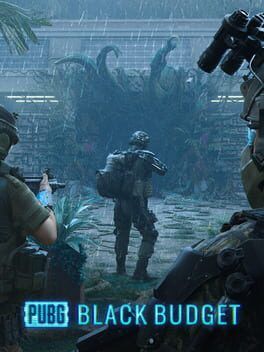

Krafton has cancelled PUBG: Black Budget after closed alpha testing, raising sharper questions about PUBG spin-offs and the crowded extraction shooter market.
Image: IGDB
Store links: PUBG: Black Budget on Steam
Krafton ends Black Budget before launch
Krafton has cancelled PUBG: Black Budget, ending development on the PUBG extraction shooter spin-off before it reached release. The publisher announced the decision in a Steam development update, saying an internal review found the project’s current direction would not support an experience players could enjoy over the long term.
That phrasing is the key detail. Krafton did not cite a single technical failure, a platform issue, or a missed production milestone in the public statement. It pointed to long-term player enjoyment, the pressure point that decides whether a live shooter survives after the first wave of curiosity burns off.
According to Eurogamer, Black Budget was first revealed in November 2025 and had been positioned as the next major PUBG game. GamesIndustry.biz reports the shutdown comes nine months after a closed alpha test on Steam, with the project having held several alpha and community tests across the year. That puts the cancellation in a narrow window: public enough to attract testers and wishlists, early enough for Krafton to walk away before a full launch or early access rollout.
The official reason is about retention, not reveal-day buzz
Krafton’s Steam post, quoted by Eurogamer and GamesIndustry.biz, says: “After reviewing the project’s development status and future direction, we concluded that its current direction would not allow us to deliver an experience players could enjoy over the long term.” The publisher added that it had made the difficult decision to end development and thanked players who participated in closed alpha tests and gave feedback.
For a shooter, that is a brutal assessment. A game can look promising in a trailer, feel interesting in a closed test, and still fail the larger test of weekly return rate, squad consistency, content cadence, balance churn, and meta health. Extraction shooters are especially exposed because the loop asks players to accept loss, downtime, risk, gear pressure, and repeated map knowledge checks. If the reward structure does not bite hard enough, squads drift. If the punishment is too sharp, newer players bounce. If PvE, PvP, loot, and progression do not land together, the whole match rhythm collapses.
Krafton has not published detailed player retention data for Black Budget in the provided sources, and it has not released a postmortem breaking down which systems underperformed. Insider Gaming reported that early playtests reached a peak concurrent player count of almost 10,000 users and that the game climbed wishlist charts, but that reporting does not contradict Krafton’s stated concern. A test can draw attention and still fail an internal forecast for long-term engagement.
Black Budget was trying to bend PUBG into extraction rules
The available descriptions paint Black Budget as a serious attempt to translate PUBG’s survival shooter DNA into a different competitive format. Eurogamer described it as a PvEvP first-person shooter set on an island trapped in a time loop, with strange weather phenomena and anomalies designed to make matches feel different. GamesIndustry.biz reported that the goal was to have whole teams survive and escape rather than chase a last-one-standing battle royale win.
Rogue, citing the game’s earlier public materials and Steam presence, described a 2.5km by 2.5km open-world map, 15 teams of three players per match, zombie or infected enemy types, biological threats, and a home base used between runs for crafting and skill progression. Those details suggest a game trying to stack several demands at once: readable squad fights, PvE pressure, extraction tension, out-of-raid progression, and a shrinking or corrupted playspace tied to the Anomaly.
On paper, that setup had a clear PUBG angle. PUBG’s core reputation has always leaned on positioning, ballistics, distance management, and the ugly math of when to fight or rotate. Extraction design can reward those same instincts. The risk is pacing. Battle royale gives every match an obvious endpoint. Extraction shooters need players to create their own finish line, then care enough about the stash, base, and next run to queue again. Krafton’s cancellation statement indicates the company was not convinced Black Budget’s direction could carry that load long-term.
A crowded extraction market leaves little room for a soft launch
The Black Budget shutdown lands in a shooter market where the extraction label is attractive but unforgiving. GamingBolt framed the decision against competition from established or high-profile extraction shooters, naming ARC Raiders and Escape from Tarkov as part of the broader fight for attention. Insider Gaming made a similar point, calling the extraction shooter space difficult terrain where even major names face sentiment and retention challenges.
That matters because PUBG is a massive brand, but brand strength does not automatically solve extraction design. Players in this lane compare time-to-action, loot readability, audio reliability, map flow, squad wipe recovery, economy pressure, anti-cheat confidence, and update cadence. If one of those pillars feels weak, the meta hardens quickly and the community conversation turns faster than it does for a conventional arcade shooter.
There is also a simple calendar problem. GamesIndustry.biz reported that Black Budget was meant to test PUBG’s expansion into new genres as Krafton worked to grow PUBG Battlegrounds into a broader content platform. In that strategy, a spin-off cannot merely exist as an experiment. It has to justify developer attention, marketing spend, server operations, and the opportunity cost of pulling players from the main ecosystem. Krafton’s wording suggests the internal review did not see the necessary long tail.
This is the second PUBG spin-off cancellation of the year
Black Budget is not an isolated retreat. Eurogamer and GamesIndustry.biz both note that it is the second publicly cancelled PUBG spin-off this year. PUBG: Blindspot, a free-to-play 5v5 top-down tactical shooter, was shut down in March after two months in Early Access. Eurogamer described Blindspot as borrowing from Rainbow Six Siege, while GamesIndustry.biz tied its closure to Krafton’s approach of using Early Access to quickly validate a game’s potential.
The pattern is important, but it should not be overstated beyond the record. The confirmed fact is that Krafton cancelled two PUBG spin-offs in 2026 after public testing or availability. The interpretation is that Krafton appears willing to cut projects quickly when they do not fit its internal expectations for long-term player behavior. That is a harder-edged strategy than letting a weak live-service shooter limp through multiple seasons while trying to find an audience.
At the same time, Krafton is not walking away from PUBG expansion. Eurogamer and GamesIndustry.biz both point to PUBG: Ded.Net, announced at gamescom in August, as another upcoming spin-off. Eurogamer describes Ded.Net as a multiplayer shooter with an 80s aesthetic and roguelite elements, developed by Krafton’s Madison, Wisconsin studio. GamesIndustry.biz says it features roguelike progression. The company is still experimenting with PUBG as a broader shooter umbrella, but Black Budget and Blindspot show that the PUBG name is not a free pass.
The business backdrop makes the cut sharper
The cancellation comes despite Krafton reporting strong company results. GamesIndustry.biz reported that Krafton posted record Q2 results, with revenue up 94.9 percent to ₩1.29 trillion, or $889.1 million, and attributed growth to continued PUBG franchise expansion and the success of Unknown Worlds’ Subnautica 2. The same report said PUBG revenue increased 25 percent year over year, driven by work on a central gameplay platform and cultural collaborations with other IP and brands.
That context changes the read on Black Budget. This does not look, based on the provided sources, like a publisher cancelling a spin-off because the parent franchise is out of runway. It looks like a publisher with a healthy core business choosing not to force a risky shooter into a market where weak retention can become visible immediately.
Krafton has previously outlined, according to GamesIndustry.biz, a plan to expand PUBG Battlegrounds into a content platform with sandbox-oriented user-generated content built around PUBG’s gunplay, mechanics, and physics engine. Black Budget and Blindspot were described as tests of PUBG’s expansion into new genres. Two failed tests do not end that strategy, but they do narrow the lesson: PUBG’s gunfeel and recognition are useful starting points, not a complete retention plan.
What players can expect now
There is no announced release date to wait for, no price to compare, and no platform rollout to track for PUBG: Black Budget. The sources identify PC and Steam as the public testing and listing context, but Krafton’s statement says development has ended. For players who joined closed alpha tests, Krafton’s only stated next step is that PUBG Studios will carry what it learned from development and testing into future projects while continuing to listen to players.
No provided source reports layoffs connected to the cancellation, and Krafton’s public Steam statement does not say what happens next for the Black Budget team. Rogue noted there had been no news of layoffs at PUBG Corporation at the time of its report, but staffing plans remain unannounced in the material available here.
For shooter players, the practical read is simple: PUBG: Black Budget cancelled means this particular PUBG extraction shooter is off the board, and the next place to watch Krafton’s shooter strategy is Ded.Net and the ongoing PUBG Battlegrounds platform push. For the extraction genre, the signal is harsher. Even with PUBG’s name, multiple closed tests, and reported early interest, Krafton decided the long-game numbers or direction were not convincing enough to keep fighting for space in one of multiplayer’s most demanding formats.