
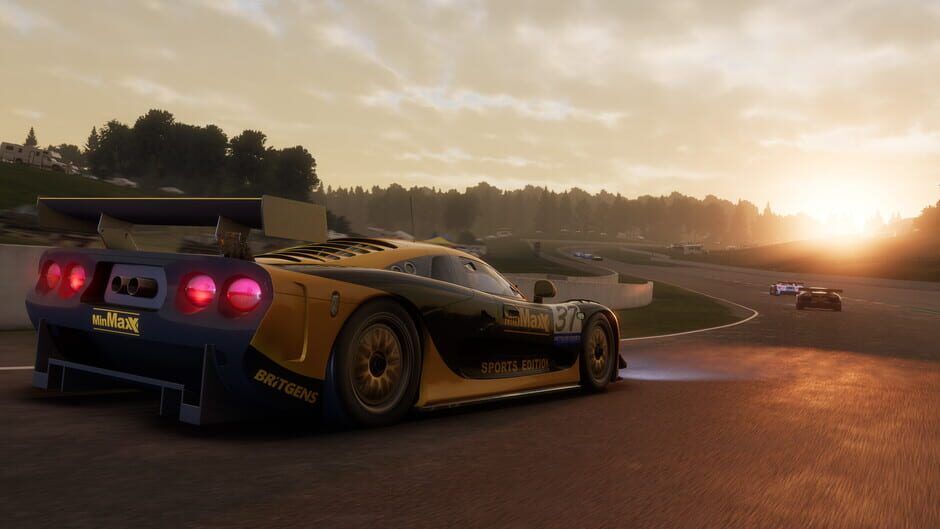

A deep look at Project Motor Racing’s GT Icons Pack DLC, why its 60s and 70s legends matter, and how the 2.0.0.6 update shapes the game for serious sim‑racing fans.
Project Motor Racing has always worn its influences on its sleeve, but the new GT Icons Pack is the clearest statement yet of what Straight4 wants this sim to be. Nine historic machines, split across three bespoke classes plus a new US circuit, turn the game into a focused tour of motorsport’s late‑60s and 70s thunder years.
This DLC lands alongside update 2.0.0.6, which folds in physics, AI and rules tweaks that directly affect how these classics feel to drive and race. For sim heads wondering whether Project Motor Racing is finally worth serious seat time, GT Icons is the first add‑on that really moves the needle.
What you actually get in the GT Icons Pack
GT Icons is not a random grab‑bag of old metal. It is tightly structured around three eras and philosophies of racing, each with its own class in the game plus a period‑appropriate venue.
Sports Car 67 is the headline act for many. This class pulls from the wild experimental age of endurance racing where aero was half science, half madness. The Chaparral 2F brings its iconic high‑mounted wing and brutally square bodywork, a car that in real life pushed downforce thinking forward years ahead of its time. Lined up alongside it is the Ford GT40 Mk IV, remembered for its Le Mans victory and raw American muscle with just enough sophistication to hang with Europe’s best. Completing the trio is the Lola T70 Mk 3, a chiselled V8 weapon that became a privateer favourite thanks to its mix of speed and relative accessibility.
GT 60 shifts the focus from prototypes to GT legends. Here the pack leans into the cars that defined what a grand touring racer looked and sounded like. Expect silhouettes inspired by the Shelby Daytona Coupe, Jaguar E‑Type Lightweight and Ferrari’s front‑engined bruisers. In historical terms these machines helped cement the template of the long‑bonnet, short‑tail GT, balancing straight‑line bellow with surprisingly delicate handling. In game that translates into cars that reward tidy inputs, lift‑off rotation and careful throttle work on corner exit rather than brute‑force traction control.
GT 70 then picks up the story as power outputs climb and road‑car‑based racers start to flirt with real aero. The Porsche 911 Carrera RSR 3.0 stands out here as a defining rear‑engined GT, demanding respect under braking and over crests. Sharing the stage are cars modeled on the Chevrolet Corvette C3 and Ford Capri RS3100. Historically these represented two routes to the same goal: big‑capacity American thunder versus lighter European chassis tuned for agility and tire preservation over distance. Project Motor Racing leans into those contrasts in its BoP and physics, making mixed‑class or one‑make races play out with a natural ebb and flow rather than spec‑series uniformity.
The DLC also ships with Rocky Knoll, a new US circuit that feels like a greatest‑hits mashup of classic American road courses. There are fast, blind kinks where the Chaparral’s wing really goes to work, heavy braking zones to test the GT40 under load, and medium‑speed sequences that show off how different the 70s GT cars break traction. Importantly for sim racers, it is not another Tilke‑style modern facility but a track that suits these analog machines.
Why these cars matter to racing history
On paper, GT Icons could have been pure fan service. In practice, the curation is smart. Each car type included here represents a turning point for how real‑world engineers thought about going fast.
The Sports Car 67 trio sits at the crossroads of mechanical grip and the dawn of serious aerodynamics. The Chaparral 2F’s huge wing is not just visual flair; in period it was one of the first big statements that you could bend air to your will and pay for it with drag. The Ford GT40 Mk IV, coming off Ford’s duel with Ferrari, shows the growing importance of top‑end stability and high‑speed safety after earlier GT40s had revealed just how scary lift could be on the Mulsanne. The Lola T70 embodies the privateer spirit, proof that small operations could threaten works teams when given the right platform.
Drop into GT 60 and you are effectively sitting at the birth of the modern GT category. Cars like the Daytona Coupe and lightweight E‑Types transformed stylish production shapes into disciplined race tools. They did not yet enjoy the science of ground effect or CFD, so success was won through chassis tuning, tire management and driver feel. That is precisely the sort of interaction sim racers crave because it foregrounds the human element over electronics.
The GT 70 machinery captures another inflection point. The 911 Carrera RSR drew a straight line from road sports car to world‑beating GT and helped standardize rear‑engined, wide‑arched bruisers across decades of racing. The Corvette and Capri variants paint a transatlantic picture of how different regions interpreted the same regulations. Bringing all of these into one pack gives context. You are not just ticking off historic names, you are experiencing a living timeline of how GT racing evolved.
How GT Icons actually feels to drive
Project Motor Racing already had a reputation for demanding handling, and the GT Icons cars double down on that identity. These are not easy mode classics. They move around on their sidewalls, punish lazy trail braking and will spin the rears well into the mid gears if you treat the throttle like a light switch.
In Sports Car 67, the main sensation is weight and inertia. The Chaparral feels oddly planted at speed but will snap if you treat it like a modern LMP. The GT40 sits lower and flatter, with that satisfying sense of loading the outside tires through long corners before gently breathing off the wheel. The Lola is the most eager to rotate, but that eagerness can quickly turn into a pendulum if you commit mid‑corner corrections at the wrong time.
GT 60 cars are comparatively friendlier but still keep you busy. You spend more time working with body roll, anticipating how the car will take a set, then timing your throttle to match. They are at their best on traditional circuits where you can link flowing sequences together and use elevation to help weight transfer.
GT 70 machines are lively in another way. With more power and early aero, you get that distinctive squirm under braking and a real need to straighten the wheel before unleashing the engine. The 911 in particular requires a different rhythm: earlier braking points, patient entry, then letting the rear squat as you drive out. It feels closer to vintage content in hardcore sims like Automobilista 2 than to the safer retro offerings found in some mainstream racers.
What update 2.0.0.6 changes for sim fans
The DLC does not land in isolation. Patch 2.0.0.6, available alongside GT Icons, works on some of the friction points that early adopters flagged.
The biggest change from a racing perspective is the continued effort to soften over‑zealous track limits and dial back AI aggression. Early versions of Project Motor Racing had a habit of handing out penalties for minor kerb usage while the AI drove like it had no concept of survival. According to the latest patch notes and early player impressions, warning thresholds have been relaxed on several circuits and AI lines have been tweaked so they defend and attack more believably, particularly in the GT categories.
Under the hood, the update also refines the tire and suspension behavior for high‑power, low‑downforce cars, which directly benefits the GT Icons set. There is a more progressive breakaway when you edge past the grip limit, so catching a slide feels achievable rather than binary. Force feedback output has been adjusted to keep you better informed about weight transfer, an important detail when you are muscling a 60s prototype through a downhill braking zone.
There are still rough edges. Wheel presets and advanced options remain fussier than they need to be, and some users continue to report inconsistencies in how penalties are applied online. But as a platform for the new DLC, 2.0.0.6 is a meaningful step rather than a token compatibility patch.
Does GT Icons make Project Motor Racing a must‑have sim?
For pure sim‑racing enthusiasts, value in a DLC pack is as much about depth as it is about car count. On that front GT Icons is a strong proposition. Each class feels distinct, the cars demand proper technique, and the Rocky Knoll circuit is a welcome addition that suits both sprint races and longer stints.
The bigger question is whether this transforms Project Motor Racing from a promising but flawed title into a staple of your sim rotation. The answer is that it does not completely rewrite the book, but it significantly strengthens the case. If you bounced off the game previously because of draconian track limits, erratic AI and a slightly sterile car roster, this combo of patch plus DLC directly addresses all three.
What GT Icons proves is that Straight4 understands what makes vintage content compelling when you are using a wheel and pedals. There is no attempt to modernize these machines with fake stability, no heavy‑handed assists forced on you. The physics are punchy and occasionally unforgiving, but they deliver that satisfying loop where learning the quirks of a single car rewards you with huge gains in consistency.
If you mainly dabble with a controller and want forgiving, modern GT3‑style racing, this pack will probably feel too raw and the wider game may still frustrate. But if you enjoy titles like Automobilista 2, rFactor 2 or a heavily modded Assetto Corsa, GT Icons is the first Project Motor Racing DLC that genuinely competes in that space.
In short, the GT Icons Pack is not just more content. It is a clear signal of intent, a historically grounded, mechanically demanding expansion that pushes Project Motor Racing closer to the top tier of sim‑focused racers. It does not fix everything overnight, but for fans of golden‑era GT and prototypes, it is very hard to ignore.