
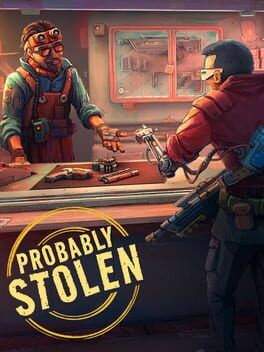
Questing Goose Studio's Probably Stolen roadmap points to free updates into April 2027, with Junker, organ trading and street food scenarios expanding the cyberpunk trading sim's economy.
Image: IGDB
Store links: Probably Stolen on Steam
Probably Stolen’s free roadmap is already testing how far its economy can stretch
Probably Stolen has an official post-launch roadmap, and the most concrete part is also the most strategically revealing: Questing Goose Studio and publisher tinyBuild have put the Junker Update in December 2026, followed by major free updates in January 2027 and April 2027. According to the official Steam roadmap cited by the Probably Stolen Vi.ki and reported by Twisted Voxel, the December update adds a new starting profession, while the January and April updates are listed as bringing new items, perks, NPCs and machines. The studio also says every update on that roadmap will be free.
The tension is that the public roadmap is broad, while reporting around it is more specific. Rock Paper Shotgun reports that the three big updates will add starting scenarios built around junk, organ dealing and street food vending, with rough windows of mid-December, late January and April. The official roadmap image, as summarized by the fan-run Vi.ki, names only the Junker Update outright and labels the later two as major updates. That does not make the more detailed reporting irrelevant, but it does mean players should treat the exact January and April contents as planned rather than locked until Questing Goose Studio names them in a public update.
For a cyberpunk trading sim about squeezing profit from suspect supply chains, those themes are not random flavor additions. Junk, organs and food each push the economy in a different direction: salvage logistics, high-risk biological goods and production-heavy consumables. If Probably Stolen’s existing appeal is the pleasure of turning a grimy kiosk into a tuned money machine, the roadmap’s real promise is three new ways to define what kind of shopkeeper you are before the first transaction ever lands.
Junker is the clearest update, and it looks like an expedition economy
The December Junker Update is the only new starting profession explicitly named in the official roadmap summary. Rock Paper Shotgun adds the operational detail: the Junker scenario is planned to include a bespoke perk, new items and the ability to hire, equip and send scavengers on expeditions. That last part is the important one. It points to a start built around procurement rather than simply buying low and selling high across a known catalogue.
A scavenger system changes the early-game question from “what can I afford to stock?” to “what risks and delays can I build around?” In an economy sim, expeditions usually function as a pressure valve and a gamble. They can create irregular supply, force equipment decisions and reward players who can survive lean periods before a haul returns. If Questing Goose Studio leans into that structure, Junker could become a start for players who like inventory volatility and long-term setup over clean retail flow.
Rock Paper Shotgun also reports that the same update will make smaller additions to the Fence and Gunsmith vocations. The Gunsmith additions named in that report include shotgun shells, 25mm grenade rounds, a tier 3 handmade SMG and new armour. Those details matter because a junk economy only becomes interesting if it plugs into demand elsewhere. Scrap, weapons, armour and contraband-adjacent goods all give Probably Stolen room to make scavenging part of a broader market rather than an isolated side activity.
Organ dealing fits the sim because bodies become supply chains
The organ trading update is the one most likely to travel outside the existing player base because the phrase “organ trading game” is lurid enough to sell itself. The useful question is how it works inside Probably Stolen’s systems. Rock Paper Shotgun cites a Steam blog explaining that players would begin by buying different organs and fulfilling specific requests, then later gain the ability to grow or print organs. The same report says players will be able to filter blood and remove diseases, with blood types carrying different value modifiers.
That is a strong fit for an economy game because it turns morality into classification, processing and margin. Organs are not simply high-value objects if the reported systems hold. They have types, requests, disease states, blood compatibility and an upgrade path from buying to production. That gives the scenario a natural curve: arbitrage at the start, quality control in the middle and vertical integration once growing or printing becomes available.
Rock Paper Shotgun also reports that acquisition can involve sending black market thugs on foraging expeditions. That is where the Organ Dealer scenario overlaps mechanically with Junker while changing the risk profile. Both may involve external acquisition, but scavenging scrap and sourcing organs imply very different customer expectations, reputational consequences and inventory standards. The official sources provided do not spell out balance values, failure states or security penalties for organ dealing, so any meta forecast has to stay cautious. Still, the design direction is clear enough: this is a scenario about making the grossest possible version of a logistics chain profitable.
Street food is the friendlier pitch, but it may be the deeper production puzzle
The April update is reported by Rock Paper Shotgun as the planned Street Food Vendor starting scenario, centered on beverages and edible goods from a range of cultures. RPS also says it will be supported by updates to Aquaculture and Hydroponics technology. The official roadmap summary does not name Street Food Vendor in its April slot, so this should be read as a reported plan rather than a final public feature list.
Strategically, street food could be the sleeper update. Junk and organs are attention-grabbing because they sound dangerous or grotesque, but food systems tend to generate the most interesting recurring economies when they depend on inputs, freshness, processing and customer segmentation. If Aquaculture and Hydroponics receive meaningful upgrades, players may be pushed toward a shop that grows, processes and sells its own stock instead of relying mainly on purchased inventory.
That would give Probably Stolen a different economic rhythm. A food start can reward planning, machine layouts and repeatable production chains. It can also create softer constraints than contraband or weapons: ingredient availability, culture-specific demand, water quality, farming throughput and beverage production. The current sources do not confirm spoilage, recipes or exact machine behavior for the April update. What they do support is the idea that Questing Goose Studio is using new starts to broaden the game’s business models, not merely to add themed item packs.
November polish shows the studio is patching systems before expanding them
Before those major Probably Stolen updates arrive, November 2026 is framed as a stability and quality-of-life month. The roadmap summary on Probably Stolen Vi.ki says the official roadmap skips November because the studio’s focus is bug fixes and quality-of-life improvements. Twisted Voxel reports the same from the developer announcement, adding that community feedback from reviews, bug reports and suggestions is helping shape priorities.
The 1.0.0.12 update, as summarized by the unofficial ProbablyStolen.net patch notes page from the Steam notes, is wide-ranging enough to matter for future balance. It adjusts story character interactions, weapon permit behavior, Power Line Hijack, Current Converter classification, water purification, hydroponics fixes, appraisal rules, battery values, fountain earnings, starting luck perks and multiple character arcs. A later 1.0.0.13 hotfix addressed a Lou storyline issue, restored Chinese localization content and warned modders about a scheduled modding API security update.
That patch cadence matters because each new starting scenario will touch systems that already have fragile economic consequences. Better machine tooltips, appraisal filters, farming fixes and power changes all affect how reliably players can model profit. If the Junker, Organ Dealer and Street Food Vendor starts arrive on top of unstable base systems, they risk becoming novelty starts. If the November polish holds, they have a better chance of becoming distinct strategic openings.
The 2027 plan is partly confirmed, partly still hidden
The safest way to read the Probably Stolen roadmap is in layers. Confirmed by the official roadmap as summarized by Vi.ki and Twisted Voxel: December 2026 brings the Junker Update with a new starting profession, January 2027 and April 2027 bring major updates with new items, perks, NPCs and machines, and the listed roadmap updates are free. Also confirmed in those reports is that the current roadmap covers roughly the next six months and that Questing Goose Studio plans to share more about the rest of 2027 later.
Reported with more specificity by Rock Paper Shotgun: the December window is mid-December, the January update is “very likely” the Organ Dealer scenario, and April is planned for Street Food Vendor. RPS also notes that there are no hard release dates and that update contents may change. That caveat should guide expectations. Players looking for the organ trading game angle should not assume a fixed January day or final feature set until the developer posts one.
There is also a useful wording distinction around the game’s audience milestone. The Vi.ki page says the roadmap was posted as the game passed “1 million shopkeepers,” while Twisted Voxel describes Probably Stolen as surpassing 1 million players one week after 1.0 launch. Both point back to the same celebration context, but “shopkeepers” is the studio-flavored phrasing attached to the announcement. Either way, the business incentive is straightforward: a fast-growing Steam audience gives Questing Goose Studio a reason to keep retention high with free systemic content rather than fragmenting the community through paid early DLC.
Should you start now or wait for the new professions?
If you already own Probably Stolen, the roadmap gives a good reason to keep playing through November rather than waiting in silence. The current patch work is aimed at the base game, and the free updates mean there is no announced paid upgrade path to plan around. The game is currently available on Steam, according to Twisted Voxel, and no source material here confirms additional platforms.
For new players, the decision depends on what kind of economy you want to learn first. Starting now means learning the existing shop systems before the roadmap widens the opening choices. Waiting until December makes sense if the Junker fantasy, scavenger expeditions and scrap-to-value loop are the draw. Waiting for January is reasonable if the organ trading systems are your main interest, but the exact timing and final feature list remain less certain than the December Junker entry. April is the window to watch for players who prefer production chains, farming tech and food service over black-market acquisition.
The broader strategic read is that Probably Stolen 2027 support is being built around new economic identities. Junker asks how much value you can extract from waste. Organ Dealer asks how much risk and processing you can stomach for premium biological goods. Street Food Vendor asks whether a kiosk can become a vertically integrated food operation in a hostile cyberpunk market. If Questing Goose Studio can make those starts mechanically distinct, the roadmap will do more than add content volume. It will change the first hour, and in a trading sim, the first hour often decides the entire shape of a run.