

Capcom’s artists spent years crafting Pragmata’s New York-like hub to feel like a distorted, AI-generated fake. Here is how they did it, why it matters for the game’s tone, and what it reveals about Capcom’s art-first approach to sci-fi worldbuilding.
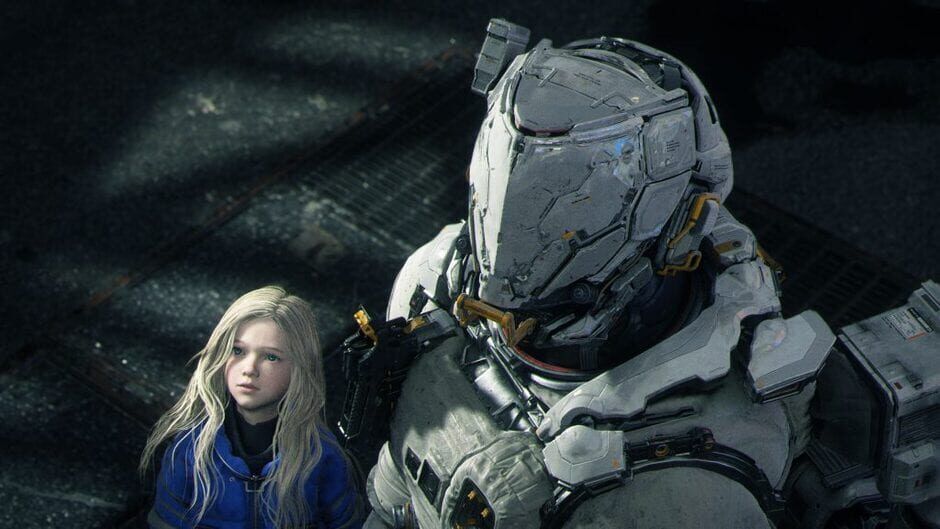
Capcom’s new sci-fi action game Pragmata is full of cold lunar corridors, hard metal, and hostile machines, but one of its most striking locations is also its most quietly unsettling. Early in the game, Hugh and Diana sprint through a New York-like city that looks almost normal at first glance. Neon, taxis, street ads, billboards, Times Square energy. Then your brain catches on something that does not fit. A bus is half-embedded in a building. A crosswalk goes nowhere. Cars are sunk into the asphalt like they are being swallowed.
It feels like a city an image generator might spit out after being told “New York, but futuristic.” That sensation is not accidental. According to director Yonghee Cho and producer Naoto Oyama, this space station “New York” was painstakingly constructed by humans to look like it was built by a machine.
“A fake New York generated by AI”
In fiction, the city is not Earth at all, but a simulation built by an in-universe AI. Cho describes the concept as “a fake New York generated by AI,” and that premise became the guiding rule for the entire stage. The team wanted you to recognize it as New York, but also to instantly feel that something is off.
This is where Capcom’s approach gets interesting. Rather than leaning on generative tools, the studio treated “AI-ness” as an aesthetic to be authored. Environment artists broke the city down into the sort of patterns machines are good at faking and then warped those patterns by hand. Rows of cloned assets, repeating ad boards, textures that almost align but not quite, geometry that looks plausible until you stare at it for longer than a second.
The result is less about photorealism and more about cognitive dissonance. You are not meant to believe you are in Manhattan. You are meant to believe you are inside an AI’s idea of Manhattan.
How do you handcraft an AI mistake?
The blueprint for the level started with something conventional. The team blocked out a believable, game-ready city: streets with readable navigation lines, clear sightlines for combat, landmarks acting as anchors in the space. Once that scaffolding worked on a pure level-design basis, they started to break it.
In interviews, Cho talks about intentionally “adding mistakes” to the environment. The art leads compiled examples of AI-generated cityscapes that float around online, pulling out the kind of errors that are uniquely machine-like. Perspective that subtly collapses. Street furniture placed where no urban planner would allow it. Buildings that fuse architectural styles without any historical logic.
Capcom then recreated that sensation with authored assets. Buses are placed at impossible angles, intersecting walls instead of lining up with roads. A line of yellow cabs is perfect in color and spacing, but one is swallowed by the pavement, caught mid-glitch. Signage sometimes mirrors or repeats like a texture tile you only notice after a few passes. Skyscrapers have silhouettes that ring true, but window grids curve in ways the eye feels rather than sees.
The key was control. Real AI output is noisy and often unusable for play spaces because it breaks basic expectations about collision, visibility, and navigation. Capcom wanted the vibe of that noise without sacrificing legibility. So every “mistake” is constrained by three internal rules: the player must always know where they can stand, where they can go next, and which objects matter for gameplay.
That meant constant iteration. The team would exaggerate a distortion, then pull it back if it read as a bug or a hidden path. They talk about testing whether a bus jutting out of a building would make players assume they could climb it. If too many people tried, that particular glitch would be nudged into the background or blocked more clearly. The city had to feel like a broken image, not a broken level.
The uncanny as a core mood
The distorted New York sequence is not just a visual gimmick. It is an early statement of what Pragmata is interested in as science fiction. This is a game fascinated with the tension between human warmth and cold, indifferent systems, between personal bonds and algorithmic logic. You see that in the relationship between Hugh and Diana, in how her android body skirts the edges of the uncanny valley. The city extends that theme to the environment itself.
When you step into this New York, the sense of wrongness initially lands as curiosity. Spotting misplaced props can even feel playful, like environmental Where’s Wally. But as the scale of the errors accumulates, the stage starts to feel oppressive. This is a world where your memories of the real New York, even if they are second-hand through movies and photos, are being used against you.
Capcom’s artists weaponize familiarity. A crossing that almost looks like the one you know from real life becomes a tell that something, somewhere, has rewritten reality. Because it is all rendered in the precise, high-fidelity RE Engine, the distortions land harder. Your eyes expect Capcom’s usual grounded realism. What you get is grounded surrealism.
This is crucial for the game’s tone. Pragmata is not a horror title in the traditional sense, but the city taps into the same primal discomfort as the uncanny valley in character animation. You are looking at something that should be right, but clearly is not. It is a precise kind of unease that fits a story about AI systems bending human spaces to their own logic.
Designing for player intuition, not confusion
There is a practical side to this art-first vision. Games depend on readability. Players subconsciously parse color, composition, and structure to figure out what to do next. If a level artist fills a scene with objects that look broken or interactable but are not, the risk is frustration instead of intrigue.
Cho and Oyama have stressed that the team spent a surprising amount of time making sure their errors did not turn into false signals. That meant careful use of lighting to frame real paths while letting the most surreal touches sit just outside the critical line of movement. A taxi clipping into a sidewalk might be placed in a compositionally strong spot for a screenshot, but slightly off the main navigation path so players register it as atmosphere first, affordance second.
They also relied on Capcom’s long experience in crafting cinematic spaces that still play smoothly. Think about how Resident Evil’s modern remakes use over-the-shoulder cameras and strong silhouettes to push you through ornate, cluttered environments without losing clarity. Pragmata’s New York takes that same philosophy into a more abstract space. Landmarks are simple and bold. The strangest distortions often live in the periphery of arenas rather than at their center.
The team monitored early feedback to see if anyone felt lost. So far, they say they have not seen players misreading the level in large numbers, which they take as evidence that the balance between weird and readable is holding. The city can look “wrong” without playing wrong.
Capcom’s art-first sci-fi playbook
What this stage really highlights is how Capcom is treating Pragmata as an art-driven sci-fi project, not just a tech demo or action vehicle. Many contemporary sci-fi games chase realism or spectacle, but Pragmata is more interested in authorial perspective. The New York level exists because someone asked a very specific question: what does it feel like to run through a world an AI thinks you want, instead of the world you actually remember?
Rather than answering that question with exposition, Capcom answers it visually. The AI theme threads through Pragmata’s character designs, enemies that look like they were designed by other machines, and the clean industrialism of the lunar station. The fake city becomes a focal point where all of those ideas crystallize into a single, playable metaphor.
It is also telling that the team arrived at this direction before the recent surge of real-world discourse about AI tools. Cho has mentioned that they did not foresee how dominant generative AI would become by the time the game shipped. The project is less a commentary on current hype cycles and more a reflection on how alien it feels when technology starts confidently imitating things we love without fully understanding them.
That is where the art-first approach pays off. Because the team built their “AI city” from scratch, they could tune it to the emotional beats they wanted. The distortions are not random glitches. They are story beats. Each impossible bus, each tessellated row of faceless billboards, reinforces the sense that Hugh and Diana are guests in a world authored by something that does not care if it gets the details right, as long as the simulation runs.
Why this matters for sci-fi worldbuilding
Pragmata’s New York speaks to a broader shift in how big-budget games can approach future worlds. Instead of simply projecting current urbanism forward with more glass and holograms, Capcom imagines a city defined as much by computation as by concrete. The layout feels like it was solved, not designed, and that makes the human hand behind the actual art direction more important, not less.
There is a lesson here for other studios flirting with AI aesthetics. If you want to evoke the uncanny quality of machine-made worlds without giving up control, you still need human artists making deliberate choices. Capcom’s solution is to study how AI fails and then recreate those failures in ways that serve play, narrative, and mood.
For Pragmata, that philosophy turns a single level into a thesis statement. You are not just shooting robots on some anonymous future street. You are moving through a deliberate approximation of a place you know, warped by a system that only half understands you. It is unsettling, specific, and unmistakably authored.
In a landscape where sci-fi can easily blur into a sea of chrome and neon, an almost-but-not-quite New York that feels wrong on purpose might be the boldest thing Capcom could have done.